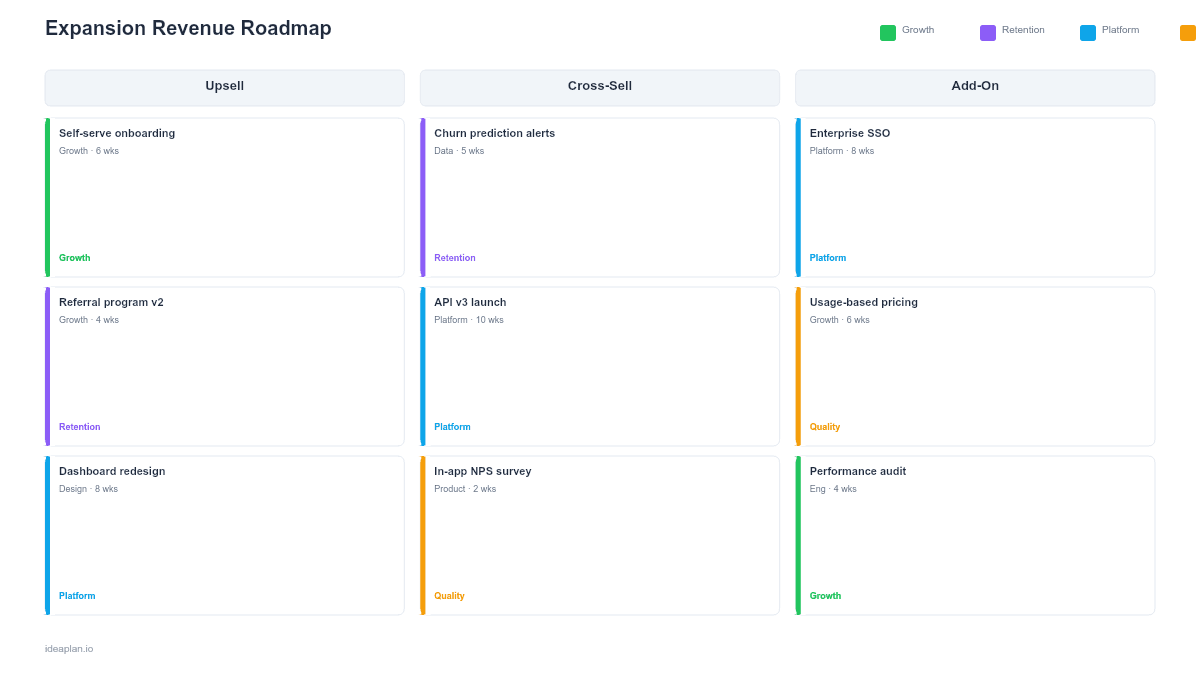
Quick Answer (TL;DR)
Growing revenue from existing customers is the most efficient path to scale. This free PowerPoint template structures your expansion strategy across four motions. Upsell, cross-sell, usage-based expansion, and land-and-expand. With triggers, timelines, and revenue projections for each. Download the .pptx, map your current expansion opportunities, and present a quarterly plan that ties product and CS efforts to net revenue retention targets.
What This Template Includes
- Expansion strategy overview slide. Current NRR, expansion MRR, and the four expansion motions mapped to customer segments with projected annual revenue impact.
- Trigger-action matrix slide. Behavioral and milestone triggers for each expansion motion, paired with the specific product or CS action that capitalizes on the moment.
- Land-and-expand playbook slide. Stage-by-stage plan from initial deployment to full organization adoption, with conversion metrics at each gate.
- Quarterly execution timeline slide. Product changes, CS campaigns, and pricing adjustments sequenced across four quarters with revenue targets per motion.
Why Expansion Revenue Needs Its Own Roadmap
Most product teams fold expansion into their general roadmap, where it competes for priority against new features, acquisition plays, and infrastructure work. The result: expansion gets planned but not executed, and expansion MRR underperforms.
A dedicated expansion roadmap solves three problems. First, it quantifies the opportunity. When you map every upsell trigger, cross-sell path, and usage-based expansion signal across your customer base, the total addressable expansion revenue becomes concrete. That number justifies dedicated product and CS investment.
Second, it creates accountability. Each expansion motion has a specific trigger, a specific action, a specific owner, and a projected revenue impact. When the quarterly review arrives, the team can point to which motions delivered and which fell short. The same rigor applied to new customer acquisition.
Third, it aligns product and go-to-market. The product team builds features and surfacing mechanisms that create expansion moments. The CS and sales teams execute the conversations and campaigns. Without a shared roadmap, product ships premium features that CS does not know how to sell, or CS pushes upgrades for capabilities that do not exist yet.
Template Structure
Expansion Motion Map
Four expansion motions, each with distinct mechanics:
- Upsell. Moving customers to a higher tier. Triggered by usage patterns, feature requests for premium capabilities, or team growth. Requires clear tier differentiation and visible upgrade paths in the product.
- Cross-sell. Adding new product modules or services. Triggered by adjacent use cases surfacing in usage data or customer conversations. Requires modular pricing and bundling options.
- Usage-based expansion. Revenue grows as the customer uses more. Triggered by approaching plan limits, seasonal spikes, or organic growth. Requires usage metering, transparent billing, and in-app visibility.
- Land-and-expand. Starting with a single team or use case and spreading across the organization. Triggered by internal referrals, new team onboarding, and champion advocacy. Requires multi-team support and admin controls.
Trigger-Action Matrix
For each expansion motion, the matrix lists the specific signals that indicate readiness and the corresponding action:
| Trigger | Motion | Action | Owner |
|---|---|---|---|
| Usage exceeds 80% of plan limit | Usage-based | In-app notification + CSM outreach | Product + CS |
| Team size doubles in 90 days | Land-and-expand | Admin invite flow + team onboarding offer | Product + Sales |
| Feature request matches premium tier | Upsell | Targeted demo of premium capability | CS |
| Customer uses adjacent workflow manually | Cross-sell | Module trial offer | CS + Marketing |
Quarterly Execution Timeline
Each quarter specifies the product changes, CS campaigns, and pricing adjustments that enable expansion. Q1 typically focuses on instrumentation. Building the triggers and dashboards. Q2-Q3 execute the highest-impact motions. Q4 reviews results and plans the next cycle.
How to Use This Template
1. Quantify your current expansion baseline
Pull expansion MRR, expansion rate, and NRR from your billing system. Break expansion down by motion: how much comes from upsells, cross-sells, usage increases, and new team additions? This baseline reveals which motions are working and which have untapped potential.
2. Map triggers across your customer base
Analyze your product data for expansion signals. How many customers are near plan limits? How many have growing teams? Which accounts have requested features that exist in higher tiers? Each signal is a potential expansion trigger. The product metrics guide covers the analytics setup for tracking these signals.
3. Prioritize motions by impact and feasibility
Score each expansion motion using estimated annual revenue impact, the number of eligible accounts, and the product or CS effort required to execute. A usage-based expansion motion that applies to 200 accounts and requires only an in-app notification beats a cross-sell motion that applies to 20 accounts and requires a new product module. Use the RICE framework for structured scoring.
4. Build product enablement for top motions
For each prioritized motion, identify the product work needed: usage dashboards, in-app upgrade prompts, plan comparison pages, multi-team admin features, or module trial flows. These product changes go on the quarterly timeline with explicit expansion revenue targets attached.
5. Align CS and sales on execution
For each motion, define whether execution is product-led (automated in-app flow), CS-led (CSM conversation), or sales-led (account executive engagement). Document the playbook for each and train the team. The roadmap should make ownership unambiguous.
When to Use This Template
An expansion revenue roadmap is the right tool when:
- NRR is below 120% and leadership wants a structured plan to grow revenue from existing customers without proportionally increasing acquisition spend
- Expansion happens ad hoc. Individual CSMs drive upgrades opportunistically, but there is no systematic approach to identifying and capitalizing on expansion signals
- Product and CS are disconnected on expansion strategy. Product builds premium features without input from CS, or CS pushes upgrades without product support
- Usage-based pricing is underperforming because customers lack visibility into their consumption or the upgrade path is unclear
- Land-and-expand is stalling. Initial deployments succeed but spread to other teams slowly or not at all
For pricing strategy design specifically, the Pricing Strategy Roadmap provides a more focused format. For the full revenue picture including new logo acquisition, see the Revenue Growth Roadmap.
Featured in
This template is featured in Growth and Revenue Roadmap Templates, a curated collection of roadmap templates for this use case.
Key Takeaways
- Four distinct expansion motions (upsell, cross-sell, usage-based, land-and-expand) require different triggers, product capabilities, and go-to-market approaches.
- Quantify your expansion baseline by motion before planning. The data reveals which levers have the most untapped potential.
- Behavioral triggers (usage approaching limits, team growth, feature requests) create natural expansion moments that feel helpful rather than salesy.
- Product enablement is the bottleneck for most expansion programs. In-app prompts, usage dashboards, and trial flows turn signals into action.
- Define clear ownership (product-led vs. CS-led vs. sales-led) for each expansion motion to prevent gaps and duplicated effort.
- Compatible with Google Slides, Keynote, and LibreOffice Impress. Upload the
.pptxto Google Drive to edit collaboratively in your browser.