Quick Answer (TL;DR)
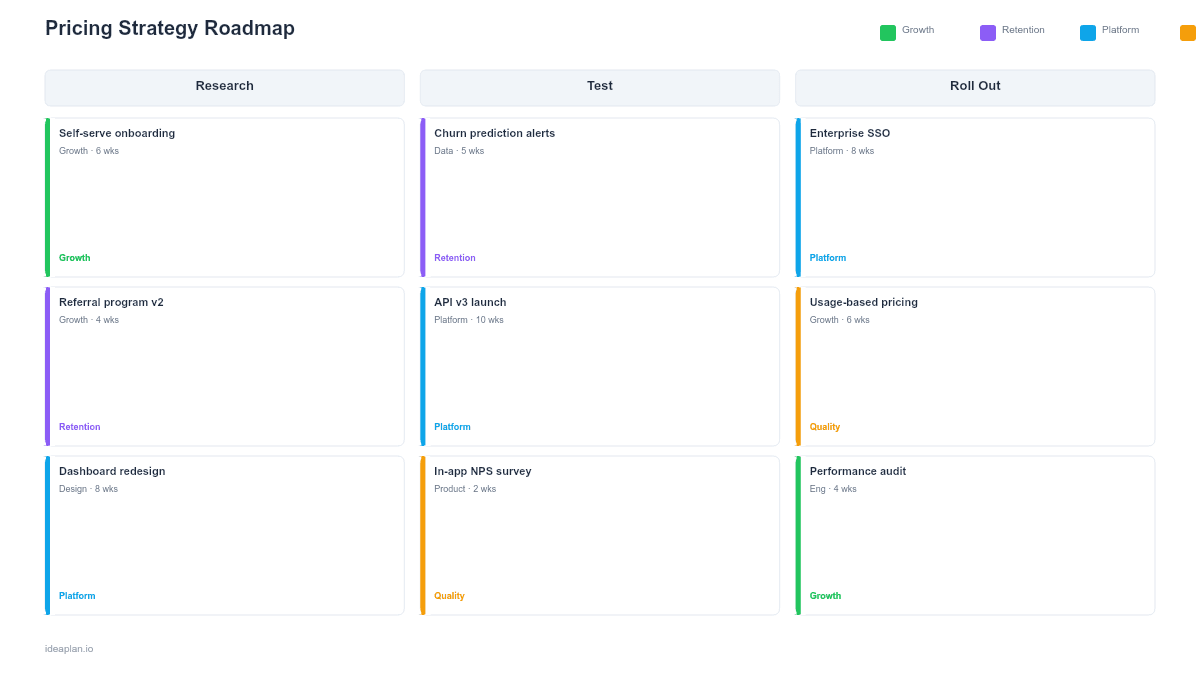
This free PowerPoint template maps your pricing evolution across four dimensions. Packaging, pricing model, billing infrastructure, and communication. Planned on a quarterly or half-year timeline. It coordinates the product, finance, engineering, and marketing work required to change how you charge. Download the .pptx, plug in your pricing initiatives, and align your team on what changes when and why.
What This Template Includes
- Cover slide. Product name, current pricing model summary, and the target pricing state with expected revenue impact.
- Instructions slide. How to evaluate pricing changes, structure migration waves, and measure impact. Remove before presenting.
- Blank template slide. Four time-period columns with rows for Packaging, Pricing Model, Billing Infrastructure, and Communication. Placeholder cards for each planned change.
- Filled example slide. A SaaS product's migration from flat-rate to usage-based pricing over three quarters, showing plan restructuring, metering infrastructure, billing system updates, and a staged customer migration with grandfather clauses.
Why Pricing Changes Need a Roadmap
Pricing touches every part of the business. A "simple" pricing change requires product work (feature gating, metering), engineering work (billing integration, usage tracking), marketing work (page updates, positioning), sales work (new playbooks, commission structures), and finance work (revenue recognition, forecasting models).
Without a coordinated plan, pricing changes create chaos. Sales discovers the new pricing on the day it launches. Engineering scrambles to build metering after the pricing page goes live. Finance cannot forecast because the billing system does not support the new model yet.
Two problems make pricing roadmaps essential:
- Pricing changes have outsized revenue impact. A 5% improvement in average revenue per user compounds across your entire customer base. Getting the rollout right matters more than getting it fast.
- Existing customers need careful migration. Unlike new feature launches, pricing changes affect people already paying you. Poor migration execution drives churn. For a deep dive on pricing approaches, see the pricing for product managers guide.
Template Structure
Time Period Columns
Columns represent quarters or half-years depending on the scope of your pricing change. A plan restructuring might fit in one quarter. A full pricing model migration (flat-rate to usage-based) typically spans 2-3 quarters.
- Period 1: Research & Design. Analyze willingness to pay, model options, and competitive pricing. Decide on the target model.
- Period 2: Build & Test. Implement billing infrastructure, create migration tools, test with a beta cohort.
- Period 3: Launch & Migrate. Roll out to new customers, begin migrating existing customers in waves.
- Period 4: Optimize. Analyze results, adjust thresholds, close grandfather periods, iterate on packaging.
Workstream Rows
Four rows ensure every function stays coordinated:
- Packaging. Plan tiers, feature allocation per tier, usage limits, add-ons. This is the "what do customers get at each price point" row.
- Pricing Model. The mechanics of how you charge. Per-seat, usage-based, flat-rate, hybrid. Includes pricing page design, rate cards, and discount structures.
- Billing Infrastructure. Metering, invoicing, payment processing, revenue recognition. The engineering and finance work that makes the model operational.
- Communication. Internal enablement (sales playbooks, CS scripts) and external communication (pricing page, email campaigns, in-app notices). Includes grandfather policy details and migration timelines.
Revenue Impact Indicators
Each card includes an estimated revenue impact: positive (green), neutral (gray), or risk (red). Packaging a popular feature into a higher tier has a positive revenue impact but a churn risk for current users on lower tiers. Making the trade-off visible supports better decisions.
How to Use This Template
1. Document your current pricing model completely
Before planning changes, write down exactly how you charge today. Every plan, every feature gate, every discount rule, every grandfather clause. Pricing accumulates complexity over time, and you need the full picture before modifying it. The pricing strategy glossary term covers the foundational concepts.
2. Define the business objective the pricing change serves
"We need to capture more value from heavy users" leads to usage-based pricing. "We need to grow seat count within accounts" leads to per-seat pricing with collaboration features gated behind it. "We need to move upmarket" leads to enterprise tier packaging. The objective determines the model, not the other way around.
3. Design packaging before pricing
Decide what features go in each tier before assigning prices. Packaging determines perceived value. A well-packaged plan at a slightly higher price outperforms a poorly packaged plan at a "fair" price. Use willingness-to-pay research to validate that customers value the tier boundaries you have drawn.
4. Build billing infrastructure with migration in mind
The billing system needs to support both the old and new pricing models simultaneously during migration. Design for grandfather clauses, prorated transitions, and the ability to roll back individual accounts if issues arise. This is engineering work that must be complete before the pricing launches.
5. Migrate customers in waves, not all at once
Start with the lowest-risk segment: new signups. Then migrate low-usage existing customers who are unlikely to see a price increase. Then migrate high-usage customers with personalized outreach. Each wave provides data that helps you adjust the next wave.
When to Use This Template
The pricing strategy roadmap is the right choice when:
- You are changing your pricing model (e.g., flat-rate to usage-based, freemium to free trial) and need to coordinate product, engineering, and go-to-market work
- You are restructuring your packaging. Adding tiers, rebalancing features between plans, or introducing add-ons
- Existing customers need migration from the old pricing to the new pricing, requiring communication plans and grandfather policies
- Revenue leadership wants visibility into the pricing change timeline and expected impact on MRR and net revenue retention
- Multiple teams are involved and need to sequence their work. Billing engineering, product, marketing, sales enablement, and finance
If your focus is broader revenue growth across acquisition, expansion, and retention rather than pricing mechanics, the Revenue Growth Roadmap PowerPoint template covers that scope. For strategic positioning including pricing, the Product Strategy Roadmap template provides a higher-level view.
Featured in
This template is featured in Product Strategy Roadmap Templates, a curated collection of roadmap templates for this use case.
Key Takeaways
- Pricing changes touch every team in the business. A roadmap prevents the coordination failures that turn a good pricing strategy into a bad customer experience.
- Design packaging (what customers get) before pricing (what they pay). Perceived value drives willingness to pay.
- Migrate customers in waves. New signups first, then low-risk existing customers, then high-value accounts with personalized outreach.
- Grandfather clauses are a migration tool, not a permanent state. Set an end date and communicate it from day one.
- Measure pricing changes over 90 days. Early signals (especially churn) can be misleading as customers adjust.
- Compatible with Google Slides, Keynote, and LibreOffice Impress. Upload the
.pptxto Google Drive to edit collaboratively in your browser.
Related reading: Notion Pricing Strategy: The Freemium Model Explained.