Quick Answer (TL;DR)
This free PowerPoint cross-sell and upsell roadmap template helps you plan revenue expansion from your existing customer base. It maps upgrade triggers, add-on opportunities, and expansion plays across customer segments and product tiers. Download the .pptx, populate it with your expansion opportunities, and present a quarterly plan that ties product changes to net revenue retention targets.
What This Template Includes
- Cover slide. Product name, current NRR, and expansion revenue target for the period.
- Instructions slide. How to identify expansion triggers, map upgrade paths, and set revenue targets per segment. Remove before presenting.
- Expansion Opportunity Map slide. Grid showing cross-sell and upsell opportunities by customer segment (SMB, Mid-Market, Enterprise) and product tier.
- Trigger & Timing slide. Table of behavioral triggers that signal expansion readiness (usage thresholds, feature requests, contract milestones) with recommended actions.
- Quarterly Execution Plan slide. Timeline of product changes, pricing updates, and go-to-market motions that enable expansion in each quarter.
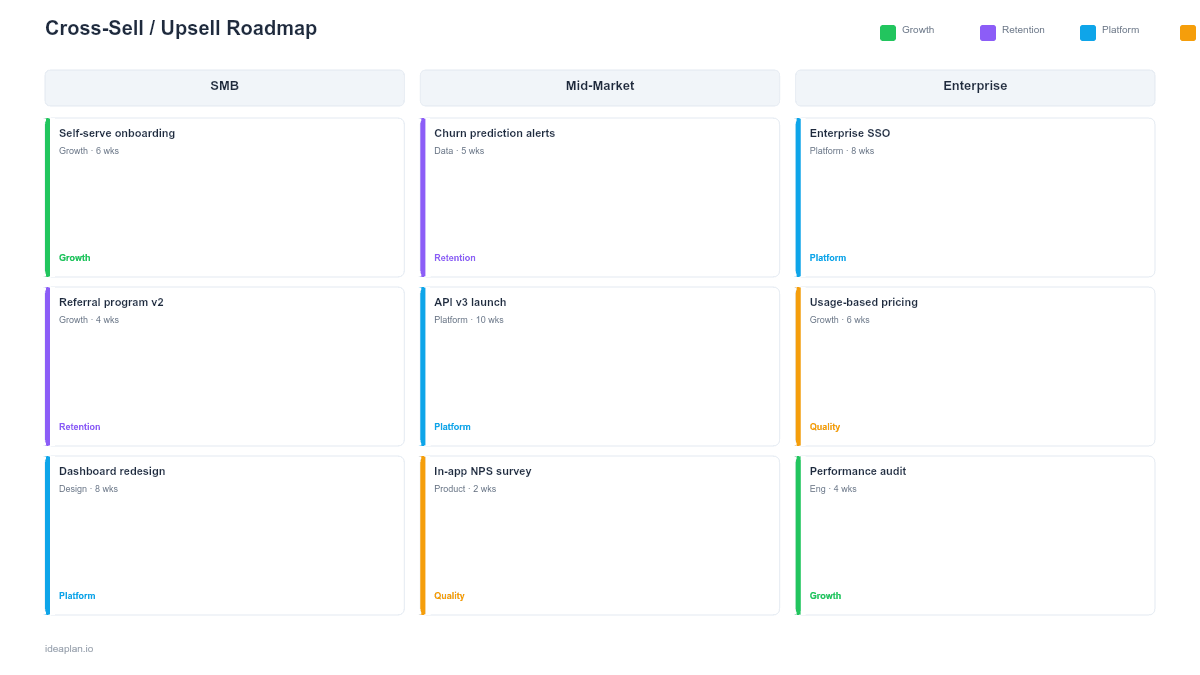
- Filled example slide. A working cross-sell roadmap with 10 expansion plays across three segments, including projected revenue impact per play.
Why Revenue Expansion Needs a Product Roadmap
Expansion revenue is the most capital-efficient growth lever in SaaS. Acquiring a new customer costs 5-7x more than expanding an existing one. Yet most product roadmaps focus entirely on acquiring new users and ignore the product changes that enable customers to spend more.
A cross-sell and upsell roadmap addresses three gaps. First, it identifies the product triggers that make expansion natural. When a customer hits their API rate limit, that is an upsell moment. But only if your pricing strategy has a clear upgrade path and the product surfaces that limit at the right time. Without a roadmap, these moments are missed or handled poorly.
Second, it aligns product and sales on expansion timing. Sales teams often push upgrades before the customer is ready, creating friction. Product teams build premium features without considering how customers discover and adopt them. The roadmap connects product changes to specific expansion triggers, so upgrades feel like solutions rather than sales pitches.
Third, it makes expansion MRR a trackable product metric. When the roadmap ties each product change to a projected revenue impact, the team can measure whether expansion features actually drive upgrades. The same accountability applied to acquisition features.
Template Structure
Expansion Opportunity Map
The opportunity map is a grid with two dimensions:
- Rows: Customer segments. SMB, Mid-Market, Enterprise (or your own segmentation). Each segment has different expansion potential and different triggers.
- Columns: Expansion types. Upsell (higher tier), Cross-sell (additional product), Add-on (feature pack), Seat expansion (more users).
Each cell describes the specific opportunity: what the customer upgrades to, what triggers the upgrade, and the estimated revenue per conversion. Empty cells reveal where expansion paths are missing. Those gaps become roadmap items.
Trigger & Timing Table
Expansion works best when it responds to customer behavior, not arbitrary sales calendars. The trigger table lists:
- Behavioral triggers. Usage exceeds 80% of plan limit, team size doubles, customer enables a premium-adjacent feature.
- Milestone triggers. 90 days post-onboarding, contract renewal approaching, successful pilot completion.
- Signal triggers. Customer requests a feature that exists in a higher tier, support tickets about limitations, champion promotion to a senior role.
For each trigger, the table specifies the recommended action (in-app prompt, CSM outreach, pricing page update) and the product work required to enable it.
Quarterly Execution Plan
Each quarter lists:
- Product changes. New premium features, usage limit adjustments, add-on packaging, in-app upgrade prompts.
- Pricing updates. Tier restructuring, add-on pricing, volume discounts for seat expansion.
- Go-to-market motions. CSM playbooks, email campaigns, in-app messaging sequences.
- Revenue target. Expected expansion rate and dollar impact from that quarter's plays.
How to Use This Template
1. Map your current expansion paths
List every way a customer can currently spend more with you: tier upgrades, seat additions, add-on purchases, usage overages. For each path, document the current conversion rate and average deal size. If you cannot list at least three distinct expansion paths, your pricing model likely needs restructuring before the roadmap will work.
2. Identify behavioral triggers from usage data
Pull product analytics to find the behaviors that correlate with expansion. Customers who use feature X within 30 days are 3x more likely to upgrade. Teams that exceed 10 users convert to Enterprise 40% of the time. These patterns become the triggers in your roadmap. If you need help selecting the right metrics, the product metrics guide covers expansion-related indicators.
3. Score opportunities by revenue impact and effort
Use a simple scoring model for each expansion play: estimated annual revenue impact multiplied by likelihood of success, divided by engineering effort. Rank plays by this score to determine what goes into Q1 versus Q4. The RICE framework works well for this prioritization.
4. Build product changes that enable expansion
For each high-priority expansion play, identify the product work required. This might be a usage dashboard that shows customers how close they are to their limit, an in-app upgrade prompt triggered at the right moment, or a feature that only becomes available at higher tiers. These product changes go on your feature roadmap with explicit expansion revenue targets attached.
5. Align with sales and customer success
Share the roadmap with sales and CS leadership. For each expansion play, define who owns the customer conversation: is it an automated in-app flow (product-led) or a CSM-led conversation (sales-led)? The roadmap should specify this for every play so there is no confusion about ownership.
When to Use This Template
A cross-sell and upsell roadmap PowerPoint template is the right choice when:
- Net revenue retention is below 110% and leadership wants a plan to improve expansion revenue.
- Your pricing has multiple tiers or add-ons but conversion between them is underperforming.
- The product team and sales team are misaligned on what features drive upgrades versus acquisition.
- Usage data shows customers hitting plan limits but not upgrading, suggesting friction in the expansion path.
- A board meeting or QBR requires a clear expansion revenue plan tied to specific product investments.
If your focus is on overall revenue growth (including new customer acquisition), the Revenue Growth Roadmap PowerPoint template covers the full picture. For pricing model design specifically, see the Pricing Strategy Roadmap PowerPoint template.
Featured in
This template is featured in Growth and Revenue Roadmap Templates, a curated collection of roadmap templates for this use case.
Key Takeaways
- Expansion revenue costs 5-7x less than new customer acquisition but requires deliberate product investment.
- Behavioral triggers (usage limits, feature adoption, team growth) time expansion offers to moments of genuine need.
- The opportunity map reveals gaps in your expansion paths by segment and expansion type.
- Every expansion play needs a clear owner. Either product-led (in-app) or sales-led (CSM outreach).
- PowerPoint format makes the expansion plan presentable to revenue leadership and board audiences.
- Compatible with Google Slides, Keynote, and LibreOffice Impress. Upload the
.pptxto Google Drive to edit collaboratively in your browser.