Quick Answer (TL;DR)
This free PowerPoint template plans your brand evolution across four pillars: positioning, messaging, visual identity, and market perception. Each pillar has a current-state assessment, target state, and quarterly initiatives. Download the .pptx, define your brand gaps, and present a roadmap that connects brand investment to measurable market outcomes.
What This Template Includes
- Cover slide. Brand name, planning horizon, and the primary brand metric (e.g., unaided awareness, brand consideration rate, or NPS).
- Instructions slide. How to audit current brand perception, identify positioning gaps, and sequence brand initiatives. Remove before presenting.
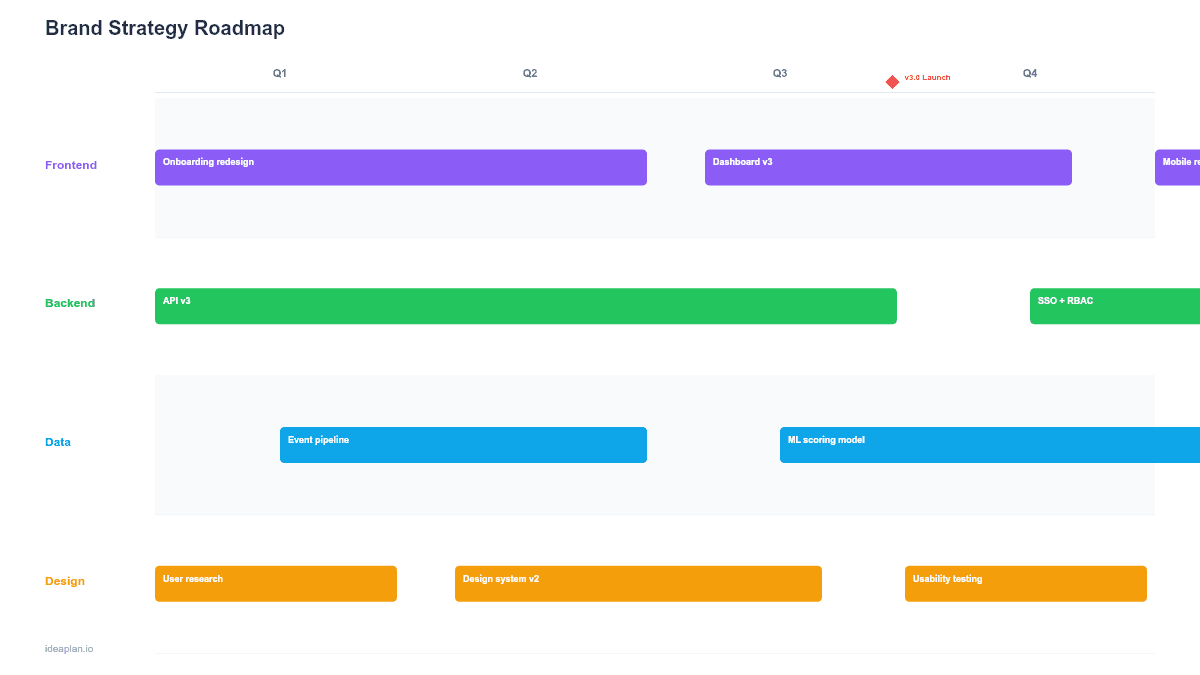
- Blank template slide. Four-pillar layout (Positioning, Messaging, Visual Identity, Market Perception) with current-state cards, target-state cards, and initiative timelines.
- Filled example slide. A SaaS company repositioning from "project management tool" to "product operating system." Shows initiatives like analyst briefings, customer story campaigns, website messaging overhaul, and design system updates across four quarters.
Why Brand Strategy Needs a Roadmap
Brand work often lives in pitch decks that describe the destination but never the path. A team agrees on a new positioning statement, then six months later, the website says one thing, sales decks say another, and customer-facing teams default to whatever language they used before.
A brand strategy roadmap solves this by making the change sequential and measurable. It answers the three questions executives always ask about brand investment: What are we changing? In what order? How will we know it worked?
Sequencing matters because brand changes have dependencies. You cannot launch a repositioning campaign before sales enablement materials are updated. You cannot update sales materials before messaging is finalized. You cannot finalize messaging before competitive positioning is defined. The roadmap makes these dependencies visible so teams do not trip over each other.
For the product strategy that should inform your brand positioning, see the product strategy guide.
Template Structure
Four Brand Pillars
The roadmap organizes work into four parallel tracks:
- Positioning. Where you sit in the market relative to competitors. Includes competitive analysis, category definition, and differentiation claims.
- Messaging. The words you use to communicate your positioning. Includes taglines, value propositions, elevator pitches, and audience-specific messaging variants.
- Visual Identity. How the brand looks. Includes logo, color palette, typography, imagery guidelines, and design system components.
- Market Perception. How the market actually perceives you versus your intended positioning. Measured through surveys, analyst sentiment, review site positioning, and social listening.
Current vs. Target State Cards
Each pillar has two cards at the top:
- Current state. Honest assessment of where the brand is. Example: "Market sees us as a lightweight PM tool for startups."
- Target state. Where you want to be. Example: "Market sees us as a full product operating system for scaling teams."
The gap between these cards defines the work.
Initiative Timeline
Below each pillar, quarterly initiative blocks show the specific work planned:
- Initiative name. "Update homepage messaging," "Launch analyst briefing series."
- Quarter. When it ships.
- Dependency. Which initiative must complete first.
- Success metric. How you will know it worked (e.g., "Unaided awareness +5pp," "Sales win rate +3pp").
How to Use This Template
1. Audit your current brand perception
Do not guess. Run a brand perception survey with prospects and customers. Check review sites, analyst reports, and social mentions. Compare what people say about you to what you want them to say. The gap is your roadmap scope.
2. Define your target positioning
Write one sentence that describes how you want the market to perceive your product in 12 months. Be specific. "Best product management tool" is not a position. "The only PM platform that connects strategy to delivery for teams scaling past 50 people" is.
3. Sequence initiatives by dependency
Start with positioning and messaging. These inform everything downstream. Visual identity changes come next. Market perception initiatives (campaigns, analyst outreach, PR) come last because they amplify the new brand, and you need the brand to be consistent before amplifying it.
4. Assign ownership across teams
Brand roadmaps are inherently cross-functional. Product marketing owns messaging. Design owns visual identity. Product owns in-app experience alignment. Sales owns enablement materials. Mark each initiative with a clear owner.
5. Measure perception quarterly
Run a short brand perception pulse survey every quarter. Track unaided awareness, brand association accuracy, and NPS. These numbers move slowly, so do not expect dramatic quarter-over-quarter shifts. A 3-5 point improvement per quarter on your primary metric is solid progress.
When to Use This Template
A brand strategy roadmap makes sense when:
- You are repositioning the product for a new market segment or moving upmarket
- Messaging is inconsistent across website, sales materials, and product UI
- A major product change (new platform, new category) requires brand alignment
- Leadership wants accountability for brand investment with measurable outcomes
- Multiple teams (marketing, product, design, sales) need to coordinate brand changes
If your brand is stable and you are focused on feature-level planning, a product feature roadmap is the right choice instead.
Featured in
This template is featured in Product Strategy Roadmap Templates, a curated collection of roadmap templates for this use case.
Key Takeaways
- Brand strategy roadmaps sequence positioning, messaging, visual, and perception changes with clear dependencies.
- Start with positioning and messaging before amplifying through campaigns. Consistency before volume.
- Measure market perception quarterly through surveys, not assumptions.
- Assign cross-functional ownership: no single team controls brand perception.
- PowerPoint format supports executive reviews where brand investment competes with product and engineering budgets for resources.
- Compatible with Google Slides, Keynote, and LibreOffice Impress. Upload the
.pptxto Google Drive to edit collaboratively in your browser.