Quick Answer (TL;DR)
This free PowerPoint template organizes your product roadmap by user segment rather than by feature or timeline. Each segment gets its own lane with mapped needs, priority features, and delivery targets. Download the .pptx, define your segments, and build a roadmap that ensures every user group gets intentional investment rather than inheriting whatever the loudest segment requested.
What This Template Includes
- Cover slide. Product name, number of active segments, and the primary metric each segment drives.
- Instructions slide. How to define segments, map needs, and balance investment across groups. Remove before presenting.
- Segment profile cards slide. Three segment cards, each with a persona summary, segment size, revenue contribution, growth potential, and satisfaction score.
- Needs-to-feature mapping slide. A matrix showing the top 3 needs per segment and the features that address them, with overlap indicators where one feature serves multiple segments.
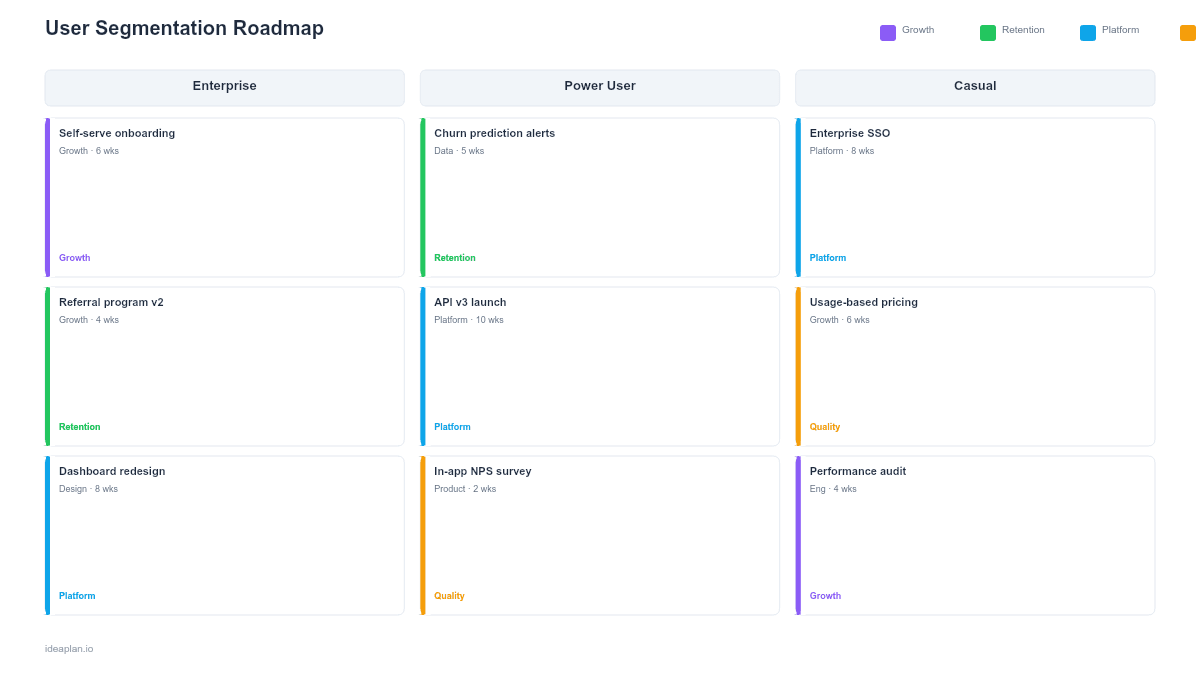
- Segment roadmap slide. Three horizontal lanes (one per segment) with feature cards showing need alignment, effort, expected impact on segment retention or activation, and target quarter.
- Filled example slide. A B2B SaaS roadmap with three segments: "Solo Founders" (activation focus), "Growing Teams" (collaboration features), and "Enterprise" (admin and compliance), each with tailored feature priorities.
Why Roadmaps Should Reflect User Segments
Most roadmaps organize work by team, timeline, or theme. None of these structures answer a critical question: which users benefit from what we are building? Without segment visibility, product teams default to building for their power users. The vocal minority. While neglecting segments that drive future growth.
A segmented roadmap makes three things visible. First, investment balance: what percentage of capacity goes to each segment? If enterprise customers generate 20% of revenue but consume 60% of the roadmap, leadership needs to see that trade-off. Second, need coverage: are there segments whose top needs have zero planned features? That is a churn risk hiding in the backlog. Third, feature impact: which features serve multiple segments simultaneously? Those are your highest-value investments.
This approach pairs well with persona definitions and segmentation analysis. The roadmap is where segment strategy becomes execution.
Template Structure
Segment Profile Cards
Each segment card summarizes the group's characteristics and business value:
- Persona label. A descriptive name: "Solo Founders," "Mid-Market Teams," "Enterprise Admins." Avoid abstract labels like "Segment A."
- Segment size. Number of active accounts or users in this segment.
- Revenue contribution. Percentage of total revenue or ARR from this segment. Reveals whether investment matches economic value.
- Growth potential. Expected segment growth over the next 12 months. High-growth segments may justify disproportionate investment even if current revenue is low.
- Satisfaction score. NPS or CSAT for this segment. Low scores signal unmet needs.
Needs-to-Feature Matrix
The matrix maps each segment's top needs to planned features:
- Segment needs. The 3 most important jobs-to-be-done for each segment, sourced from user research and usage data.
- Feature candidates. The features that address each need. Some features map to a single segment; others serve multiple segments (marked with overlap indicators).
- Priority. Must-have / Should-have / Nice-to-have per the MoSCoW framework. Prevents every feature from being labeled "critical."
Segment Lanes
The roadmap slide uses horizontal lanes, one per segment. Each lane contains feature cards with:
- Feature name. Short description of what ships.
- Need alignment. Which segment need this feature addresses. Links back to the matrix.
- Effort. T-shirt size.
- Segment impact. Expected improvement to the segment's key metric (retention, activation, expansion).
- Target quarter. Delivery timeline.
How to Use This Template
1. Define your segments with data, not assumptions
Use product analytics and revenue data to identify natural segments. Common segmentation axes: company size, use case, lifecycle stage, plan tier, or industry vertical. Limit to 3-4 segments for the roadmap. More than that fragments focus. Validate segments with cohort analysis to confirm they behave differently.
2. Map the top needs per segment
Interview 5-8 users from each segment. Combine qualitative insights with quantitative signals (feature usage frequency, support ticket themes, churn reasons). Distill to the top 3 unmet needs per segment. A jobs-to-be-done lens helps frame needs as outcomes rather than feature requests.
3. Identify cross-segment features
The needs-to-feature matrix will reveal features that serve multiple segments. These are high-impact investments. Flag them as priorities regardless of which segment is loudest. A feature that improves activation for Solo Founders and retention for Growing Teams delivers twice the value.
4. Allocate capacity by segment
Decide what percentage of quarterly capacity goes to each segment. Base this on a blend of current revenue contribution, growth potential, and satisfaction gap. Do not split evenly. Equal investment across unequal segments produces mediocre outcomes for everyone.
5. Validate with segment representatives
Share the draft roadmap with 2-3 users from each segment before finalizing. This catches blind spots where the team misunderstood a need or misjudged priority. It also builds trust with key accounts who see their input reflected in the plan.
When to Use This Template
- Multi-persona products where different user types have conflicting needs and the team must balance investment
- PLG to enterprise transitions where the product roadmap needs to serve self-serve users and sales-led accounts simultaneously
- Retention-focused planning where churn analysis reveals that specific segments are underserved
- New market expansion where entering a new segment requires dedicated features without abandoning existing users
- Pricing tier alignment where Free, Pro, and Enterprise tiers map to distinct user segments with different feature needs
If your planning is organized by lifecycle stage rather than user type, the customer journey roadmap template is a better fit.
Key Takeaways
- Segment-based roadmaps make investment balance visible: which users get how much of the team's capacity.
- Three segments is the practical limit for a focused roadmap. Merge or deprioritize beyond that.
- The needs-to-feature matrix reveals high-impact features that serve multiple segments simultaneously.
- Allocate capacity by blending revenue contribution, growth potential, and satisfaction gap. Not by equal division.
- PowerPoint format lets you present the segment roadmap in product reviews, board meetings, and cross-functional planning without format conversion.
- Compatible with Google Slides, Keynote, and LibreOffice Impress. Upload the
.pptxto Google Drive to edit collaboratively in your browser.