Quick Answer (TL;DR)
This free PowerPoint template maps your product team growth from current state to target org structure. It connects hiring timelines, capability gaps, and structural changes to the product milestones that require them. Download the .pptx, assess your team gaps, and present a scaling plan that ties headcount investment to product delivery capacity.
What This Template Includes
- Cover slide. Current team size, target team size, planning horizon, and the number of product squads at start and end of the period.
- Instructions slide. How to assess capability gaps, sequence hires, and plan org structure transitions. Remove before presenting.
- Blank template slide. Three-track layout (Hiring Pipeline, Capability Building, Org Structure) across quarterly columns with milestone markers and dependency arrows.
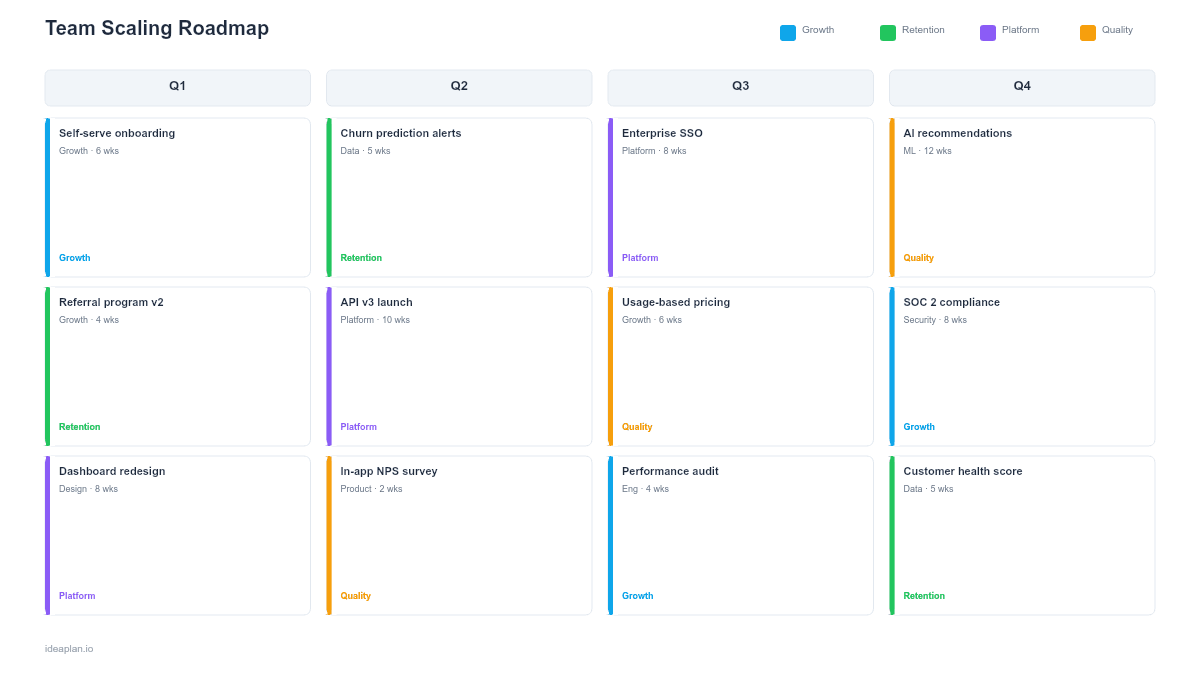
- Filled example slide. A product team scaling from 12 to 28 people over four quarters. Shows hiring for a new platform squad, capability investments in data engineering and ML, and the org transition from functional teams to cross-functional squads. Each quarter shows team composition snapshots and delivery capacity projections.
Why Team Scaling Needs a Roadmap
Hiring without a plan produces random team growth. You end up with three frontend engineers and no one who can build an API, or two product managers with overlapping scope and no clear ownership boundaries.
A team scaling roadmap connects people investment to product outcomes. It answers the question every CFO asks: "Why do you need these roles, and what will we get from them?" The answer should never be "because we are busy." It should be "because [product milestone] requires [capability] and we currently have a gap in [specific area]."
Sequencing hires matters as much as headcount. Hiring a senior backend engineer in Q1 means the platform squad can start building in Q2. Hire them in Q3 instead, and the platform work slides to Q4. Along with every feature that depends on it. The roadmap makes these dependencies visible before they become missed deadlines.
For guidance on structuring product teams, see the guide to building a product team.
Template Structure
Three Parallel Tracks
The roadmap runs three tracks simultaneously:
- Hiring Pipeline. Open roles, target start dates, and sourcing status. Each role is tagged with the product initiative that requires it. Roles are sequenced by dependency. Hire the tech lead before the individual contributors they will manage.
- Capability Building. Investments in existing team skills. Training programs, internal transfers, and contractor-to-FTE conversions. Not every gap requires a new hire; sometimes you need to upskill the team you already have.
- Org Structure. How the team is organized and how that structure will evolve. Shows transitions like splitting a single product team into two squads, creating a dedicated platform team, or moving from project-based to empowered product teams.
Quarterly Team Snapshots
Each quarter column includes a team composition summary:
- Headcount. Total people, broken down by function (PM, engineering, design, data).
- Squad count. Number of cross-functional squads and their focus areas.
- Delivery capacity. Estimated throughput in story points, features per quarter, or whatever unit your team uses.
- Key gaps. Remaining capability gaps that limit delivery.
Dependency Arrows
Arrows connect hiring milestones to product milestones on other roadmaps. "Hire ML engineer by Q1" connects to "Launch recommendation engine in Q2" on the product roadmap. These arrows make it clear that the product roadmap depends on the team scaling roadmap. One cannot succeed without the other.
How to Use This Template
1. Audit current capabilities against the product roadmap
List every major initiative on your product roadmap for the next 12 months. For each initiative, identify the skills required. Compare required skills to what you have today. The gaps are your scaling scope.
2. Classify gaps as hire, build, or borrow
Not every gap needs a full-time hire. Short-term gaps can be filled with contractors. Skill gaps in adjacent areas can be addressed through training. Only hire for capabilities you need permanently and cannot develop fast enough internally.
3. Sequence hires by product dependency
Identify which product milestones are blocked by capability gaps. Those gaps get hiring priority. A Q2 product milestone that requires a role means you need to post that job in Q4 of the prior year (assuming 3-4 months for senior technical hiring).
4. Plan org structure transitions
If you are growing from 1 to 3 squads, you need to plan the split: which people move where, how ownership boundaries shift, and when the transition happens. Poorly timed reorgs during critical shipping periods create chaos. Schedule structural changes during natural planning boundaries. Between quarters or after major releases.
5. Review monthly against reality
Hiring timelines slip. Offers get declined. Star performers resign unexpectedly. Review the scaling roadmap monthly and adjust. If a Q1 hire slips to Q2, cascade the impact through the product roadmap immediately. The capacity planning template can help model these shifts.
When to Use This Template
Team scaling roadmaps fit when:
- The product roadmap exceeds current team capacity and headcount growth is the answer
- You are pitching headcount to leadership or the CFO and need to justify each role
- The org structure needs to change. Splitting teams, adding squads, or creating new functions
- A funding round is closing and you need to deploy capital into team growth efficiently
- Onboarding velocity matters. You need to sequence hires so managers are in place before ICs
If your team is stable and the focus is on prioritizing work within existing capacity, the capacity planning template is the better tool.
Key Takeaways
- Team scaling roadmaps connect headcount investment to product delivery capacity.
- Three tracks (Hiring, Capability Building, Org Structure) capture the full picture of team growth.
- Sequence hires by product dependency. Blocked milestones dictate hiring priority.
- Plan org structure transitions during natural planning boundaries, not mid-sprint.
- PowerPoint format supports headcount pitch meetings where product, HR, and finance need a shared view of team growth plans.
- Compatible with Google Slides, Keynote, and LibreOffice Impress. Upload the
.pptxto Google Drive to edit collaboratively in your browser.