Quick Answer (TL;DR)
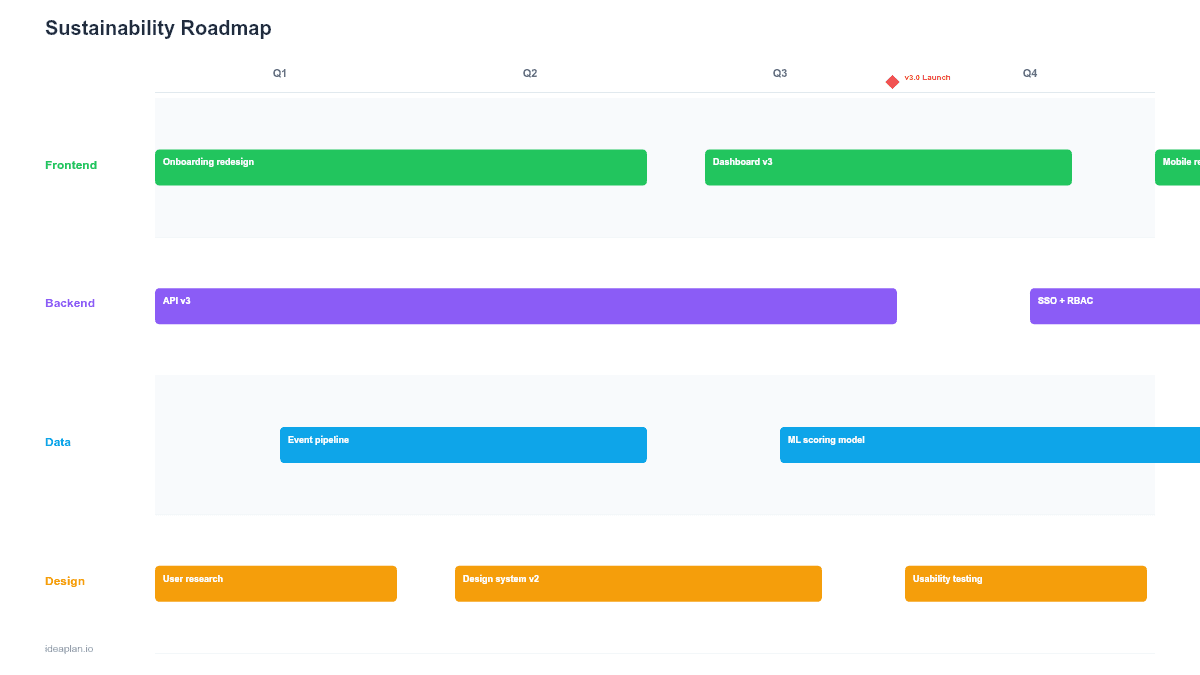
This free PowerPoint sustainability roadmap template structures your ESG and sustainability initiatives into three horizons. Quick Wins, Systemic Changes, and Long-Term Targets. Across four pillars: Environmental, Social, Governance, and Product. Each initiative card tracks ownership, impact estimate, and progress against measurable targets. Download the .pptx, define your sustainability pillars, and present a credible plan that goes beyond pledges to concrete actions with deadlines.
What This Template Includes
- Cover slide. Organization name, sustainability vision statement, reporting year, and headline metric (e.g., "Target: 40% carbon reduction by 2028").
- Instructions slide. How to define pillars, set baselines, and assign initiative owners. Remove before presenting.
- Blank template slide. Three time horizons with four pillar swim lanes and placeholder initiative cards including baseline/target metric fields.
- Filled example slide. A working sustainability roadmap for a mid-size SaaS company with 14 initiative cards: cloud infrastructure optimization (Environmental), supplier diversity program (Social), ESG board reporting (Governance), and eco-mode feature development (Product).
Why Sustainability Needs a Roadmap
Corporate sustainability commitments are common. Credible plans to deliver on them are not. A sustainability roadmap addresses the gap between aspirational goals and operational reality.
The first challenge is sequencing. You cannot measure your carbon footprint before you have baseline data, and you cannot set reduction targets before you can measure. Many organizations announce targets without the measurement infrastructure to track them. This template puts data collection and baselining in the Quick Wins horizon, ensuring the foundation exists before longer-term commitments depend on it.
The second challenge is accountability. Sustainability work often sits between teams with no single owner. Engineering owns infrastructure efficiency. Facilities owns energy procurement. Product owns user-facing sustainability features. HR owns workforce diversity metrics. Without a roadmap that assigns specific owners to specific initiatives, sustainability becomes everyone's priority and no one's responsibility.
The third challenge is credibility. Customers, investors, and regulators increasingly distinguish between real plans and greenwashing. A structured roadmap with measurable targets, clear owners, and regular progress reporting signals genuine commitment.
Template Structure
Three Time Horizons
The roadmap organizes work by impact timeline:
- Quick Wins (0-6 months). Low-effort, measurable actions that establish baselines and demonstrate early commitment. Examples: carbon footprint audit, green hosting migration assessment, initial ESG data collection.
- Systemic Changes (6-18 months). Structural changes to operations, supply chain, or product that require cross-functional coordination. Examples: renewable energy procurement, supplier sustainability requirements, energy-efficient feature design.
- Long-Term Targets (18-36 months). Ambitious goals that depend on Quick Wins and Systemic Changes being in place. Examples: net-zero operations, circular economy product features, industry-leading ESG ratings.
Four Pillar Swim Lanes
Each time horizon is divided into:
- Environmental. Carbon emissions, energy consumption, cloud infrastructure efficiency, waste reduction.
- Social. Workforce diversity, supplier diversity, community impact, digital accessibility.
- Governance. ESG reporting, board oversight, compliance frameworks, transparency commitments.
- Product. Sustainability features visible to users, eco-mode options, carbon-aware computing, sustainable design principles.
Initiative Cards
Each card displays:
- Initiative name. Specific and actionable (e.g., "Migrate primary workloads to green-certified data centers").
- Owner. Individual accountable for delivery.
- Baseline metric. Current measurement (e.g., "Current annual cloud carbon: 120 tonnes CO2e").
- Target metric. Goal measurement (e.g., "Target: 72 tonnes CO2e by Q4 2027").
- Status. Green (on track), amber (at risk), red (behind target), grey (not started).
Impact Summary Row
An optional bottom row aggregates key metrics across all pillars: total carbon reduced, percentage of renewable energy, diversity percentages, and ESG score improvement.
How to Use This Template
1. Establish baselines
Before setting targets, measure where you stand. Use the Quick Wins horizon to scope a carbon audit, collect workforce diversity data, and inventory your supply chain's sustainability certifications. You cannot manage what you have not measured.
2. Define pillar-specific goals
For each pillar, set 1-2 measurable goals tied to a specific time horizon. Environmental goals might reference Science Based Targets. Social goals might align with industry diversity benchmarks. Governance goals should map to your reporting obligations (GRI, SASB, or CDP). Product goals should connect to user outcomes. For guidance on setting measurable product objectives, see the OKR guide.
3. Sequence initiatives by dependency
Map dependencies between initiatives. A carbon reduction target (Long-Term) depends on green hosting migration (Systemic) which depends on a carbon footprint audit (Quick Win). Each initiative should have at most 2 prerequisites visible on the roadmap.
4. Assign cross-functional owners
Sustainability initiatives cross team boundaries. The Environmental pillar might need engineering, facilities, and procurement owners for different initiatives. Assign one person per initiative. Not a committee. Committees diffuse accountability.
5. Report progress quarterly
Present the roadmap at quarterly business reviews. Update status indicators and metric values. Celebrate initiatives that hit their targets. Flag initiatives that are stalled and need executive intervention. For structuring these reviews, the QBR Roadmap PowerPoint template provides a complementary format.
When to Use This Template
A sustainability roadmap PowerPoint template works best when:
- Your organization has made public sustainability commitments and needs a structured plan to deliver on them
- ESG reporting obligations require you to demonstrate progress against specific metrics
- Multiple departments contribute to sustainability goals and need coordination
- Investors or board members expect to see a credible sustainability plan with timelines
- Product sustainability features are part of your competitive differentiation or product strategy
If your sustainability focus is primarily on product features rather than organizational ESG, the Outcome-Based Roadmap PowerPoint template lets you frame sustainability features as user outcomes. If you need to align sustainability goals with broader company OKRs, the OKR Product Roadmap PowerPoint template can work alongside this template.
Key Takeaways
- Sustainability roadmaps bridge the gap between public commitments and operational execution.
- Three time horizons (Quick Wins, Systemic Changes, Long-Term Targets) sequence work so foundations are built before ambitious targets depend on them.
- Four pillars (Environmental, Social, Governance, Product) ensure no dimension of sustainability is overlooked.
- Every initiative requires a baseline metric, target metric, and individual owner to maintain accountability.
- PowerPoint format makes the sustainability plan presentable to boards, investors, and all-hands audiences.
- Compatible with Google Slides, Keynote, and LibreOffice Impress. Upload the
.pptxto Google Drive to edit collaboratively in your browser.