Quick Answer (TL;DR)
Every product decision happens within a web of people who can accelerate or block your work. This free PowerPoint template plots stakeholders on an influence-interest matrix, assigns engagement strategies to each quadrant, and lays out a communication plan so nothing falls through the cracks. Download the .pptx, map your stakeholders in 15 minutes, and walk into your next planning cycle knowing exactly who needs what level of attention.
What This Template Includes
- Cover slide. Product name, planning period, and the PM responsible for stakeholder relationships.
- Instructions slide. How to assess influence and interest, place stakeholders on the matrix, and select engagement tactics. Remove before presenting.
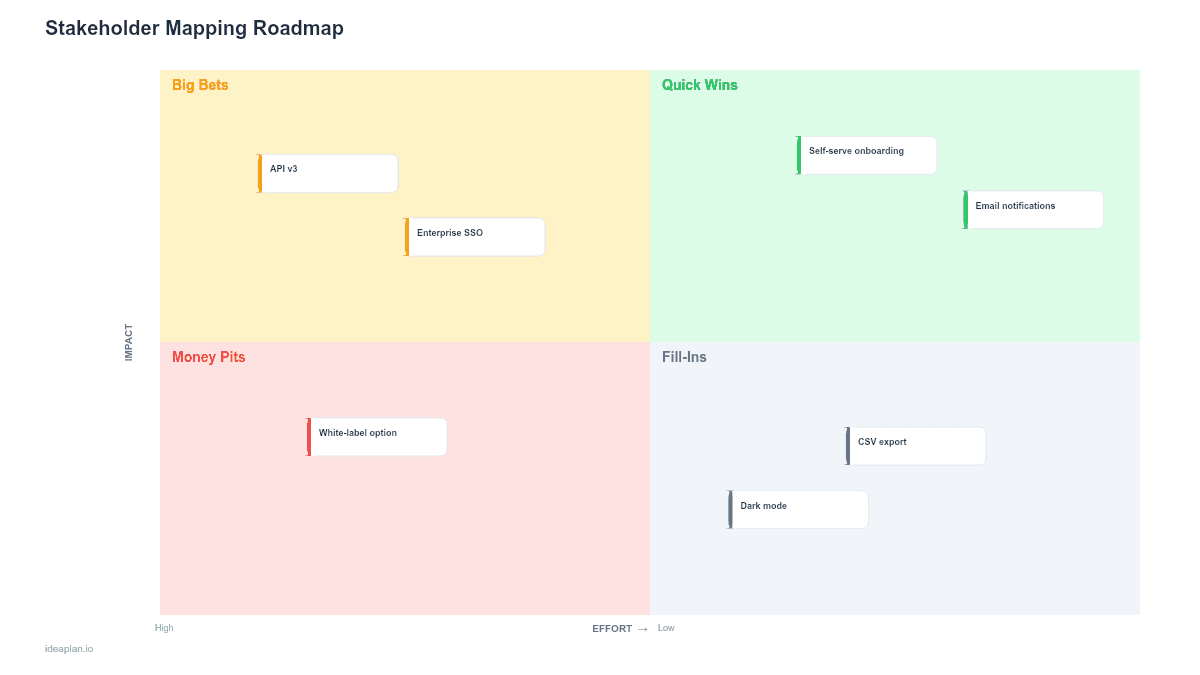
- Blank template slide. A 2x2 influence-interest matrix with quadrant labels (Manage Closely, Keep Satisfied, Keep Informed, Monitor), plus a stakeholder register table below with name, role, quadrant, engagement frequency, and preferred channel.
- Filled example slide. A B2B SaaS product with 12 stakeholders mapped: VP Engineering in "Manage Closely," a legal reviewer in "Keep Satisfied," customer success leads in "Keep Informed," and an adjacent team PM in "Monitor."
Why Stakeholder Mapping Matters
Product managers who skip stakeholder mapping tend to discover misalignment at the worst possible moment. A launch blocked by legal, a feature rejected by sales leadership, or a quiet VP who escalates concerns directly to the CEO. These surprises are preventable.
The influence-interest matrix is the standard tool for this. Influence measures a stakeholder's power to affect your product decisions (budget authority, technical veto, executive access). Interest measures how much they care about your product area day to day. The combination determines how you engage: high-influence, high-interest stakeholders need regular deep engagement; low-influence, low-interest stakeholders need periodic updates at most.
This is not a one-time exercise. Stakeholder positions shift as organizational priorities change, new leaders join, and product scope evolves. Revisit the map quarterly and update engagement strategies to match. The stakeholder management guide covers the full process in depth.
Template Structure
Influence-Interest Matrix
The 2x2 grid is the centerpiece of the template. Each quadrant carries a default engagement strategy:
- Manage Closely (high influence, high interest). These stakeholders shape decisions. Meet weekly or biweekly. Share drafts before they become final. Seek their input early, not after the plan is locked.
- Keep Satisfied (high influence, low interest). They have power but are not closely following your work. Monthly executive summaries. Avoid surprising them. Surface only decisions that affect their domain.
- Keep Informed (low influence, high interest). Enthusiastic supporters or domain experts. They cannot block you, but they provide valuable signal. Include them in broader updates and feedback channels.
- Monitor (low influence, low interest). Minimal engagement. Quarterly newsletters or all-hands updates. Do not spend 1:1 time here unless their position changes.
Stakeholder Register
A table below the matrix captures operational details for each stakeholder: name, title, team, matrix quadrant, engagement frequency, preferred communication channel (Slack, email, 1:1, deck review), key concerns, and last contact date. This register is the working document you update between planning cycles.
Engagement Timeline
A quarterly strip along the bottom shows when key engagement moments happen: board reviews, planning cycles, launch milestones, and OKR check-ins. Overlay stakeholder touchpoints on these events so you can batch communications efficiently rather than scheduling ad-hoc meetings.
How to Use This Template
1. List every stakeholder who touches your product
Cast a wide net. Include executives, engineering leads, designers, sales reps, customer success managers, legal, finance, and any external partners. Most PMs undercount by 30-40% on the first pass. Ask your manager and cross-functional peers who else cares about your product area.
2. Score influence and interest
Rate each stakeholder on a 1-5 scale for both influence and interest. Influence: Can they approve budget? Block a release? Escalate to the CEO? Interest: Do they attend your demos? Ask about your roadmap? Send feature requests? Plot them on the matrix based on their scores.
3. Assign engagement strategies by quadrant
Use the default strategies as a starting point, then customize. A "Manage Closely" stakeholder who prefers async communication gets a weekly Loom video instead of a standing meeting. A "Keep Satisfied" VP who only cares about revenue impact gets a monthly one-liner in their team's Slack channel. Match the format to the person.
4. Set up communication cadences
Block time in your calendar for stakeholder management. Most PMs treat it as reactive. Responding to pings and escalations. The map lets you be proactive. A 30-minute weekly block for stakeholder updates prevents the 2-hour emergency meeting when someone feels out of the loop.
5. Revisit quarterly
People change roles, new leaders join, and product strategy shifts. Re-score influence and interest at the start of each quarter. Move stakeholders between quadrants and adjust engagement accordingly.
When to Use This Template
Stakeholder mapping is most valuable when:
- You are new to a product or team and need to quickly understand who matters and why
- A product launch requires coordination across sales, marketing, legal, and engineering leadership
- Political dynamics are causing misalignment or surprise objections during planning
- Stakeholder alignment is cited as a problem in retrospectives or feedback
- You manage a platform product that serves multiple internal teams with competing priorities
If you have a small team with two or three stakeholders, a simple Slack channel may suffice. This template adds value when the stakeholder count exceeds what you can manage from memory alone. For the presentation layer, pair it with the stakeholder communication roadmap.
Featured in
This template is featured in Roadmap Templates for Executive and Board Presentations, a curated collection of roadmap templates for this use case.
Key Takeaways
- The influence-interest matrix sorts stakeholders into four quadrants, each with a distinct engagement strategy.
- Most PMs undercount their stakeholders on the first pass. Ask cross-functional peers who else cares about your product.
- Match communication format to stakeholder preference: some want weekly 1:1s, others want a monthly Slack summary.
- Proactive stakeholder management (30 minutes per week) prevents reactive crisis meetings when someone feels blindsided.
- Revisit the map quarterly as organizational priorities, roles, and product scope evolve.
- Compatible with Google Slides, Keynote, and LibreOffice Impress. Upload the
.pptxto Google Drive to edit collaboratively in your browser.