Quick Answer (TL;DR)
This free PowerPoint template structures any organizational change initiative into four phases: prepare, communicate, enable, and sustain. Each slide maps the people-side activities that determine whether a change actually sticks. Stakeholder mapping, communication sequences, training rollouts, and adoption measurement. Download the .pptx, define your change scope, and present a plan that addresses the reason most changes fail: not the technical implementation, but the human adoption.
What This Template Includes
- Cover slide. Change initiative name, affected teams and headcount, target completion date, and executive sponsor.
- Instructions slide. How to assess change readiness, map stakeholder influence, and design communication cadences. Remove before presenting.
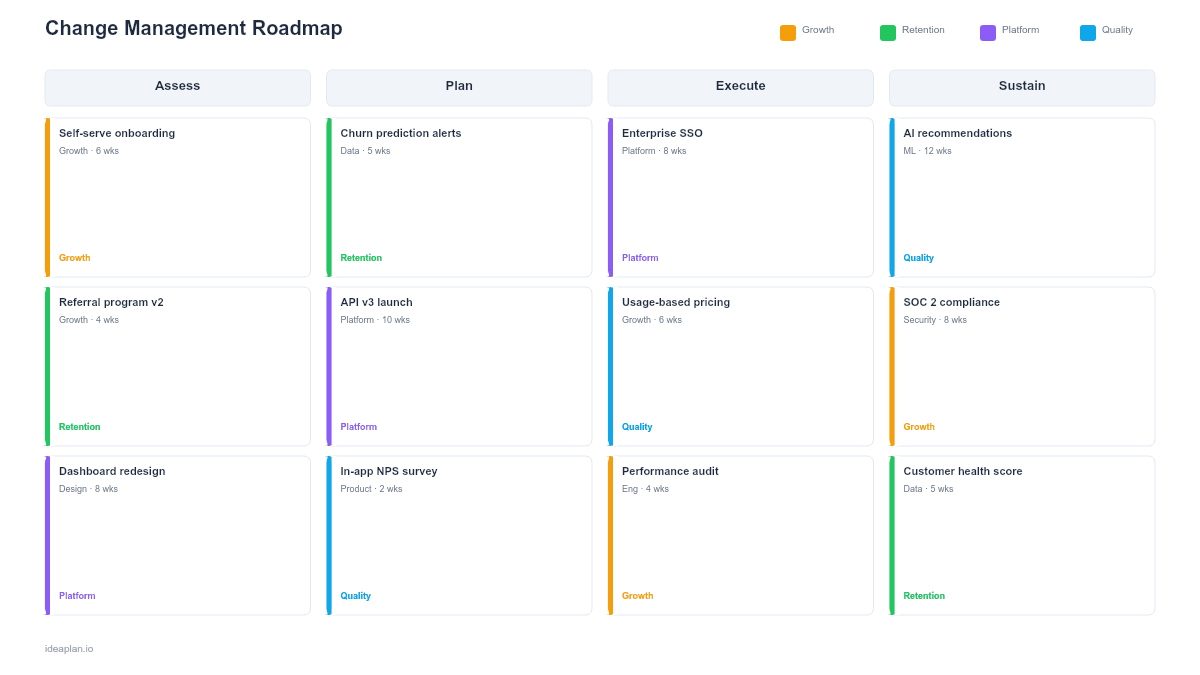
- Blank template slide. Four-phase layout (Prepare, Communicate, Enable, Sustain) across a timeline with activity cards, stakeholder touchpoints, and adoption metrics per phase.
- Filled example slide. A company migrating from Jira to Linear across 120 people over three months. Shows stakeholder mapping and champion recruitment in Phase 1, a tiered communication plan in Phase 2, hands-on training workshops and migration support in Phase 3, and adoption dashboards with feedback loops in Phase 4.
Why Change Management Needs a Roadmap
Organizations announce changes all the time. New tools, new processes, new org structures, new strategies. Most of these changes follow the same pattern: an executive sends an email, a training session is scheduled, and then everyone is expected to adopt the new way of working. Six months later, half the team is still using the old tool, the new process has workarounds everywhere, and leadership wonders why the initiative "failed."
It failed because the people side was not planned. Technical implementation is the easy part. Getting 50 or 500 people to actually change their daily behavior requires a deliberate sequence of activities: building awareness, creating understanding, providing enablement, and reinforcing adoption over time.
A change management roadmap makes this sequence explicit. It assigns ownership to each phase, sets measurable adoption targets, and creates accountability for the human side of change. Which is where most initiatives succeed or fail. For related guidance on aligning people across functions, see the stakeholder management guide.
Template Structure
Four Phases of Change
The roadmap progresses through phases that mirror how people actually adopt change:
- Prepare. Before announcing anything, assess readiness and build the coalition. Map stakeholders by influence and impact. Identify champions who will model the new behavior. Assess the organization's change capacity. If three other changes are in flight, adding another will fail from fatigue. Define success metrics and the rollback criteria if adoption does not meet thresholds.
- Communicate. Announce the change with a structured communication plan. Different audiences need different messages: executives need the "why" and business case, managers need the "what changes for my team" and timeline, individual contributors need the "what changes for me" and support available. Sequence matters. Managers hear first so they can field questions from their teams.
- Enable. Provide the skills and support people need to actually make the change. Training workshops, documentation, office hours, peer coaching from champions, and a dedicated support channel for questions. The gap between "knowing about the change" and "being able to execute the change" is where most initiatives stall.
- Sustain. Reinforce the change until it becomes the default behavior. Track adoption metrics weekly. Celebrate early wins publicly. Address resistance directly. Understand whether it stems from legitimate concerns (the new process is genuinely worse) or from habit (the old way is just more comfortable). Remove the old option when adoption reaches threshold to prevent regression.
Stakeholder Map
The template includes a 2x2 stakeholder map (influence vs. impact) that categorizes affected people into four groups: manage closely (high influence, high impact), keep informed (high influence, low impact), support actively (low influence, high impact), and monitor (low influence, low impact). Each group gets a tailored communication and engagement approach.
Adoption Dashboard
The sustain phase includes an adoption dashboard template tracking three metrics: awareness (percentage who know about the change), ability (percentage who have been trained), and adoption (percentage who are actively using the new way). The gap between ability and adoption reveals whether the problem is enablement or motivation.
How to Use This Template
1. Define the change scope and impact
Describe what is changing, who is affected, and what "done" looks like. Be specific: "Marketing, Sales, and CS (85 people) will move from Salesforce Classic to Lightning by June 30" is actionable. "We are improving our CRM experience" is not. Clarity on scope prevents the plan from expanding uncontrollably. Use a problem statement format to articulate why the change is happening.
2. Map stakeholders and recruit champions
List every person or group affected by the change. Plot them on the influence-impact matrix. For high-impact stakeholders, identify 3-5 champions. People who are respected by peers, open to the change, and willing to model the new behavior publicly. Champions are your most effective change agents because people trust their peers more than they trust management emails.
3. Design the communication sequence
Plan communications in three waves. Wave 1 (2-4 weeks before change): executive sponsor announces the "why," the timeline, and who to contact with questions. Wave 2 (1-2 weeks before): managers receive detailed briefings and FAQ documents so they can support their teams. Wave 3 (at launch): individual contributors receive practical "here is exactly what changes for you" guides with training dates.
4. Build the enablement program
Design training based on how people will actually encounter the change in their daily work. Generic tool training is less effective than workflow-based training: "Here is how you do your weekly report in the new system." Offer multiple formats. Live workshops for complex changes, self-paced guides for simple ones, and office hours for ongoing questions. Track completion as a leading indicator of adoption.
5. Measure adoption and close the loop
Define adoption metrics before launch: what percentage of the target population should be using the new way within 30, 60, and 90 days? Measure weekly. If adoption plateaus below target, investigate whether the gap is awareness (people do not know), ability (people cannot), or willingness (people will not). Each gap requires a different intervention. Review results with the OKR framework to keep adoption targets connected to broader organizational goals.
When to Use This Template
Change management roadmaps fit when:
- A new tool or system is being rolled out across multiple teams and adoption requires people to change established workflows
- An organizational restructure is planned and affected teams need a structured transition with clear communication and support
- A process change affects daily work habits (new code review process, new sprint cadence, new customer success playbook) and voluntary adoption is unlikely without deliberate enablement
- A previous change initiative failed or stalled and the organization needs a more structured approach for the retry
- Multiple changes are in flight simultaneously and you need to sequence and coordinate to avoid change fatigue
If the change is primarily a technology migration with minimal process impact, the migration roadmap template is more appropriate. For changes that span the entire company over multiple years, the digital transformation roadmap template covers the broader scope.
Key Takeaways
- Change management roadmaps cover four phases: prepare, communicate, enable, and sustain. In strict sequence because each phase depends on the previous one.
- Map stakeholders by influence and impact, then recruit champions from the high-impact group to model the new behavior.
- Design communication in three waves: executives first (the why), then managers (the what), then individual contributors (the how).
- Track three adoption metrics: awareness, ability, and adoption. The gap between them reveals whether the problem is communication, training, or motivation.
- PowerPoint format supports executive reviews and cross-functional alignment meetings where the people side of change needs as much rigor as the technical implementation plan.
- Compatible with Google Slides, Keynote, and LibreOffice Impress. Upload the
.pptxto Google Drive to edit collaboratively in your browser.