Quick Answer (TL;DR)
This free, no-signup PowerPoint digital transformation roadmap template maps your transformation initiatives across three phases. Foundation, Acceleration, and Scale. With parallel workstreams for technology, process, and people change. Each initiative card tracks status, ownership, and dependencies. Download the .pptx, define your transformation pillars, and present a clear plan that connects technical investments to business outcomes.
What This Template Includes
- Cover slide. Program name, executive sponsor, transformation vision statement, and target completion timeline.
- Instructions slide. How to define phases, assign workstreams, and track initiative status. Remove before presenting.
- Blank template slide. Three-phase timeline with four workstream swim lanes (Technology, Process, People, Governance) and placeholder initiative cards.
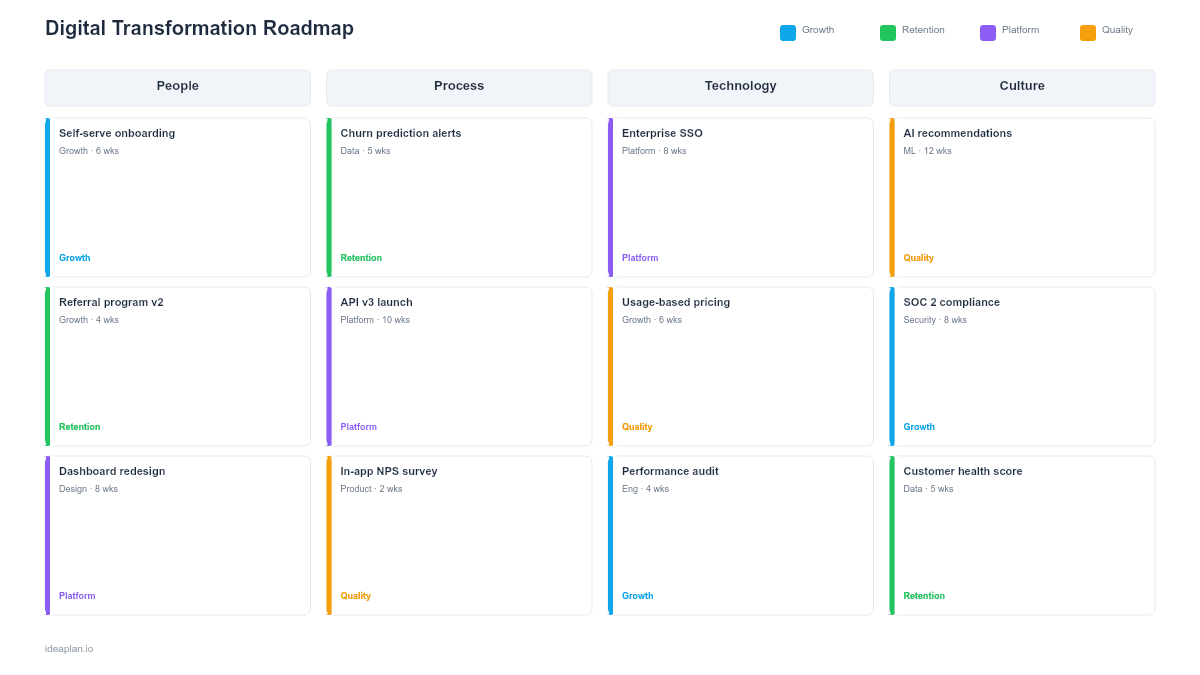
- Filled example slide. A working transformation roadmap for a mid-market SaaS company migrating from monolith to microservices, with 16 initiative cards across all workstreams showing dependencies and status indicators.
Why PowerPoint for Digital Transformation
Digital transformation touches every team in the organization. The audience for this roadmap spans engineering, operations, HR, finance, and the executive team. PowerPoint is the one format everyone already has.
More importantly, transformation roadmaps are presented more often than they are edited. Board meetings, steering committees, town halls, and skip-level updates all need a visual representation of where the program stands. A slide deck lets you present the same roadmap in each context, adjusting the level of detail by showing or hiding slides.
Finally, transformation timelines are measured in quarters and years, not sprints. The phased format in this template reflects that reality. You are planning long arcs of change, not individual feature releases. For more on building product strategy that supports these long arcs, see the strategy glossary entry.
Template Structure
Three Phases
The default phases are:
- Foundation (Q1-Q2). Infrastructure investments, team formation, and pilot programs. The goal is to prove the approach works in a controlled scope.
- Acceleration (Q3-Q4). Scale successful pilots, retire legacy systems, and expand adoption. The goal is to reach critical mass.
- Scale (Q5-Q8). Optimize, measure ROI, and embed new capabilities into standard operations. The goal is to make the transformation irreversible.
Adjust phase names and durations to match your program timeline. Some organizations use Assess / Build / Operate. Others prefer Crawl / Walk / Run. The labels matter less than having distinct phases with clear success criteria.
Four Workstream Swim Lanes
Each phase is divided into four horizontal swim lanes:
- Technology. Platform migrations, new tool deployments, API integrations, data infrastructure.
- Process. Workflow redesigns, automation rollouts, new operating procedures.
- People. Training programs, role changes, hiring, change management communications.
- Governance. Compliance requirements, security reviews, audit checkpoints, decision gates.
Initiative Cards
Each card displays:
- Initiative name. Descriptive label (e.g., "Migrate CRM to Salesforce").
- Owner. Single accountable person, not a team name.
- Status. Green (on track), amber (at risk), red (blocked), grey (not started).
- Dependencies. Dotted arrows connecting cards that depend on each other across workstreams.
Progress Dashboard
An optional summary slide shows aggregate metrics: percentage of initiatives complete per phase, budget spent vs. allocated, and a traffic-light summary for each workstream.
How to Use This Template
1. Define your transformation pillars
Start by listing the 3-5 major outcomes your transformation must deliver. These become the organizing principle for every initiative on the roadmap. Each initiative should trace back to at least one pillar.
2. Map initiatives to workstreams and phases
For each initiative, decide which workstream it belongs to and which phase it starts in. Use the product development lifecycle concept to sequence technical work. Front-load foundational work (data migration, platform setup) into Phase 1 so downstream initiatives are not blocked.
3. Identify dependencies
Draw dependency arrows between initiatives that have hard sequencing requirements. Keep the number of cross-workstream dependencies low. More than 3 dependencies on a single initiative is a sign that the scope is too large and should be broken down.
4. Assign owners and set status
Every initiative gets one owner. Set all Phase 1 initiatives to an active status. Phase 2 and 3 initiatives start as grey (not started). Update status at each steering committee meeting.
5. Review at steering committee cadence
Present the roadmap at your regular transformation steering committee (biweekly or monthly). Move cards between phases if timelines shift. Update status colors. The roadmap should always reflect reality, not the original plan.
When to Use This Template
A digital transformation roadmap PowerPoint template works best when:
- Multiple workstreams run in parallel across technology, process, and people change
- Executive and board audiences need a single visual showing the full program
- The timeline spans 12+ months and requires phased planning
- Cross-functional dependencies need to be visible at a glance
- Change management is as important as the technical delivery
If your transformation is primarily a single-team technical migration, the Migration Roadmap PowerPoint template is more focused. If you need to align transformation goals to measurable outcomes, consider the OKR Product Roadmap PowerPoint template alongside this one.
For a broader look at building product strategy, including how transformation fits into your strategic planning, see the strategy guide.
Key Takeaways
- Digital transformation roadmaps organize cross-functional change into phased, manageable workstreams.
- Four swim lanes (Technology, Process, People, Governance) ensure no dimension of change is overlooked.
- Three default phases (Foundation, Acceleration, Scale) reflect the multi-quarter reality of transformation programs.
- Dependency arrows make cross-workstream sequencing visible to executive audiences.
- PowerPoint format ensures the roadmap is presentable in every forum from board meetings to team town halls.
- Compatible with Google Slides, Keynote, and LibreOffice Impress. Upload the
.pptxto Google Drive to edit collaboratively in your browser.