Quick Answer (TL;DR)
This free PowerPoint template maps out improvements to your security incident response capabilities. From detection and alerting through containment, eradication, recovery, and lessons learned. Each improvement initiative gets a NIST-aligned phase, priority score, owner, and target completion date. Download the .pptx, assess your current incident response gaps, and build a quarterly plan that makes each incident response faster and more effective than the last.
What This Template Includes
- Cover slide. Organization name, security incident response plan version, CISO or security lead name, and review period.
- Instructions slide. How to map improvements to NIST incident response phases, score priority, and track maturity progression. Remove before presenting.
- Maturity assessment slide. A radar chart scoring your current capabilities across six dimensions: Detection, Analysis, Containment, Eradication, Recovery, and Post-Incident. Each dimension is rated 1-5, revealing where to focus investment.
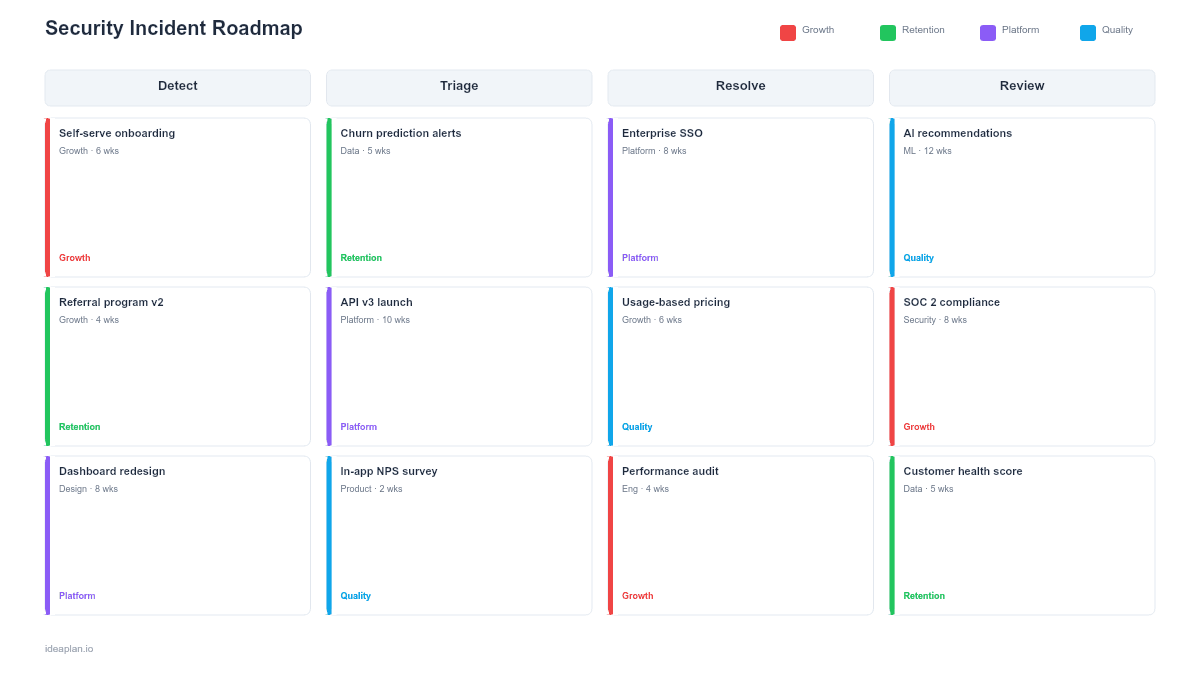
- Improvement roadmap slide. A quarterly timeline with improvement initiatives organized by NIST phase. Each card shows the current maturity level, target maturity, effort estimate, owner, and dependencies.
- Filled example slide. A growth-stage SaaS company improving its security incident response: Q1 deploys SIEM with automated alerting (Detection), Q2 creates containment playbooks for the top 5 threat scenarios (Containment), Q3 builds forensic investigation capability (Eradication), Q4 runs a red team exercise to validate all improvements.
Why Security Incident Response Needs a Roadmap
Every security team has an incident response plan. Few have a plan for making incident response better over time. The result is a static document that reflects the team's capabilities when it was written, not their current gaps.
Security incidents expose specific weaknesses: detection took too long, containment was manual, eradication was incomplete, or the post-incident review produced action items that nobody tracked. These weaknesses are improvement opportunities, but they get lost in the post-mortem document unless they are translated into a roadmap with owners and deadlines.
The NIST Incident Response framework (Preparation, Detection & Analysis, Containment/Eradication/Recovery, Post-Incident Activity) provides the structure. This template maps improvement initiatives to those phases so your security program matures methodically rather than reactively. Filling gaps only after an incident forces the issue.
Template Structure
Maturity Assessment Radar
The radar chart scores six dimensions of incident response maturity. Each dimension maps to specific capabilities:
- Detection. SIEM coverage, alert rules, monitoring for indicators of compromise, mean time to detect.
- Analysis. Triage procedures, threat intelligence integration, correlation of alerts, severity classification accuracy.
- Containment. Playbooks for common scenarios, isolation procedures, authority to act without executive approval.
- Eradication. Forensic investigation capability, malware removal procedures, root cause analysis depth.
- Recovery. System restoration procedures, data integrity verification, service re-enablement sequencing.
- Post-Incident. Structured reviews, action item tracking, metrics collection, trend analysis.
A team that scores 4/5 on Detection but 2/5 on Containment has a dangerous gap: they catch incidents quickly but cannot stop them from spreading.
Quarterly Improvement Timeline
Initiatives are plotted on a four-quarter timeline, organized by NIST phase. The template enforces balance. Each quarter should include work across multiple phases rather than investing entirely in detection while neglecting response capabilities. Connecting these improvements to your broader product strategy ensures security work gets sustained investment alongside feature development.
How to Use This Template
1. Score your current maturity honestly
Gather your security team and rate each dimension 1-5 based on evidence, not aspiration. A 3/5 on Detection means you have automated alerting for known threat patterns but miss novel attacks and have significant blind spots. If your last incident was detected by a customer rather than your monitoring, Detection is not a 3. Use recent incident data to calibrate.
2. Identify the highest-risk gaps
A dimension scored 1 or 2 is a critical gap. A dimension where the gap between adjacent phases is large (high Detection but low Containment) indicates a dangerous imbalance. Prioritize improvements that close the most dangerous gaps first, not the easiest improvements.
3. Plan improvements in quarterly increments
Map 2-4 improvement initiatives per quarter. Each initiative should move a specific dimension from its current score toward the next level. Avoid planning more than one major initiative per NIST phase per quarter. Security teams are small and context-switching between detection engineering and forensic capability building is expensive.
4. Validate with exercises, not just deployments
An improvement is not complete when the tool is deployed or the playbook is written. It is complete when the team has used it under realistic conditions. Schedule a tabletop exercise or red team engagement each quarter that specifically tests the quarter's improvements. The security roadmap template covers the broader security program; this template focuses specifically on incident response capability.
When to Use This Template
A security incident response roadmap fits when:
- A recent incident revealed gaps in detection time, containment speed, or post-incident follow-through that need structured improvement
- Compliance audits (SOC 2, ISO 27001, PCI-DSS) require evidence of an incident response improvement program, not just a static plan
- Your security team is growing and needs a maturity model to guide hiring, tooling, and process development decisions
- Executive leadership wants visibility into security operations investment and how it reduces organizational risk over time
- You are building incident response capability from scratch and need a phased plan rather than trying to implement everything simultaneously
If you need to plan the response to a specific active incident rather than improving your general capability, the incident response roadmap template handles active incident coordination. For data breach scenarios specifically, the data breach response template covers notification and compliance requirements.
Key Takeaways
- Map incident response improvements to NIST phases (Detection, Analysis, Containment, Eradication, Recovery, Post-Incident) to ensure balanced investment.
- The maturity radar chart reveals dangerous imbalances. High detection with low containment means you catch incidents you cannot stop.
- Plan 2-4 improvement initiatives per quarter. Validate each with a tabletop exercise or red team engagement, not just tool deployment.
- Track MTTD, MTTC, and MTTR across incidents to measure whether roadmap investments are producing measurable capability improvement.
- Score maturity based on evidence from real incidents, not aspirational self-assessment.
- Compatible with Google Slides, Keynote, and LibreOffice Impress. Upload the
.pptxto Google Drive to edit collaboratively in your browser.