Quick Answer (TL;DR)
This free PowerPoint template structures your data breach response. From initial discovery through forensic investigation, regulatory notification, affected-user communication, remediation, and compliance follow-up. Each phase has regulatory deadlines, task owners, and decision checkpoints mapped to GDPR, CCPA, and HIPAA requirements. Download the .pptx, customize the notification timelines for your jurisdiction, and have a breach response plan ready before you need it.
What This Template Includes
- Cover slide. Organization name, breach response plan version, Data Protection Officer or breach lead name, and last review date.
- Instructions slide. How to classify breach severity, trigger notification obligations, and coordinate with legal counsel. Remove before external distribution.
- Breach assessment slide. A structured checklist for the first 24 hours: what data was exposed, how many individuals are affected, whether the breach is ongoing, and which regulatory notification requirements apply.
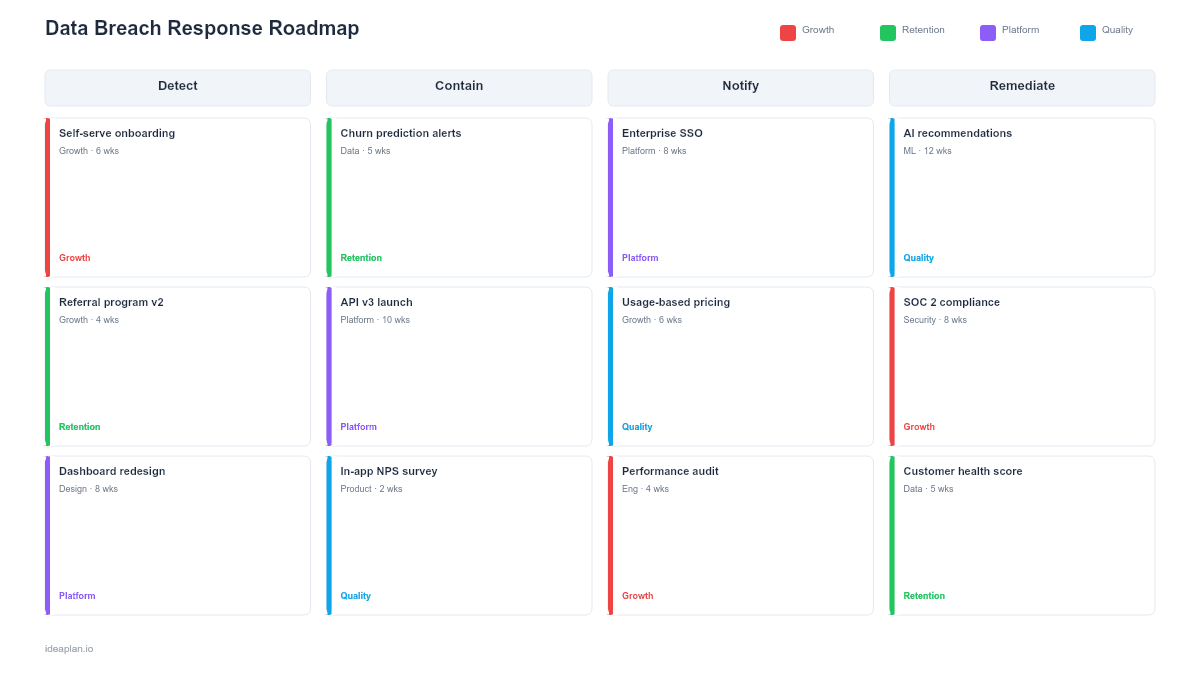
- Response timeline slide. Six phases (Discover, Contain, Investigate, Notify, Remediate, Report) with parallel tracks for Legal, Engineering, Communications, and Compliance. Each task includes regulatory deadline references, owners, and status.
- Filled example slide. A SaaS company responding to a breach of customer PII: breach contained within 4 hours, forensic investigation completed in 72 hours, GDPR supervisory authority notified within 72 hours, affected users notified within 7 days, remediation deployed within 2 weeks, and a compliance report filed within 30 days.
Why Data Breaches Need a Specific Response Plan
A data breach is not just a security incident. It is a legal event with regulatory deadlines that start counting from the moment of discovery. GDPR requires supervisory authority notification within 72 hours. CCPA requires individual notification "in the most expedient time possible." HIPAA mandates notification within 60 days.
Missing these deadlines exposes your company to fines that dwarf the cost of the breach itself. GDPR penalties reach 4% of annual global revenue. The operational challenge is that the 72-hour clock starts ticking before you fully understand what happened, which means the investigation and notification tracks must run in parallel.
A generic incident response plan does not account for these legal obligations. It focuses on containment and technical remediation. A breach response plan adds the regulatory layer: what notifications are required, who approves them, what information they must contain, and when they must be delivered. The data privacy roadmap template covers your ongoing privacy program; this template handles the acute response when that program is tested.
Template Structure
Breach Assessment Checklist
The first slide after the cover provides a rapid-assessment framework for the first 24 hours:
- Data classification. What categories of data were exposed? Personal data, financial data, health data, credentials, or proprietary information. The data type determines which regulations apply.
- Scope. Number of individuals affected, geographic distribution (determines jurisdictional requirements), and whether the data was actually accessed versus merely exposed.
- Status. Is the breach ongoing or contained? Ongoing breaches require immediate containment before notification planning begins.
- Notification triggers. A decision matrix mapping data type and scope to specific regulatory notification obligations (GDPR, CCPA, HIPAA, PCI-DSS, state breach notification laws).
Six-Phase Timeline
- Discover (0-4 hours). Confirm the breach, activate the response team, engage legal counsel, and begin the assessment checklist. Document the discovery timestamp. This starts regulatory clocks.
- Contain (4-24 hours). Stop data exfiltration, revoke compromised credentials, isolate affected systems. Containment must not destroy forensic evidence.
- Investigate (24-72 hours). Determine root cause, full scope of exposed data, attack vector, and whether the attacker retains access. Engage forensic specialists if internal capability is insufficient.
- Notify (72 hours - 30 days). File regulatory notifications, notify affected individuals, and brief key stakeholders. Timing depends on jurisdiction and data type.
- Remediate (1-4 weeks). Fix the vulnerability, strengthen controls, and implement monitoring to detect similar attacks. Verify that remediation is complete.
- Report (30-90 days). File final compliance reports, complete internal documentation, and present lessons learned to leadership. Update the security incident roadmap with improvements identified during the breach.
How to Use This Template
1. Customize notification timelines for your jurisdictions
The default template includes GDPR (72 hours to supervisory authority), CCPA (expedient notification), and HIPAA (60 days) deadlines. If you operate in specific US states, add their breach notification laws. Requirements vary from 30 to 90 days. Have legal counsel validate the deadlines before finalizing.
2. Pre-identify your breach response team
Name the people who will be activated when a breach is confirmed: breach lead, legal counsel (internal or external), forensic investigator, engineering lead, communications lead, and executive sponsor. Include backup contacts for every role. Refer to the stakeholder management guide for structuring communication across these roles during high-pressure events.
3. Draft notification templates before the breach
Regulatory notifications and individual notification letters should be pre-drafted with blanks for specifics (date, data types, number of individuals, remediation steps). Writing notification language under a 72-hour deadline while also managing the technical response produces poor results. Pre-approved templates save hours when hours matter.
4. Run a tabletop exercise annually
Simulate a breach scenario and walk the response team through the plan. Time the critical path: how long from discovery to containment? From containment to regulatory notification? Identify bottlenecks. Usually legal review of notification language is the slowest step. Adjust the plan to address what the exercise reveals.
When to Use This Template
A data breach response roadmap is essential when:
- Your product stores personal data (names, emails, addresses, payment information, health data) for customers or end users
- You operate in jurisdictions with breach notification laws. Which, in practice, means every company with customers in the EU, California, or most US states
- Compliance frameworks (SOC 2, ISO 27001, HIPAA, PCI-DSS) require a documented and tested breach response plan
- Enterprise customers require breach notification commitments in their contracts or data processing agreements
- You have not yet experienced a breach and want to be prepared rather than improvising under regulatory deadlines
If your focus is on improving security incident response capabilities over time rather than planning for a specific breach scenario, the security incident roadmap template covers the maturity improvement program. For broader compliance planning beyond breach response, the compliance audit roadmap template is more appropriate.
Key Takeaways
- A data breach triggers regulatory notification deadlines that start counting at discovery. The 72-hour GDPR clock does not pause while you investigate.
- Run investigation and notification tracks in parallel. Waiting for full investigation results before starting notification preparation will blow your deadlines.
- Pre-draft notification templates and pre-identify your response team. Both save critical hours during the real event.
- Retain external forensic capability before you need it. Negotiating retainer agreements during an active breach is expensive and slow.
- Test the plan annually with a tabletop exercise. The legal review bottleneck is the most commonly discovered gap.
- Compatible with Google Slides, Keynote, and LibreOffice Impress. Upload the
.pptxto Google Drive to edit collaboratively in your browser.