Quick Answer (TL;DR)
Revenue operations exists to eliminate the gaps between sales, marketing, and customer success that cause pipeline leaks, forecasting errors, and customer handoff failures. This free PowerPoint template plans RevOps improvements across four tracks: data infrastructure, process alignment, system integration, and metrics standardization. Download the .pptx, map your current RevOps maturity, and build a quarterly plan that turns three siloed go-to-market functions into a coordinated revenue engine.
What This Template Includes
- Cover slide. Title slide with company name, RevOps owner, and planning horizon.
- Instructions slide. How to assess current state across the four RevOps tracks, identify quick wins, and sequence multi-quarter initiatives. Remove before presenting to leadership.
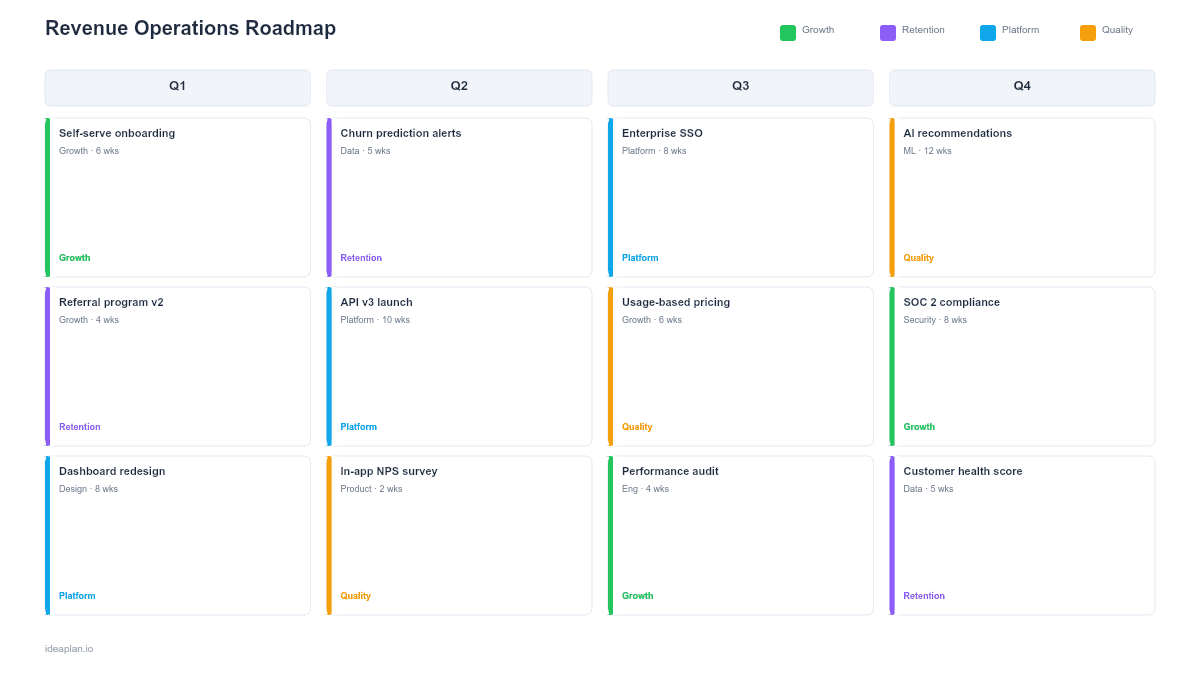
- Blank RevOps timeline slide. A four-track quarterly view covering data infrastructure, process alignment, system integration, and metrics. Each track shows initiatives with owner, target metric, and dependencies between tracks.
- Filled example slide. A complete RevOps roadmap for a $15M ARR SaaS company, showing CRM data cleanup in Q1, lead-to-close process standardization in Q2, marketing-to-sales system integration in Q3, and unified revenue dashboard deployment in Q4. With net revenue retention and pipeline velocity as north star metrics.
Why Revenue Operations Needs a Roadmap
Most companies do not have a revenue operations problem. They have three separate operations problems wearing a trench coat. Marketing ops optimizes for lead volume. Sales ops optimizes for close rate. CS ops optimizes for retention. Nobody optimizes for the handoffs between them, and those handoffs are where revenue leaks.
The symptoms are familiar: marketing generates leads that sales says are unqualified. Sales closes deals that CS says were oversold. CS identifies expansion opportunities that sales never follows up on. Each function measures its own metrics while the end-to-end customer journey. From first touch to expansion. Has no single owner.
A RevOps roadmap addresses this by treating revenue generation as a connected system rather than three independent pipelines. The roadmap sequences improvements to the data layer (so everyone works from the same numbers), the process layer (so handoffs are explicit), the system layer (so tools pass information automatically), and the metrics layer (so performance is measured end-to-end). The product-led growth model makes RevOps alignment even more critical, since product usage data must flow into the same pipeline that sales and CS use.
Template Structure
Data Infrastructure Track
Clean, consistent data is the foundation. This track covers CRM data hygiene (deduplication, field standardization, enrichment), data model alignment (consistent definitions of "lead," "opportunity," "customer" across systems), and the creation of a single source of truth for revenue data. Without this foundation, every report that sales, marketing, and CS produce will tell a different story.
Process Alignment Track
Process alignment standardizes the handoffs that leak revenue. Key processes to define: lead qualification criteria (when does marketing hand to sales?), opportunity stages (what does each stage mean, and what evidence moves a deal forward?), closed-won to CS handoff (what information does CS need to onboard effectively?), and expansion signal routing (how do CS-identified upsell opportunities reach sales?). Each process gets documented criteria and a measurable SLA.
System Integration Track
The average B2B SaaS company uses 40-60 tools in the go-to-market stack. Most are not connected, which means data lives in silos and handoffs require manual copying between systems. This track covers system-to-system integrations: CRM to marketing automation (bi-directional lead status sync), CRM to CS platform (account health scores visible in the sales record), product usage data to CRM (usage signals informing expansion and churn risk), and unified reporting layer across all systems.
Metrics Standardization Track
Agree on definitions, calculation methods, and reporting cadence for shared revenue metrics. The complete guide to product metrics covers metric design principles. Key RevOps metrics include pipeline velocity, lead-to-close conversion rate, customer acquisition cost, sales cycle length, win rate by segment, net revenue retention, and expansion revenue as a percentage of total revenue. Each metric gets a single owner, a single data source, and a single dashboard.
How to Use This Template
1. Audit the current state
Interview sales, marketing, and CS leadership separately. Ask each function three questions: What data do you need that you cannot get? Where do handoffs break down? Which metrics do you distrust? The overlapping complaints reveal the highest-priority RevOps gaps. Map these gaps to the four tracks on the template.
2. Prioritize by revenue impact
Not all RevOps improvements are equal. A CRM data cleanup that improves forecasting accuracy is valuable but slow-burning. An automated lead-routing fix that reduces response time from 24 hours to 5 minutes has immediate pipeline impact. Score initiatives by estimated revenue impact (pipeline dollars influenced), implementation effort, and dependency on other work. The RICE framework works well for this prioritization.
3. Sequence dependencies
Data infrastructure typically comes first because process and metrics improvements depend on clean, consistent data. System integrations depend on standardized data models. Metrics standardization depends on integrated systems. This does not mean you wait for perfect data before starting anything else. But the first quarter should focus heavily on the data foundation while starting quick-win process fixes in parallel.
4. Assign cross-functional owners
Each initiative needs a single owner, even if the work spans functions. The lead-to-sales handoff process improvement might be owned by the marketing ops manager with input from sales leadership. The CS-to-sales expansion routing might be owned by the CS ops manager. Avoid co-ownership. It creates ambiguity about who drives decisions when priorities conflict.
5. Report on shared metrics monthly
Stand up a monthly RevOps review with sales, marketing, and CS leadership. Review the shared metrics dashboard, highlight trends, and update the roadmap based on results. The review cadence keeps the roadmap alive. Without it, each function reverts to optimizing its own metrics independently. Track pipeline velocity and NRR as the north star indicators of RevOps health.
When to Use This Template
Revenue operations roadmaps deliver the most value when:
- Sales, marketing, and CS use different tools and data does not flow between them, causing handoff failures and conflicting reports
- Pipeline conversion rates are declining despite adequate lead volume, suggesting process gaps rather than demand gaps
- Forecasting accuracy is low because opportunity data is inconsistent and pipeline stages mean different things to different reps
- Customer handoffs are creating churn risk. Deals close without adequate context passing to the CS team, leading to poor onboarding
- Expansion revenue is underperforming because CS-identified opportunities are not reaching sales or are not prioritized
For companies with a single go-to-market motion and tight functional alignment, a revenue growth roadmap focused on growth levers may be more appropriate. This template is for organizations where the operational infrastructure between functions needs significant improvement.
Featured in
This template is featured in Growth and Revenue Roadmap Templates, a curated collection of roadmap templates for this use case.
Key Takeaways
- Revenue operations aligns sales, marketing, and CS around shared data, processes, systems, and metrics. Eliminating the handoff gaps where revenue leaks.
- Start with data infrastructure: clean, consistent CRM data and agreed-upon definitions are the foundation for every other RevOps improvement.
- Standardize the three critical handoffs: marketing-to-sales (lead qualification), sales-to-CS (closed-won onboarding), and CS-to-sales (expansion opportunity routing).
- Measure end-to-end revenue metrics (pipeline velocity, NRR) rather than letting each function optimize its own isolated KPIs.
- Plan for 12-18 months of sustained investment. RevOps transformation is structural, not a one-quarter project.
- Compatible with Google Slides, Keynote, and LibreOffice Impress. Upload the
.pptxto Google Drive to edit collaboratively in your browser.