Quick Answer (TL;DR)
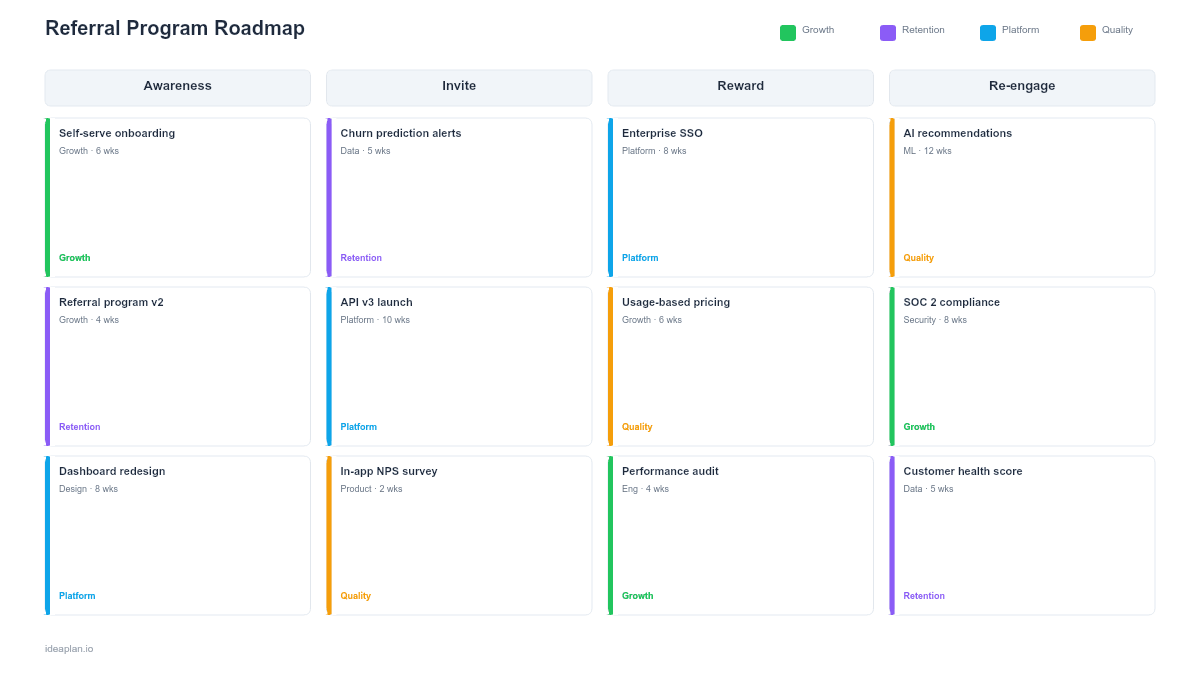
This free PowerPoint template maps out a phased referral program from initial design through optimization. It covers referral mechanics, incentive structures, channel rollout, and the metrics you need to track at each stage. Download the .pptx, define your referral loop, and build a growth engine where your best users bring in the next wave.
What This Template Includes
- Cover slide. Product name, current viral coefficient, and the target K-factor for this planning cycle.
- Instructions slide. How to design referral mechanics, set incentive tiers, and measure loop performance. Remove before presenting.
- Referral loop diagram slide. A visual flow showing the complete referral cycle: trigger point, share mechanism, landing experience, conversion, and reward fulfillment.
- Phased rollout slide. Three phases (Foundation, Scale, Optimize) with initiative cards for each phase showing effort, channel, expected impact on K-factor, and launch date.
- Filled example slide. A SaaS referral roadmap showing Phase 1 (in-app share modal + $10 credit), Phase 2 (email campaigns + tiered rewards), Phase 3 (A/B test incentive structures + referral leaderboard).
Why Referral Programs Need a Roadmap
Launching a referral program without a phased plan produces one of two outcomes: either the team ships a basic "invite a friend" button that nobody uses, or they over-engineer a complex rewards system that takes six months to build and still underperforms.
A roadmap forces you to start simple and iterate based on data. Phase 1 validates that users will refer at all. Phase 2 scales the channels and incentives that work. Phase 3 optimizes the loop economics. This sequencing matters because referral mechanics are hard to predict. What motivates sharing varies by product, audience, and price point.
The roadmap also aligns product, marketing, and engineering around shared metrics. Product owns the in-app mechanics. Marketing owns the messaging and channels. Engineering owns the tracking and attribution. Without a shared plan, these teams optimize locally and the referral loop has gaps.
Template Structure
Referral Loop Diagram
The loop slide visualizes the five stages of every referral:
- Trigger. The moment a user is prompted to refer. Timing matters: after a success event (project completed, goal hit) beats a random prompt during onboarding.
- Share mechanism. How the user sends the referral: unique link, email invite, social share, or in-product collaboration invite.
- Landing experience. What the referred person sees. A generic homepage converts worse than a personalized landing page showing who referred them and why.
- Conversion. The referred user signs up and completes the activation milestone.
- Reward. Both sides receive their incentive, and the loop resets for the new user.
Phased Rollout
Each phase has 3-4 initiative cards containing:
- Initiative name. The specific feature or campaign being shipped.
- Channel. Where the referral happens (in-app, email, social, partner).
- Expected K-factor lift. Estimated improvement to the viral coefficient. Forces the team to quantify impact rather than guess.
- Effort. T-shirt size for engineering and design work.
- Launch date. Target ship date for each initiative.
Metrics Dashboard Row
A footer row tracks the core referral metrics across all phases: invites sent per user, referral conversion rate, time to first referral, cost per referred acquisition, and the overall K-factor.
How to Use This Template
1. Map your current referral loop
Document how users share your product today, even if it is informal. Check support tickets, social mentions, and onboarding surveys for organic referral signals. If users already refer without a program, you are validating demand. Not creating it.
2. Design Phase 1: the minimum viable referral
Start with one trigger point, one share mechanism, and one incentive. Do not launch with tiered rewards, leaderboards, or gamification. Phase 1 answers one question: will users refer when asked? A simple two-sided credit ($10 for referrer and referred) is enough.
3. Set K-factor targets by phase
Phase 1 target might be K = 0.1 (1 in 10 users refers someone who converts). Phase 2 targets K = 0.3. Phase 3 pushes toward K = 0.5 or higher. These targets are product-specific. Check the referral rate benchmark for your category.
4. Plan instrumentation before launch
You cannot optimize what you cannot measure. Before shipping Phase 1, ensure your analytics tracks every loop stage: trigger impressions, share clicks, landing page visits, signup conversions, and reward fulfillment. Gaps in tracking will delay Phase 2 by weeks.
5. Iterate based on loop-stage drop-off
After Phase 1 data arrives, identify where the loop breaks. If trigger-to-share is low, the prompt timing or copy needs work. If share-to-signup is low, the landing page is weak. Focus Phase 2 investments on the biggest drop-off points.
When to Use This Template
- Product-led growth planning when referrals are a core acquisition channel alongside organic and paid
- Growth team quarterly planning to sequence referral experiments across the next 2-3 months
- Exec-level growth reviews where leadership needs to see the referral strategy alongside other PLG channels
- New product launches where building an early referral loop can reduce customer acquisition cost
- Marketplace or platform products where network effects amplify the value of each new user
If you need to plan broader growth experiments beyond referrals, use the growth experiment roadmap template.
Featured in
This template is featured in SaaS Product Roadmap Templates, a curated collection of roadmap templates for this use case.
Key Takeaways
- Referral programs succeed through phased iteration, not big-bang launches.
- Map the complete referral loop (trigger, share, land, convert, reward) before building anything.
- Set K-factor targets by phase and instrument every stage of the loop for drop-off analysis.
- Start with a simple two-sided incentive in Phase 1; optimize mechanics and rewards in later phases.
- PowerPoint format lets you present the referral roadmap in growth reviews and cross-functional planning sessions.
- Compatible with Google Slides, Keynote, and LibreOffice Impress. Upload the
.pptxto Google Drive to edit collaboratively in your browser.