Quick Answer (TL;DR)
This free PowerPoint template walks your team through a product recall or critical rollback. From initial impact assessment through customer notification, remediation execution, and prevention planning. Each phase has clear owners, timelines, and decision criteria so you can move fast without skipping steps. Download the .pptx, adapt the phases to your product type, and keep it ready for the day a release goes wrong enough to require a full recall.
What This Template Includes
- Cover slide. Product name, affected version or feature, severity classification, and recall lead.
- Instructions slide. Severity definitions, escalation triggers, and decision authority for each recall phase. Remove before external distribution.
- Impact assessment slide. A structured grid for quantifying blast radius: users affected, data at risk, revenue exposure, SLA breaches, and regulatory implications. Includes a severity scoring matrix.
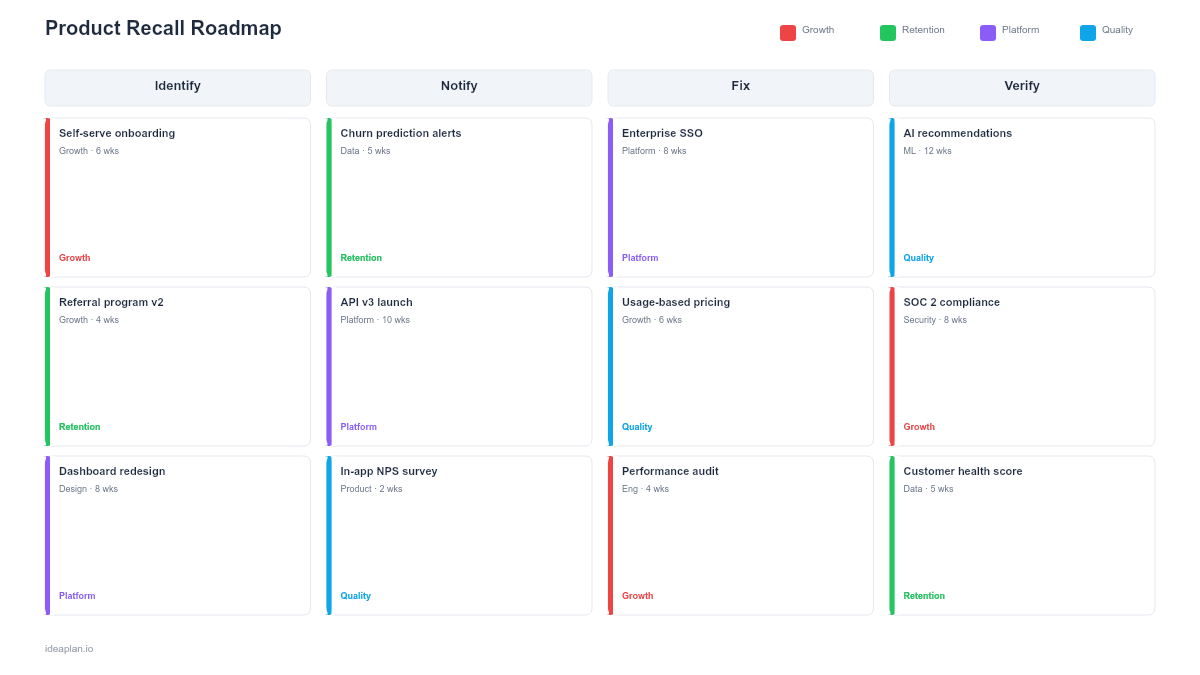
- Recall timeline slide. Four phases (Assess, Contain, Remediate, Prevent) with parallel workstreams for Engineering, Communication, Legal/Compliance, and Customer Success. Each card shows owner, deadline, and status.
- Filled example slide. A SaaS product recalling a billing feature that charged incorrect amounts: impact assessment within 2 hours, affected customer notification within 4 hours, refund processing within 24 hours, root cause fix deployed within 48 hours, and a process change to prevent recurrence.
Why Product Recalls Need a Structured Plan
A bad release that affects customer data, billing, or core workflows requires more than a hotfix. It requires coordinated action across engineering, support, legal, and leadership. All moving faster than normal while making decisions that carry real consequences.
Most teams have deployment runbooks but not recall runbooks. The deployment path is well-rehearsed because it happens weekly. The recall path happens once or twice a year, which means it is always improvised. Improvisation under pressure leads to missed notifications, incomplete rollbacks, and customers who discover the problem before your support team knows about it.
This template turns a recall into a repeatable process. The phases are fixed. The decision criteria are pre-defined. The communication plan is ready. The only variables are the specifics of what went wrong and how many customers were affected.
Template Structure
Impact Assessment Grid
The assessment slide quantifies five dimensions of the recall:
- User impact. How many accounts, users, or transactions are affected. A billing error affecting 50 enterprise accounts is a different severity than a UI bug affecting 5,000 free-tier users.
- Data integrity. Whether customer data was corrupted, lost, or exposed. Data issues escalate severity immediately.
- Revenue exposure. Direct financial impact: incorrect charges, refund obligations, SLA penalty payments.
- Regulatory risk. Whether the issue triggers notification requirements under GDPR, HIPAA, PCI-DSS, or contractual obligations.
- Reputational risk. Whether the issue is visible to the public, press, or competitors.
Four-Phase Timeline
- Assess (0-4 hours). Confirm the issue, quantify blast radius, classify severity, and decide whether a full recall is necessary versus a targeted fix.
- Contain (4-12 hours). Stop the bleeding. Roll back the change, disable the feature, or implement a temporary workaround. Notify affected customers that you are aware and acting.
- Remediate (12-72 hours). Fix the root cause, process refunds or corrections, restore data integrity, and verify the fix. Communicate resolution to all affected parties.
- Prevent (1-4 weeks). Implement regression testing, update deployment checks, and add monitoring to catch the same failure class before it reaches production.
How to Use This Template
1. Run the impact assessment immediately
Within the first two hours of discovering the issue, fill out the impact grid. You need numbers, not guesses. How many users? How much money? What data? The assessment drives every decision that follows. Including whether a full recall is warranted. Use your product analytics to pull precise affected-user counts fast.
2. Make the contain-or-fix decision
Not every issue requires a rollback. If the affected feature can be patched in under an hour without making things worse, a forward fix may be faster. If the blast radius is growing or data integrity is at risk, roll back immediately and fix later. The template includes a decision tree for this fork.
3. Coordinate communication across stakeholder tiers
The stakeholder communication roadmap template handles ongoing multi-audience messaging, but during a recall, the communication plan is embedded in the timeline: who is told what, when, and by whom. Do not wait for a perfect message. Send an acknowledgment within the first hour and follow up with details as they emerge.
4. Close the loop with prevention
The recall is not done when the fix ships. Schedule a post-mortem within one week. Document what went wrong, why it was not caught earlier, and what changes prevent recurrence. Prevention items go into the next sprint. Not a backlog that gets deprioritized.
When to Use This Template
A product recall roadmap is the right tool when:
- A release introduces a bug that affects customer data, billing, or security and cannot be fixed with a minor patch
- Regulatory obligations require structured incident documentation and notification timelines
- Multiple teams must coordinate. Engineering for the fix, support for customer outreach, legal for compliance, leadership for external communication
- The blast radius is large enough that individual customer outreach is not feasible and you need a systematic process
- You need to present the recall plan to leadership for approval before executing, which happens with Sev-1 incidents at most companies
For smaller issues that need a rollback but not full cross-functional coordination, the incident response roadmap template covers the technical side. For sunsetting a feature intentionally, see the feature sunset template.
Key Takeaways
- A recall is not just a rollback. It is a coordinated cross-functional response covering engineering, communication, legal, and customer success.
- The impact assessment grid should be filled within 2 hours. Numbers. Not guesses. Drive severity classification and response scope.
- The contain-or-fix decision tree prevents teams from defaulting to slow forward fixes when a fast rollback would limit damage.
- Prevention is part of the recall. Schedule a post-mortem within one week and ship prevention items in the next sprint.
- Pre-approve refund policies and notification templates so customer-facing teams can act without waiting for approvals during the crisis.
- Compatible with Google Slides, Keynote, and LibreOffice Impress. Upload the
.pptxto Google Drive to edit collaboratively in your browser.