Quick Answer (TL;DR)
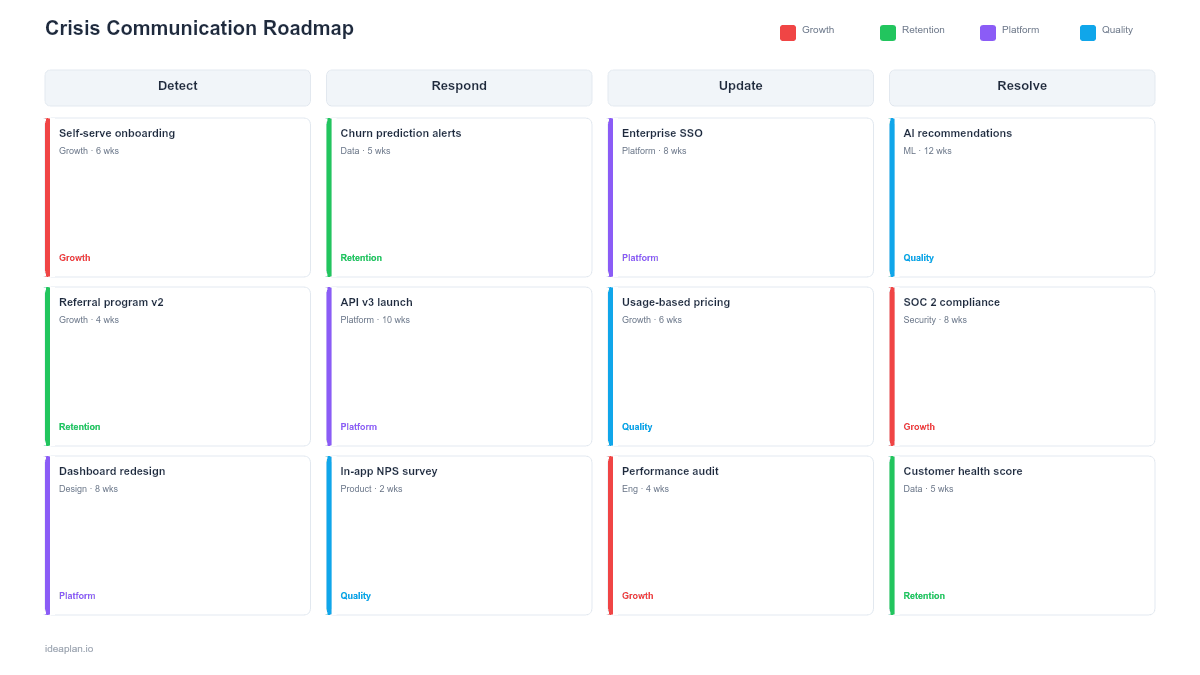
This free PowerPoint template gives your team a structured crisis communication plan. Response protocols, pre-written messaging templates, channel routing, and stakeholder tiering. All on slides you can share in the first minutes of an incident. Download the .pptx, customize the stakeholder tiers and channel matrix for your organization, and have a ready-to-execute communication playbook before the next crisis hits.
What This Template Includes
- Cover slide. Organization name, crisis communication plan version, and the designated crisis lead.
- Instructions slide. How to activate the plan, assign communication roles, and escalate across tiers. Remove before distributing externally.
- Stakeholder tier matrix slide. A four-tier grid (Tier 1: executive and board, Tier 2: affected customers, Tier 3: all customers and partners, Tier 4: public and media) with channel assignments, response windows, and message approval chains for each tier.
- Crisis timeline slide. A phased timeline (0-1 hour, 1-4 hours, 4-24 hours, 24-72 hours, post-crisis) showing what each team communicates, to whom, and through which channel at each phase.
- Filled example slide. A SaaS company handling a major outage: CEO emails Tier 1 within 30 minutes, status page updates every 15 minutes, customer success contacts top accounts directly, and a post-incident summary goes to all users within 48 hours.
Why Crisis Communication Needs a Roadmap
When something breaks, the communication failure usually causes more damage than the incident itself. Customers tolerate outages; they do not tolerate silence. Yet most teams default to improvisation during a crisis. Scrambling to decide who writes the status page update, whether the CEO should email customers, and what to tell the sales team while deals are in flight.
A pre-built communication roadmap removes decision-making from the moment when decision-making quality is lowest. Everyone knows their role, the messaging is pre-approved for common scenarios, and the channel routing is already decided. The stakeholder management guide covers the theory; this template is the operational artifact.
Template Structure
Stakeholder Tiers
Four tiers determine who hears what, when, and how:
- Tier 1 (Executive/Board). Notified within 30 minutes via direct message or phone call. Receives candid status including revenue impact and estimated resolution time.
- Tier 2 (Affected customers). Notified within 1 hour via email and in-app notification. Receives impact description, workaround if available, and next update time.
- Tier 3 (All customers/partners). Notified within 4 hours via status page and email. Receives a clear summary without speculation.
- Tier 4 (Public/media). Only if the crisis reaches public visibility. Uses pre-approved holding statements through official channels.
Channel Matrix
Each tier maps to specific channels. Tier 1 gets Slack DMs and phone calls. Tier 2 gets personalized emails from their CSM plus in-app banners. Tier 3 gets status page updates and broadcast emails. This prevents the common failure of sending a CEO-level briefing to the entire customer base, or leaving the board uninformed while the status page gets updated.
Response Phases
Five time-based phases structure the communication cadence. The first hour focuses on acknowledgment. Confirming the issue exists and that the team is working on it. Hours 1-4 shift to regular status updates. Hours 4-24 cover resolution or extended incident management. Post-crisis covers the retrospective and follow-up communication.
How to Use This Template
1. Map your stakeholder tiers
List every audience that needs communication during a crisis. Group them into the four tiers based on urgency and relationship. Your tier assignments will differ from the defaults. A B2B company with 50 enterprise accounts might put every customer in Tier 2, while a consumer app with millions of users keeps Tier 2 for the top 1%.
2. Assign channel owners
Each channel needs a named owner who is responsible for updates during a crisis. The status page owner is not the same as the CEO email drafter. Assign backups for every role so the plan works when someone is on vacation.
3. Pre-write message templates
Draft templates for the three most likely crisis types: outage, data incident, and security vulnerability. Templates should have blanks for specifics (duration, affected features, timeline) but the tone, structure, and approval chain should be locked. Waiting to draft messaging during the crisis costs critical minutes.
4. Run a tabletop drill
Before a real crisis, walk through the plan with a simulated scenario. Time how long it takes to send the first Tier 1 notification. Identify bottlenecks. Usually the approval chain is slower than expected. Adjust the plan based on what the drill reveals. The product experimentation guide discusses structured testing approaches that apply to crisis preparedness.
When to Use This Template
A crisis communication roadmap is essential when:
- Your product serves enterprise customers who have SLA expectations and escalation paths that activate during outages
- You have multiple stakeholder audiences (board, customers, partners, press) that require different messaging and timing
- Regulatory requirements mandate specific notification timelines for incidents involving data or availability
- Your team has grown beyond 20 people and ad-hoc communication during incidents no longer works
- A previous crisis exposed communication gaps that cost customer trust or created internal confusion
If your incidents are small and your customer base is technical enough to watch a status page, a simpler incident response roadmap may suffice. This template is for when the communication challenge is as large as the technical one.
Key Takeaways
- Pre-built stakeholder tiers and channel assignments remove decision-making from the moment when judgment is most impaired.
- The first communication goal is acknowledgment, not explanation. "We know, we are on it" beats silence every time.
- Pre-written message templates for your three most likely crisis types save critical minutes during the real event.
- Run a tabletop drill at least once before relying on the plan. Most plans fail on the approval chain bottleneck.
- Review the plan quarterly and after every incident to keep names, channels, and escalation paths current.
- Compatible with Google Slides, Keynote, and LibreOffice Impress. Upload the
.pptxto Google Drive to edit collaboratively in your browser.