Quick Answer (TL;DR)
This free PowerPoint template converts post-mortem findings into a structured improvement roadmap. Each action item gets a risk score, owner, effort estimate, and target date. Turning a retrospective document into an executable plan. Download the .pptx after your next incident review and build a roadmap that prevents the same class of failure from recurring.
What This Template Includes
- Cover slide. Incident name, severity, date, and the number of action items in this improvement cycle.
- Instructions slide. How to extract action items from post-mortems, score risk, and assign owners. Remove before presenting.
- Incident summary slide. Timeline of the incident, root cause chain, blast radius (users affected, revenue impact, downtime duration), and the post-mortem date.
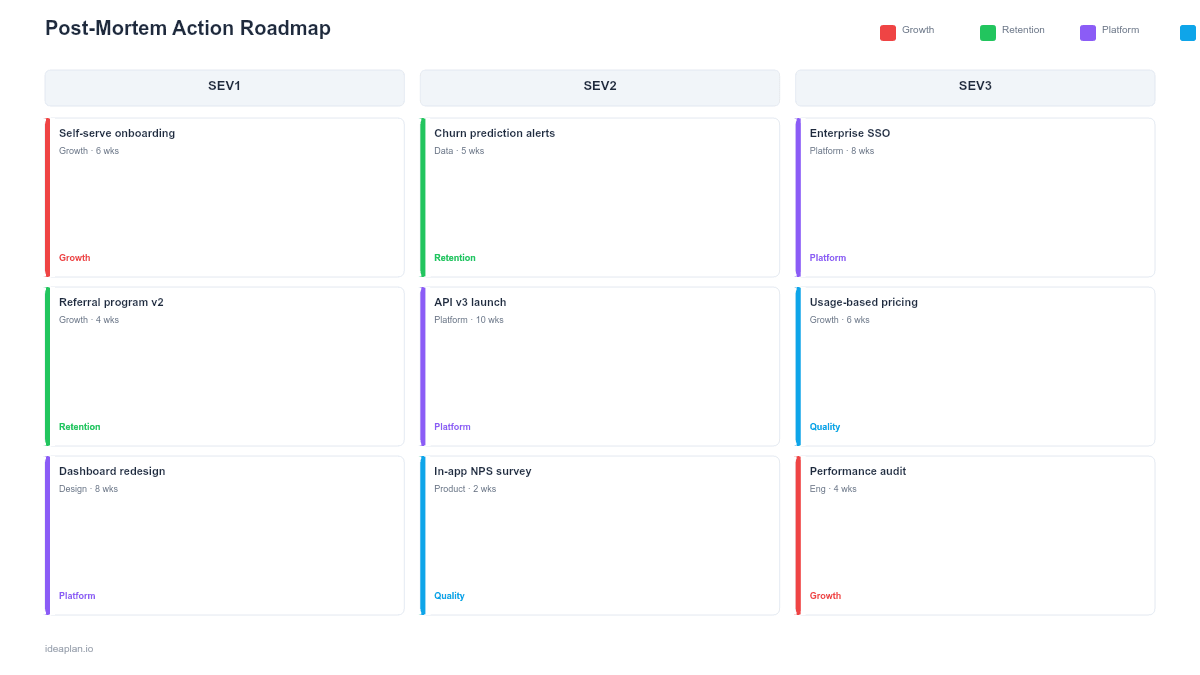
- Action roadmap slide. A prioritized table of action items grouped by category (Detection, Prevention, Response, Process) with risk scores, effort, owners, and target completion dates.
- Filled example slide. A SaaS product post-mortem roadmap with actions like "Add circuit breaker to payment service," "Create runbook for database failover," and "Instrument latency alerts at P95 threshold."
Why Post-Mortems Need a Roadmap
Most teams run solid post-mortems. They identify root causes, list action items, and file them in a doc that nobody opens again. The failure is not in the analysis. It is in the follow-through.
A post-mortem action roadmap solves the accountability gap by treating action items like product work: scoped, estimated, assigned, and tracked. When the same incident class recurs six months later, leadership asks whether the original actions were completed. Without a roadmap, the answer is usually "we started but did not finish."
The roadmap also helps you prioritize competing improvements. Not every action item has the same risk reduction value. Some prevent catastrophic failures. Others reduce mean time to recovery by minutes. The risk scoring in this template forces the team to make those trade-offs explicitly rather than defaulting to whatever is easiest.
Template Structure
Incident Summary
The summary slide captures the facts that frame the improvement roadmap:
- Timeline. Key timestamps from detection to resolution. How long each phase took reveals where the response broke down.
- Root cause chain. Not a single cause, but the sequence of failures. Example: "Deployment skipped staging, load balancer did not health-check the new pod, monitoring alert was muted from a previous false positive."
- Blast radius. Users affected, revenue lost, SLA breaches, and reputational impact. Quantifying the impact justifies the improvement investment.
Action Item Table
The main roadmap slide presents action items in a prioritized table with these columns:
- Action. A specific, scoped task. "Improve monitoring" is too vague. "Add P95 latency alert on checkout endpoint with 500ms threshold" is actionable.
- Category. Detection, Prevention, Response, or Process. This groups related actions and reveals blind spots (if all actions are Prevention and none are Detection, the team still cannot catch the next incident quickly).
- Risk score. Likelihood of recurrence multiplied by impact severity on a 1-5 scale. High scores get prioritized.
- Effort. T-shirt size (S/M/L) so the team can assess feasibility within the current sprint cycle.
- Owner. A named individual, not a team. Teams do not ship action items; people do.
- Target date. A specific deadline, not "next quarter." High-risk items should land within two weeks.
Progress Tracker
A bottom section shows completion status: how many actions are done, in progress, and not started. This slide gets updated at each stand-up or weekly check-in until all items are closed.
How to Use This Template
1. Extract action items from the post-mortem
Review the post-mortem document and pull every recommendation into the action table. Rewrite vague items as specific tasks. Each action should pass the test: "Could someone start working on this today without asking clarifying questions?"
2. Score risk for each action
Assign a likelihood score (1-5) and an impact score (1-5). Multiply them. A risk score of 20+ means the item should be treated as urgent. Scores below 8 can be batched into a future sprint. This mirrors how risk assessment works at the portfolio level.
3. Assign owners and set deadlines
Every action needs one owner and one date. Shared ownership produces zero accountability. For high-risk items, set deadlines within 1-2 weeks of the post-mortem. For lower-risk items, align with the next sprint boundary.
4. Track weekly until closure
Add the progress tracker to your weekly team sync. Walk through open items, flag blockers, and escalate anything past its deadline. Close the roadmap only when every action is either completed or explicitly deprioritized with documented reasoning.
When to Use This Template
- After any Sev-1 or Sev-2 incident to ensure post-mortem findings translate to shipped improvements
- Quarterly reliability reviews to consolidate action items from multiple incidents into a single improvement plan
- Engineering-product alignment when reliability work competes with feature delivery for sprint capacity
- Compliance audits where regulators need evidence that incident learnings produced corrective actions
- Blameless post-mortem culture building, where the focus shifts from "who" to "what will we fix"
If you need to plan ongoing technical debt reduction rather than incident-specific actions, see the technical debt roadmap template.
Key Takeaways
- Post-mortem action items need the same rigor as product features: scoped, estimated, assigned, and tracked.
- Risk scoring (likelihood times impact) forces teams to prioritize the most dangerous gaps first.
- Assign individual owners and specific deadlines. Shared ownership and vague timelines kill follow-through.
- Track progress weekly until every action is completed or explicitly deprioritized.
- PowerPoint format lets you present the improvement plan in leadership reviews and compliance audits without re-formatting.
- Compatible with Google Slides, Keynote, and LibreOffice Impress. Upload the
.pptxto Google Drive to edit collaboratively in your browser.