Quick Answer (TL;DR)
This free PowerPoint template maps your employee experience strategy across five lifecycle stages: attract, onboard, develop, engage, and retain. Each slide connects people initiatives to measurable outcomes like time-to-productivity, engagement scores, and voluntary attrition rates. Download the .pptx, assess where your employee journey has the biggest gaps, and present a structured plan that ties people investment to business results.
What This Template Includes
- Cover slide. Current headcount, target headcount, planning horizon, and the top three EX priorities for the period.
- Instructions slide. How to assess lifecycle gaps, sequence initiatives, and define success metrics for each stage. Remove before presenting.
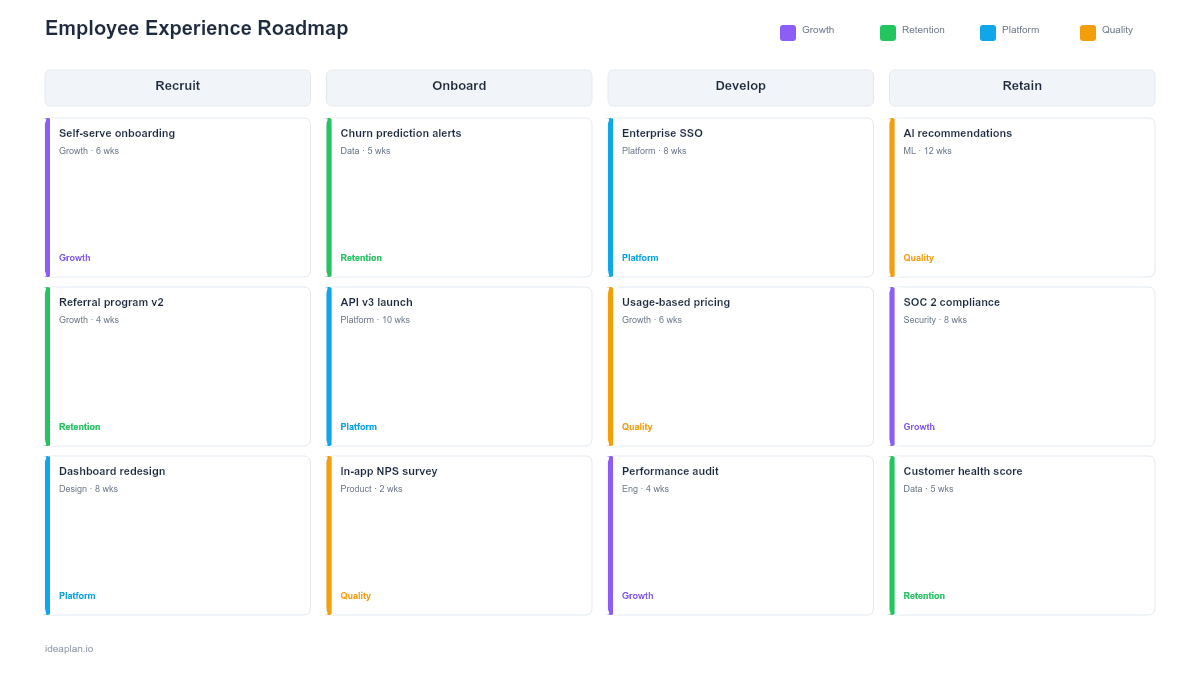
- Blank template slide. Five-stage employee lifecycle layout (Attract, Onboard, Develop, Engage, Retain) across quarterly columns with initiative cards and metric targets per stage.
- Filled example slide. A 200-person product org improving employee experience over four quarters. Shows a revamped interview process in Q1, structured onboarding program in Q2, career ladder rollout in Q3, and engagement pulse survey program in Q4. Each quarter includes baseline and target metrics.
Why Employee Experience Needs a Roadmap
Most organizations treat employee experience as a collection of disconnected HR programs. There is a benefits review here, an engagement survey there, and an onboarding checklist somewhere in a shared drive. None of it connects into a coherent strategy, and none of it ties back to the business outcomes that leadership cares about.
An employee experience roadmap changes this by mapping the full lifecycle. From a candidate's first interaction to a tenured employee's growth trajectory. It makes visible which stages are strong and which are leaking talent. If your 90-day attrition rate is high, the onboarding stage needs immediate attention. If senior engineers are leaving after 18 months, the development stage is broken.
The roadmap also forces sequencing decisions. Investing in career development is wasted if onboarding is so poor that new hires leave before they reach the development stage. Fix the upstream problems first, then build on a solid foundation. For related planning on team growth, see the guide to building a product team.
Template Structure
Five Lifecycle Stages
The roadmap organizes initiatives across the full employee journey:
- Attract. Employer branding, job descriptions, interview process, candidate experience. Everything from first contact to signed offer. Track metrics like offer acceptance rate and time-to-fill.
- Onboard. First 90 days from signed offer to full productivity. Structured programs, buddy systems, milestone check-ins. Track time-to-productivity and 90-day retention rate.
- Develop. Career growth, skill building, and internal mobility. Career ladders, learning budgets, mentorship programs, promotion criteria. Track internal mobility rate and promotion velocity.
- Engage. Day-to-day experience, culture, recognition, and feedback loops. Pulse surveys, team rituals, recognition programs, manager effectiveness. Track engagement rate and eNPS.
- Retain. Compensation reviews, stay interviews, burnout prevention, exit analysis. Track voluntary attrition rate, regrettable attrition rate, and tenure distribution.
Quarterly Initiative Cards
Each initiative card includes a description, the lifecycle stage it targets, an owner (HR lead, hiring manager, or department head), target date, and the metric it aims to move. Initiatives are color-coded by lifecycle stage for quick scanning.
Metric Baseline Row
A bottom row tracks key metrics per stage with current baseline and quarterly targets. This row turns a list of HR programs into a measurable strategy. Without it, you are tracking activity instead of outcomes.
How to Use This Template
1. Map the current state of each lifecycle stage
Survey employees at different tenure milestones: 30 days, 90 days, 6 months, 1 year, 2+ years. Ask what is working and what is not at their stage. Combine survey data with hard metrics (attrition rates by tenure, time-to-fill, promotion rates) to score each lifecycle stage. The lowest-scoring stages are your priority.
2. Identify the highest-impact gaps
Not every gap is worth fixing in the first quarter. Prioritize by business impact. High 90-day attrition is urgent because you are spending to hire people who leave before contributing. Low engagement among tenured employees is important but slower-moving. Use a simple prioritization framework to rank gaps.
3. Design 2-3 initiatives per quarter
Avoid loading the roadmap with 15 simultaneous programs. Pick 2-3 initiatives per quarter that target the highest-priority lifecycle stages. Each initiative should have a clear owner, a defined metric, and a realistic timeline. Spreading effort across too many programs means none of them get done well.
4. Assign metrics and owners
Every initiative needs one owner and one primary metric. The onboarding revamp is owned by the Head of People with time-to-productivity as the metric. The career ladder rollout is owned by the VP of Engineering with internal promotion rate as the metric. Shared ownership means no ownership.
5. Review quarterly with lifecycle scorecards
Each quarter, update the metric baseline row. Are the numbers moving? If you launched a structured onboarding program in Q1 and 90-day attrition has not improved by Q3, the program is not working. Adjust or replace it. The roadmap is a living document, not a plan you set and forget.
When to Use This Template
Employee experience roadmaps fit when:
- Attrition is higher than industry benchmarks and you need a structured plan to diagnose which lifecycle stages are losing people
- The organization is scaling rapidly and ad-hoc people programs cannot keep pace with headcount growth
- Engagement survey scores are declining and leadership wants a concrete action plan tied to quarterly milestones
- HR and engineering leadership need alignment on people investments and their expected return
- You are building a people team or function from scratch and need to sequence foundational programs
If your focus is specifically on hiring volume and team structure rather than the full employee lifecycle, the team scaling roadmap template is the better fit.
Key Takeaways
- Employee experience roadmaps cover five lifecycle stages: attract, onboard, develop, engage, and retain.
- Prioritize lifecycle stages by business impact. Fix upstream leaks (onboarding attrition) before investing in downstream programs (career development).
- Limit initiatives to 2-3 per quarter with clear owners and metrics to avoid spreading effort too thin.
- Track metrics at each lifecycle stage quarterly to determine whether programs are working or need adjustment.
- PowerPoint format supports cross-functional alignment between HR, engineering, and executive leadership on people investment priorities.
- Compatible with Google Slides, Keynote, and LibreOffice Impress. Upload the
.pptxto Google Drive to edit collaboratively in your browser.