Quick Answer (TL;DR)
This free PowerPoint competitive response roadmap template helps you plan how your product responds to competitor moves, closes feature parity gaps, and strengthens differentiation. It categorizes competitive threats by urgency, maps your response options (match, differentiate, ignore), and schedules product changes across quarters. Download the .pptx, populate it with your competitive intelligence, and present a structured response plan instead of reacting to every competitor announcement ad hoc.
What This Template Includes
- Cover slide. Product name, number of tracked competitors, and your primary differentiation statement.
- Instructions slide. How to categorize threats, choose response strategies, and avoid reactive feature chasing. Remove before presenting.
- Competitive Threat Matrix slide. Table listing competitor moves, their impact on your win rate, and your planned response (match, differentiate, or ignore).
- Parity vs. Differentiation slide. Two-column view separating features you need to match (table stakes) from features where you can outperform (differentiators).
- Quarterly Response Plan slide. Timeline showing specific product investments organized by response type, with projected impact on win rate.
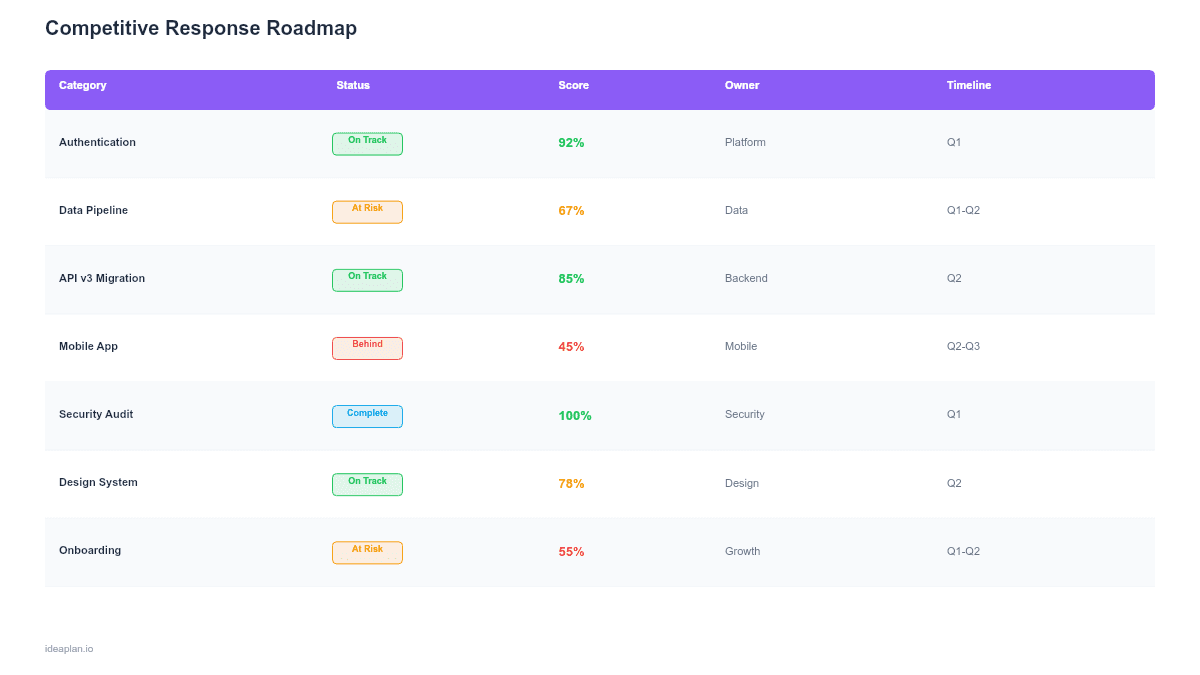
- Filled example slide. A working competitive response roadmap with 8 threat responses across three competitors, each with an explicit strategy and timeline.
Why Competitive Response Needs Structure
Every product team faces the same pressure: a competitor launches a feature, sales loses a deal, and someone says "we need to build that." Without a structured response framework, this pressure turns into reactive feature chasing that fragments the roadmap and dilutes your differentiation.
A competitive response roadmap provides that structure in three ways. First, it separates threats that matter from noise. Not every competitor move threatens your position. If a competitor adds a feature your target segment does not care about, the right response is to ignore it. The threat matrix forces this assessment before any engineering time is allocated.
Second, it distinguishes between parity and differentiation investments. Some competitive gaps are table stakes. If every competitor offers SSO and you do not, that is a parity problem you need to close. Other gaps are differentiation opportunities where you can build something better, not just equivalent. The roadmap makes this distinction explicit so the team does not treat every competitive gap the same way.
Third, it prevents the "always catching up" cycle. Teams that only react to competitors never lead. The roadmap allocates time for proactive differentiation alongside reactive parity fixes, ensuring the product maintains a distinct identity. For a deeper framework on competitive positioning, see the competitive analysis guide.
Template Structure
Competitive Threat Matrix
The threat matrix evaluates each competitor move across four dimensions:
- Competitor. Which competitor made the move and their market position (leader, challenger, niche).
- Their Move. What they launched, announced, or changed (feature, pricing, positioning).
- Impact on Your Win Rate. High (directly affects deal outcomes), Medium (mentioned in evaluations but not decisive), Low (irrelevant to your buyers).
- Response Strategy. Match (build equivalent), Differentiate (build something better that solves the same problem differently), Ignore (no action), or Counter (invest in a strength they cannot replicate).
Parity vs. Differentiation View
Two columns that separate competitive investments:
- Parity features. Capabilities your product must have to remain competitive. These are not differentiators; they are entry requirements. Examples: integrations your buyers expect, security certifications your market requires, performance benchmarks you must meet.
- Differentiation features. Capabilities where your approach is fundamentally different and better for your target segment. These are worth more investment because they widen your competitive gap rather than just closing it.
The split matters for resource allocation. Parity features should be built efficiently. Good enough is sufficient. Differentiation features deserve deeper investment because they drive product-market fit and pricing power.
Quarterly Response Plan
Each quarter includes:
- Parity investments. Features built to close competitive gaps that affect win rates. Target: minimum viable implementations.
- Differentiation investments. Features that strengthen your unique position. Target: best-in-class implementations.
- Positioning changes. Messaging, website, and sales collateral updates that reframe competitive conversations.
- Win rate targets. Expected improvement in competitive win rates from the quarter's investments.
How to Use This Template
1. Audit your competitive position
Start with data, not opinions. Pull win/loss reports from sales, analyze competitor feature comparisons from G2 or Gartner, and review recent deals where you lost on feature gaps. Identify the 3-5 competitors that actually show up in your deals. Ignore the rest. The competitive analysis template can help structure this research.
2. Categorize each threat by impact
For every competitor move on your list, answer one question: does this change deal outcomes? If sales confirms that prospects are choosing the competitor because of this specific capability, the impact is high. If it is mentioned but not decisive, it is medium. If nobody cares, it is low. Be ruthless. Most competitor moves are low-impact noise.
3. Choose your response strategy
For high-impact threats, decide whether to match or differentiate. Matching means building an equivalent capability. Differentiating means solving the same customer problem in a better or different way. Both are valid, but differentiation creates more durable advantage. For medium-impact threats, consider whether a positioning change (reframing the conversation) is sufficient without a product investment.
4. Allocate capacity deliberately
Set a ratio for competitive response versus proactive roadmap work. A healthy split is 20-30% competitive response, 70-80% proactive differentiation and customer-driven development. If competitive response exceeds 40% of your roadmap, you are in reactive mode and need to step back to assess your product strategy.
5. Track win rates, not just feature releases
The success metric for a competitive response roadmap is win rate improvement, not features shipped. If you build 5 parity features and win rates do not change, the features were not the problem. Positioning, pricing, or sales execution might be. Review win rate trends quarterly alongside the roadmap.
When to Use This Template
A competitive response roadmap PowerPoint template is the right choice when:
- Win rates have dropped and loss analysis points to specific competitor capabilities as the cause.
- A new competitor has entered your market and you need a structured plan rather than a panicked reaction.
- An existing competitor has launched a major feature that your sales team is struggling to sell against.
- Leadership is pressuring the team to "match competitor X" and you need a framework to evaluate which moves are worth responding to.
- Your product strategy review needs a competitive component alongside the proactive roadmap.
If your focus is on understanding the competitive field rather than planning responses, the Competitive Landscape Roadmap PowerPoint template focuses on analysis and monitoring. For overall product strategy, see the Product Strategy Roadmap PowerPoint template.
Featured in
This template is featured in Go-to-Market and Product Launch Roadmap Templates, a curated collection of roadmap templates for this use case.
Key Takeaways
- Not every competitor move deserves a product response. The threat matrix forces impact assessment before engineering investment.
- Parity features should be built efficiently (good enough). Differentiation features deserve deeper investment (best-in-class).
- Cap competitive response at 25-30% of capacity to prevent the roadmap from becoming purely reactive.
- Win rate improvement is the success metric, not features shipped in response to competitors.
- PowerPoint format makes the competitive response plan presentable to leadership and sales teams who need to understand the strategy.
- Compatible with Google Slides, Keynote, and LibreOffice Impress. Upload the
.pptxto Google Drive to edit collaboratively in your browser.