Quick Answer (TL;DR)
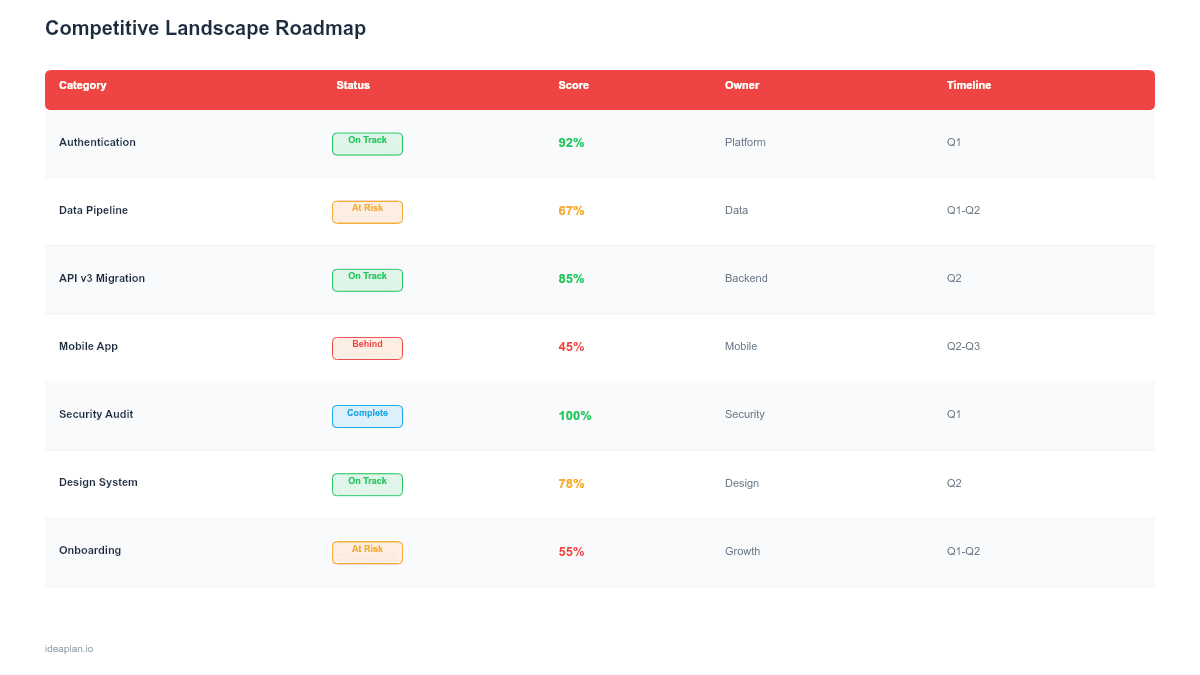
This free PowerPoint template helps you map your product's position against competitors, identify feature parity gaps, and plan differentiation moves across quarters. It includes a positioning matrix, a feature comparison grid, and a strategic response timeline. Download the .pptx, fill in your competitive data, and use it to show leadership where you lead, where you trail, and what you plan to do about it.
What This Template Includes
- Competitive positioning matrix slide. A 2x2 grid plotting your product and key competitors on two strategic dimensions (e.g., ease of use vs. depth of features). Visualizes where you sit in the market relative to alternatives.
- Feature parity grid slide. A table comparing your product and top competitors across critical capabilities. Each cell is marked as "Leading," "Parity," or "Gap" with color coding.
- Strategic response timeline slide. A quarterly timeline showing which competitive gaps you plan to close, which leads you plan to extend, and which gaps you will deliberately ignore.
- Differentiation thesis slide. A single slide summarizing your core differentiation and the 2-3 bets that sustain it over the next 12 months.
Why PowerPoint for Competitive Planning
Competitive analysis involves cross-functional input from product, marketing, sales, and leadership. PowerPoint works because the visual formats. Positioning matrices, comparison grids, and timelines. Communicate competitive dynamics at a glance. Sales teams use the feature parity grid in deal reviews. Product teams reference the strategic timeline during planning. Executives scan the positioning matrix in board prep. One file serves all three audiences.
Template Structure
The template follows a "where we stand, where the gaps are, what we will do" narrative.
Slide 1. Positioning Matrix. A 2x2 grid where you choose the two axes that matter most for your market. Common pairs: ease of use vs. feature depth, self-serve vs. enterprise, horizontal vs. vertical. Plot your product and 3-5 competitors. This visual anchors the strategic conversation. For a full walkthrough on building competitive analyses, see the competitive analysis guide.
Slide 2. Feature Parity Grid. A comparison table listing 10-15 critical capabilities down the left column and competitors across the top. Each cell is rated. The grid shows exactly where you lead and where you trail. For a structured scoring approach, use the competitive analysis framework.
Slide 3. Strategic Response Timeline. A quarterly plan showing your response to each gap. Not every gap deserves a response. Some are deliberate trade-offs. The timeline separates "close this gap" initiatives from "extend this lead" bets and "intentionally ignore" decisions.
Slide 4. Differentiation Thesis. One slide that states your core differentiation in plain language and the product bets that protect it. This slide prevents the team from spending all its energy on parity and neglecting the features that make your product distinct.
How to Use This Template
1. Select competitors and dimensions
Choose 3-5 direct competitors. Pick two positioning dimensions that reflect how buyers actually evaluate products in your market. If you are unsure, interview 5 recent buyers and ask what criteria they used. Avoid generic axes like "quality". Use specific attributes like "time-to-value" or "admin control granularity."
2. Build the feature parity grid
List the 10-15 capabilities that influence purchase decisions. Rate each competitor honestly. If your sales team reports losing deals on a specific feature gap, that gap deserves a "Gap" rating regardless of whether the product team considers it a minor missing feature. Use win/loss data if available.
3. Classify your response
For each gap: decide whether to close it, ignore it, or reframe it. Closing means building the feature. Ignoring means the gap is a deliberate trade-off aligned with your positioning. Reframing means addressing the underlying user need differently. Assign each response to a quarter on the timeline.
4. Draft the differentiation thesis and present
Write one sentence: "We win because [specific advantage], and we sustain this by [2-3 product bets]." Present the full deck to product and leadership. The positioning matrix starts the conversation. The timeline ends it with commitments.
When to Use This Template
Competitive roadmaps are most useful when your market has clear, established competitors and purchase decisions involve direct feature comparisons. Use this template when:
- Sales is losing deals on feature parity gaps and the product team needs to prioritize which gaps to close
- A new competitor has entered your market and leadership wants to understand the competitive impact and response plan
- Annual or quarterly planning requires a strategic layer that connects product bets to competitive positioning
- The team is over-indexing on competitor features and you need to refocus on differentiation rather than imitation
If your competitive dynamics are less about features and more about strategic positioning, a product strategy roadmap may be a better fit.
Key Takeaways
- Plot your product and competitors on a positioning matrix with dimensions that reflect how buyers actually evaluate options.
- Use a feature parity grid to make gaps and leads visible, then classify each gap as "close," "ignore," or "reframe."
- Not every competitive gap deserves a response. Deliberate trade-offs are a sign of strategy; reacting to every competitor move is not.
- State your differentiation thesis in one sentence and protect it by allocating roadmap capacity to differentiation, not just parity.
- Update quarterly and use win/loss data from sales to keep the parity grid grounded in reality.
- Compatible with Google Slides, Keynote, and LibreOffice Impress. Upload the
.pptxto Google Drive to edit collaboratively in your browser.