Quick Answer (TL;DR)
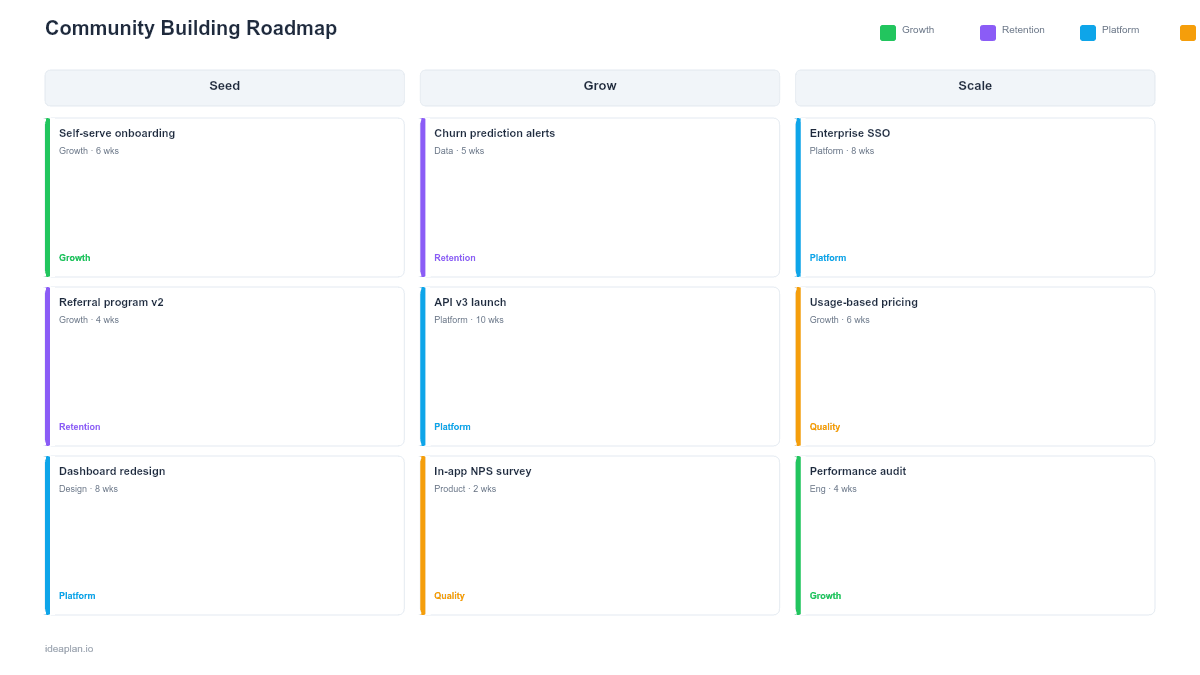
This free PowerPoint template maps your community growth plan across acquisition, activation, engagement, and advocacy stages. Each stage includes specific programs, success metrics, and timelines. Download the .pptx, plug in your community segments, and present a plan that connects community investment to product growth.
What This Template Includes
- Cover slide. Community name, planning period, and the primary growth metric (e.g., monthly active community members).
- Instructions slide. Guidance on defining community segments, setting engagement tiers, and mapping programs to growth stages. Remove before presenting.
- Blank template slide. Four-stage funnel (Acquisition, Activation, Engagement, Advocacy) with program cards, metric targets, and owner assignments.
- Filled example slide. A developer community roadmap showing programs like onboarding workshops, content contributor tracks, champion programs, and ambassador tiers. Each program includes target metrics and quarterly milestones.
Why Community Roadmaps Matter
Most community efforts fail because they lack structure. A team launches a Slack group, posts occasionally, and wonders why engagement flatlines after month two. The problem is not effort. It is the absence of a funnel.
Communities grow through stages, just like products. A new member needs to find the community, experience value quickly, form a habit around participation, and eventually become a contributor or advocate. Each stage requires different programs, different content, and different success metrics.
A community roadmap makes these stages visible. It shows leadership where investment is going, what return to expect, and how community health connects to product metrics like retention and referral rate. Without this visibility, community teams get cut first during budget reviews because their impact looks invisible.
For a broader view on how community connects to product strategy, see the product strategy guide.
Template Structure
The Four-Stage Funnel
The roadmap organizes community programs into four sequential stages:
- Acquisition. How new members discover and join. Programs here include SEO content, social campaigns, event sponsorships, and integration with product onboarding.
- Activation. The moment a new member experiences value. This could be their first answered question, first workshop attended, or first resource downloaded.
- Engagement. Repeated participation that forms a habit. Programs include recurring events, content creation tracks, mentorship matching, and feedback loops into product development.
- Advocacy. Members who actively recruit others or represent the community externally. Champion programs, speaking opportunities, and co-marketing partnerships live here.
Program Cards
Each program card within a stage shows:
- Program name. Short label (e.g., "Weekly Office Hours," "Contributor Certification").
- Target metric. The specific number the program aims to move (e.g., "50 new members/month from content," "30% of new members attend first event within 14 days").
- Owner. Who runs it. Community programs without clear ownership die quickly.
- Status. Planned, Active, or Scaling.
Health Dashboard
A bottom row summarizes overall community health: total members, monthly active members, engagement rate (MAM/total), and NPS from the most recent community survey.
How to Use This Template
1. Define your community segments
Not all community members are the same. Separate users, developers, partners, and internal advocates. Each segment may need different acquisition channels and engagement programs. Start with your highest-value segment.
2. Map your current state
Before planning new programs, audit what exists. How are members currently finding you? What does first-week engagement look like? Where do members drop off? If you do not have data, your first quarter should focus on instrumenting activation metrics.
3. Fill in programs per stage
For each funnel stage, list 2-3 programs you will run this planning period. Be specific about what success looks like. "Grow the community" is not a program. "Launch a monthly technical webinar series targeting 100 attendees per session by Q2" is.
4. Set quarterly milestones
Each program should have measurable checkpoints. In Q1, you might target 500 new members. In Q2, a 40% activation rate. In Q3, 20 community-contributed resources. The OKR framework works well for structuring these milestones.
5. Review monthly and rebalance
Community programs have long feedback loops. Check metrics monthly, but give programs at least 6-8 weeks before deciding whether they work. Shift resources from underperforming stages to bottlenecks in the funnel.
When to Use This Template
Community building roadmaps fit when:
- You are starting a new community and need a structured launch plan with milestones
- An existing community has stalled and needs a growth reboot with clear stages
- Leadership wants justification for community investment tied to product metrics
- Developer relations or community teams need to align with product and marketing on shared goals
- You are presenting to executives who need to see community as a growth channel, not a cost center
If your community is mature and the focus is on specific feature co-creation, consider the innovation pipeline roadmap instead.
Key Takeaways
- Community growth follows a funnel: acquisition, activation, engagement, advocacy.
- Each stage needs distinct programs with specific metrics and owners.
- Connect community health metrics to product outcomes to justify ongoing investment.
- Give programs 6-8 weeks before evaluating effectiveness. Community feedback loops are slower than product ones.
- PowerPoint format makes it easy to present community plans in leadership reviews alongside product roadmaps.
- Compatible with Google Slides, Keynote, and LibreOffice Impress. Upload the
.pptxto Google Drive to edit collaboratively in your browser.