Quick Answer (TL;DR)
Capacity planning tells you what the team can do this quarter. Capacity forecasting tells you what the team will be able to do next quarter, and the quarter after that. This free PowerPoint template projects team capacity across 4-6 quarters, factoring in hiring pipeline, attrition risk, skill gap closure, and utilization targets. Download the .pptx, input your current headcount and hiring plan, and use the forecast to align product ambitions with realistic team growth.
What This Template Includes
- Cover slide. Title slide with department or product area, forecast owner, and forecast horizon.
- Instructions slide. How to calculate projected capacity, model hiring ramp-up time, and adjust for attrition assumptions. Remove before presenting to leadership.
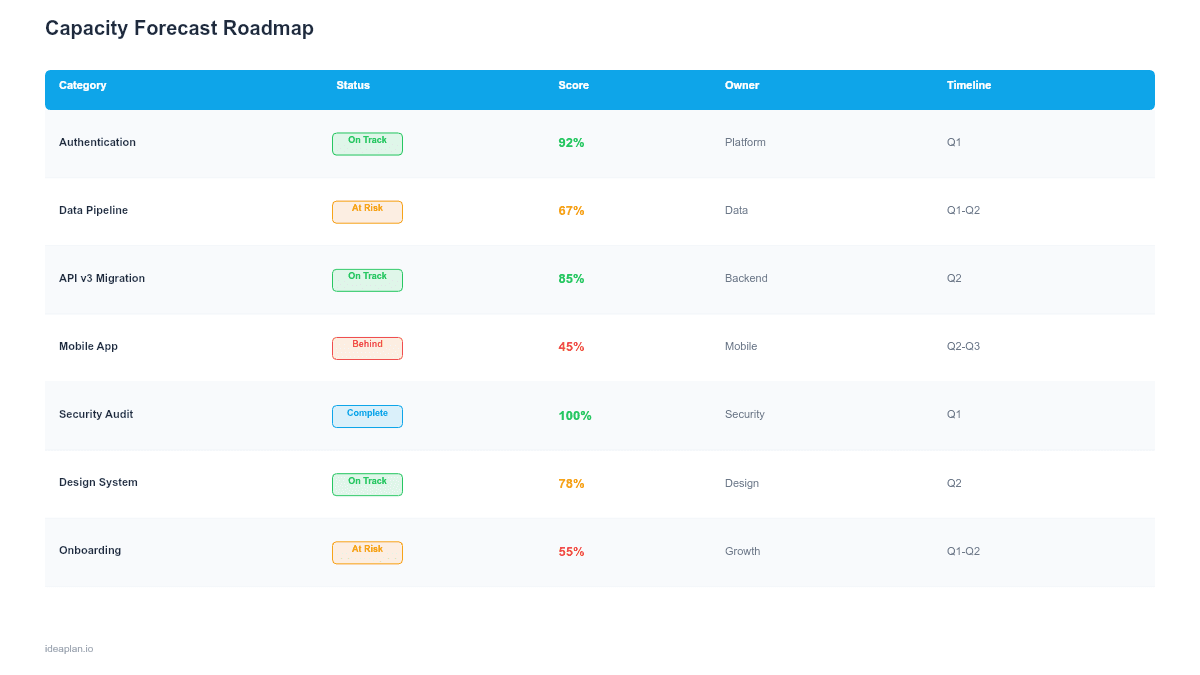
- Blank forecast timeline slide. A multi-quarter view showing current headcount, projected hires (with ramp-up adjustment), projected attrition, net effective capacity per quarter, and skill composition breakdown. Utilization targets are shown as horizontal reference lines.
- Filled example slide. A six-quarter capacity forecast for a product engineering team growing from 12 to 22 engineers, showing staggered hiring, a 3-month ramp-up factor for new hires, 10% annualized attrition, and a skill gap in backend engineering closing by Q3.
Why Capacity Forecasting Matters
Product roadmaps plan what to build. Capacity forecasts determine whether the team can actually build it. The gap between these two artifacts is where most planning failures live. A roadmap with 20 initiatives and a team that will grow from 10 to 15 engineers over the year creates a false promise if the roadmap does not account for hiring timelines, onboarding ramp-up, and the inevitable attrition.
The forecast makes three hidden costs visible. First, new hires are not productive on day one. A senior engineer typically takes 2-3 months to reach full productivity, and the existing team loses capacity during onboarding. Second, attrition is not zero. Even healthy teams lose 10-15% of engineers annually, and each departure creates a productivity dip that lasts until the backfill ramps up. Third, skill gaps constrain delivery regardless of headcount. Having 15 engineers does not help if the roadmap needs 3 backend specialists and the team only has 1.
A capacity planning roadmap handles the current quarter's allocation. This template extends that thinking across multiple quarters, turning tactical allocation into strategic workforce planning.
Template Structure
Headcount Projection
The top section of the forecast shows raw headcount by quarter: starting headcount, planned hires, projected departures, and ending headcount. Planned hires come from approved requisitions and pipeline data from recruiting. Projected departures use the team's historical attrition rate. If the rate is unknown, 12-15% annualized is a reasonable starting assumption for engineering teams.
Effective Capacity Curve
Raw headcount overstates capacity because it treats new hires as immediately productive. The effective capacity curve adjusts for onboarding ramp-up: a new hire contributes roughly 25% capacity in month one, 50% in month two, and 75% in month three before reaching full productivity. This curve shows the real delivery capacity the team can commit against, not the optimistic headcount number.
Skill Composition View
A stacked bar chart breaks capacity by skill area: frontend, backend, infrastructure, mobile, data, QA. This view surfaces skill bottlenecks that headcount alone misses. If the roadmap requires heavy backend work in Q3 but the team's backend capacity does not increase until Q4 (when the hired backend engineer finishes ramping), the skill view flags the mismatch before the quarter starts.
How to Use This Template
1. Establish the baseline
Input current headcount by skill area. Pull the last 12 months of attrition data to calculate your actual rate. If data is limited, use industry benchmarks: 12-15% annual attrition for stable engineering teams, higher for hypergrowth companies or tight labor markets. Count only engineers who contribute to product delivery. Managers, coordinators, and part-time contributors need separate accounting.
2. Layer in the hiring plan
Add approved requisitions with expected start dates. Work with recruiting to estimate close probability for each requisition. Not every open role fills on schedule. A conservative forecast assumes 70-80% of requisitions fill within the target quarter. For each hire, apply the ramp-up curve: 25% / 50% / 75% over the first three months.
3. Model skill gap closure
Compare the skill composition of the current team against the product roadmap requirements. If Q2 requires significant data engineering work but the team's first data engineer starts in Q1, the forecast should show data engineering capacity ramping from zero to partial in Q1 and reaching full in Q2. This timing matters for sequencing roadmap initiatives.
4. Set utilization targets
Not all capacity goes to roadmap work. Budget for operational overhead: on-call rotations (5-10%), meetings and planning (10-15%), and unplanned work (10-15%). The remaining capacity. Typically 60-75% of gross capacity. Is the allocatable budget for roadmap initiatives. Plot this as a reference line on the forecast so the gap between demand and supply is visible at a glance.
5. Reconcile with the roadmap quarterly
Every quarter, compare actual capacity against the forecast. Adjust for hiring delays, unexpected departures, and changes in attrition rate. If the forecast consistently overestimates capacity, the ramp-up curve or attrition assumptions need recalibration. Use the updated forecast to re-validate next quarter's roadmap commitments. Track sprint velocity trends as a reality check against the forecast model.
When to Use This Template
Capacity forecasting is most valuable when:
- The team is growing and hiring timelines directly affect when roadmap initiatives can start
- Annual planning requires headcount requests justified by capacity-to-demand gap analysis
- Skill gaps are constraining delivery more than raw headcount, and the team needs to plan targeted hires
- Attrition is higher than expected and the forecast needs to model the compounding impact of backfill cycles
- Leadership wants confidence that the product roadmap is staffed realistically, not aspirationally
For teams with stable headcount and no near-term hiring, a capacity planning roadmap covers the current quarter's allocation without the multi-quarter projection. Capacity forecasting adds value when headcount is changing. Growing, shrinking, or restructuring. And those changes affect what the team can deliver.
Key Takeaways
- Capacity forecasts project delivery capability across quarters, accounting for hiring ramp-up, attrition, and skill gaps that raw headcount ignores.
- New hires reach full productivity in roughly three months. The effective capacity curve prevents overcommitting during onboarding periods.
- Skill composition matters as much as headcount. Fifteen engineers cannot deliver backend-heavy work if only one is a backend specialist.
- Budget 25-40% of gross capacity for operational overhead (on-call, meetings, unplanned work) to set realistic utilization targets.
- Reconcile forecast versus actual every quarter and adjust assumptions based on real hiring and attrition data.
- Compatible with Google Slides, Keynote, and LibreOffice Impress. Upload the
.pptxto Google Drive to edit collaboratively in your browser.