Quick Answer (TL;DR)
This free PowerPoint template structures vendor evaluation from requirements gathering through final selection. Each slide maps evaluation phases. Discovery, shortlisting, proof-of-concept, negotiation, and decision. Onto a timeline with weighted scoring criteria and clear decision gates. Download the .pptx, define your evaluation criteria, and use it to run a structured procurement process that produces a defensible vendor recommendation.
What This Template Includes
- Cover slide. Title slide with project name, evaluation owner, and target decision date.
- Instructions slide. How to define scoring criteria, weight categories, and run the evaluation phases. Remove before sharing externally.
- Blank evaluation timeline slide. A phased timeline with five stages, each showing key activities, evaluation criteria, and a decision gate with pass/fail conditions.
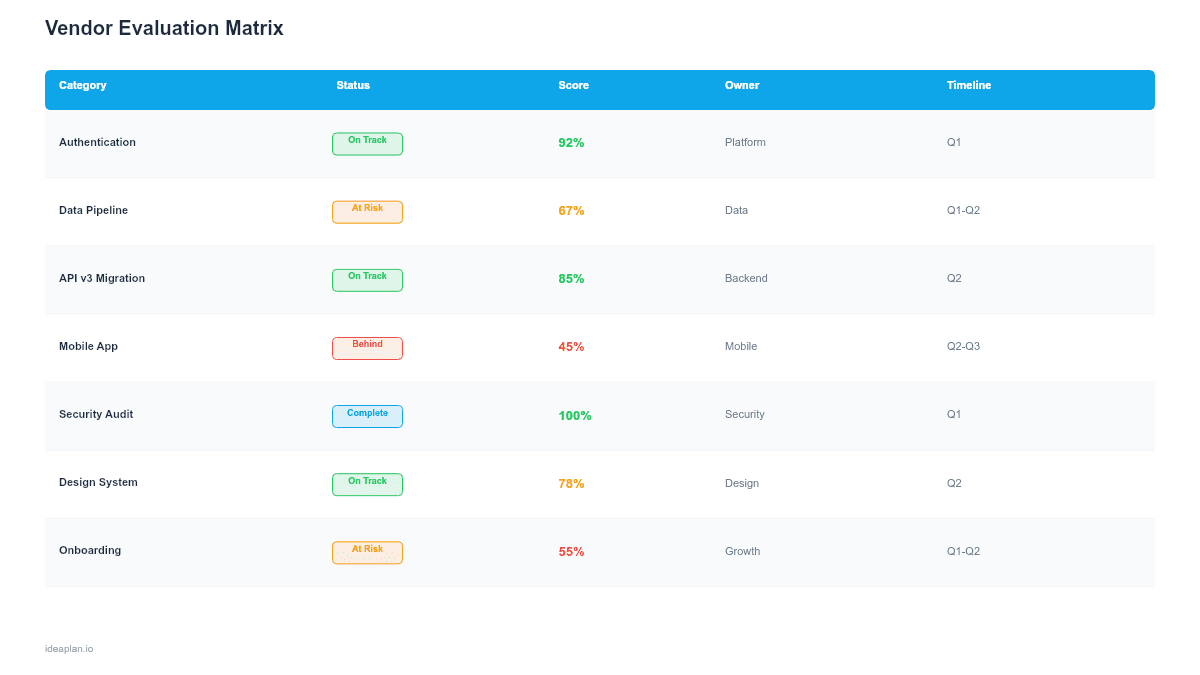
- Filled example slide. A complete vendor evaluation for selecting a product analytics platform, showing four vendors scored across eight criteria with weighted totals and a final recommendation.
Why Vendor Evaluation Needs a Roadmap
Most vendor evaluations fail not because teams pick the wrong tool, but because the process collapses. Requirements shift mid-evaluation, stakeholders inject new vendors at the last minute, and the team ends up comparing three products on different criteria. Six months later, nothing has been decided.
A structured evaluation roadmap prevents this by locking in the criteria, timeline, and decision gates upfront. Every stakeholder agrees on what matters before the first demo. Each phase has a clear exit condition. If a vendor does not meet the shortlist criteria, they do not advance to the POC phase. This discipline cuts evaluation cycles from months to weeks.
The roadmap also creates an audit trail. When someone asks "Why did we pick Vendor B over Vendor A?" six months after go-live, the scoring slide answers the question. This matters for stakeholder management and for teams in regulated industries where procurement decisions require documentation.
Template Structure
Evaluation Criteria Matrix
The scoring framework sits on a dedicated slide. Define 6-10 criteria across four categories: functionality (does it solve the problem?), integration (does it fit the stack?), commercial (pricing, contract terms, support SLAs), and risk (vendor stability, data residency, security posture). Each criterion gets a weight from 1-5 based on stakeholder input. Teams that skip weighting end up treating minor nice-to-haves as equal to critical requirements.
Phase Timeline
Five phases map onto a 6-12 week timeline:
- Discovery (Week 1-2). Define requirements, identify candidates, issue RFI/RFP
- Shortlist (Week 3-4). Score initial responses, conduct demos, narrow to 2-3 finalists
- Proof of Concept (Week 5-8). Run structured POCs with real data and defined success criteria
- Negotiation (Week 9-10). Commercial terms, security review, legal review
- Decision (Week 11-12). Final scoring, stakeholder sign-off, contract execution
Decision Gates
Each phase ends with a gate. The shortlist gate requires a minimum weighted score of 70%. The POC gate requires all critical success criteria to pass. The negotiation gate requires acceptable commercial terms and a completed security review. Gates prevent the evaluation from advancing on enthusiasm alone. If the data does not support it, the vendor does not move forward.
How to Use This Template
1. Define requirements and weights
Gather requirements from every team that will use the tool: product, engineering, design, support, and finance. Use the criteria matrix slide to assign weights. Run a calibration session where stakeholders rank the criteria independently, then compare and negotiate. This prevents the loudest voice from dominating the weighting.
2. Build the long list and shortlist
Research candidates through analyst reports, peer recommendations, and existing vendor relationships. Score each vendor against the criteria using publicly available information and initial demos. Apply the shortlist gate: vendors below the threshold are eliminated.
3. Run structured POCs
Design POC scenarios that test the criteria that matter most. If integration complexity is the top concern, the POC should test your actual integration patterns, not a demo environment. Set a fixed POC duration. Two weeks is typical. And define success criteria before starting.
4. Score and recommend
Complete the scoring matrix with POC results, commercial terms, and reference checks. The weighted total produces a ranked list. Present the recommendation with the full scoring breakdown so stakeholders can see the reasoning, not just the conclusion.
5. Secure sign-off and plan migration
Use the decision gate to get formal stakeholder approval. Once approved, transition to a migration roadmap to plan the implementation. The evaluation roadmap's risk slide feeds directly into migration risk planning.
When to Use This Template
Vendor evaluation roadmaps are most valuable when:
- Multiple stakeholders have different priorities and the selection needs to be transparent and defensible
- The tool will be widely adopted across teams and a bad choice creates significant switching costs
- Procurement timelines are slipping because the evaluation lacks structure and clear decision points
- Regulatory or compliance requirements demand documented selection criteria and audit trails
- Previous vendor selections have failed because of scope creep, undefined criteria, or decision-by-committee paralysis
For simple tool decisions with one stakeholder and low switching cost, a quick comparison in a spreadsheet is enough. This template is for decisions where the stakes, the number of voices, and the complexity justify a structured process. Consider a competitive analysis framework to supplement the evaluation with market context.
Key Takeaways
- Define and weight evaluation criteria before the first demo to prevent requirements from shifting mid-process.
- Decision gates at each phase prevent vendors from advancing on enthusiasm rather than evidence.
- Limit the shortlist to two or three vendors to avoid evaluation fatigue and timeline drift.
- Run POCs against real data and actual integration patterns, not vendor-curated demo environments.
- Document the full scoring breakdown so the recommendation is defensible months after the decision.
- Compatible with Google Slides, Keynote, and LibreOffice Impress. Upload the
.pptxto Google Drive to edit collaboratively in your browser.