Quick Answer (TL;DR)
This free PowerPoint template structures your product operations roadmap around four capability pillars: processes, tooling, data infrastructure, and team enablement. Each pillar has maturity stages and specific initiatives mapped to quarters. Download the .pptx, assess your current maturity, and build a plan that scales how your product team works. Not just what it builds.
What This Template Includes
- Cover slide. Team name, planning period, and the product ops mission statement framing the roadmap.
- Instructions slide. How to assess current maturity, define target states, and sequence initiatives. Remove before presenting.
- Maturity assessment slide. A four-pillar radar chart showing current vs. target maturity for processes, tools, data, and enablement.
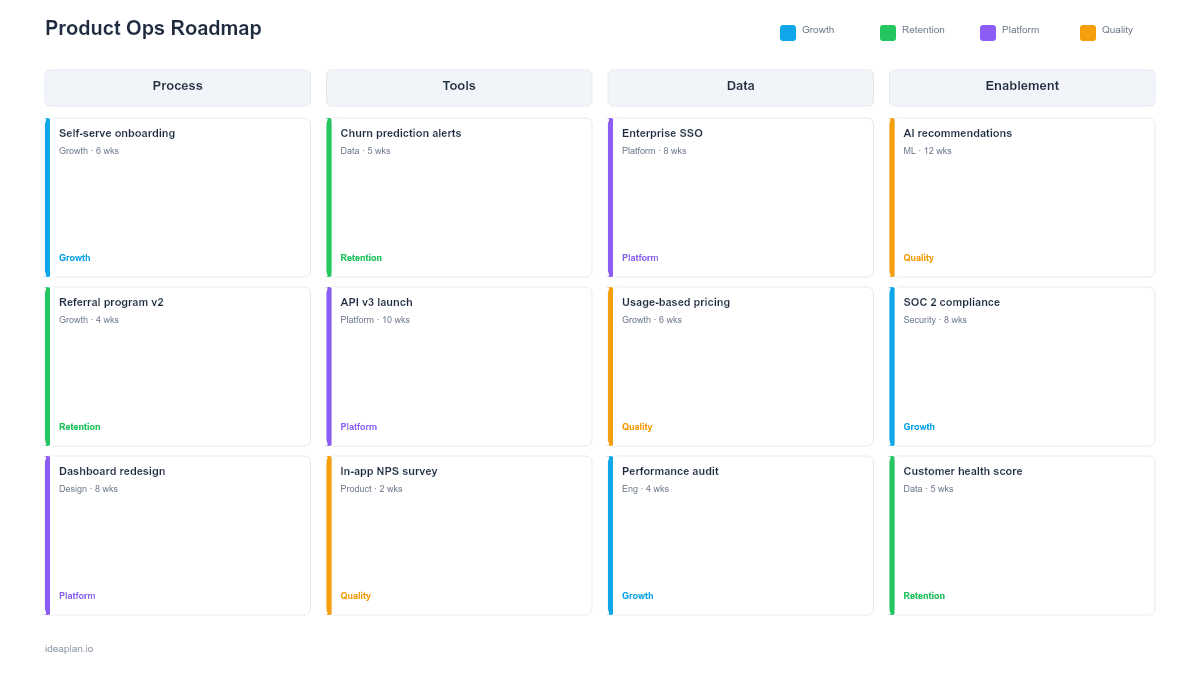
- Quarterly roadmap slide. Four columns (Q1-Q4) with initiative cards color-coded by pillar. Each card shows the capability gap it closes, effort, and owner.
- Filled example slide. A product ops roadmap for a 40-person product org showing initiatives like "Standardize intake process," "Deploy feature flagging," and "Launch PM onboarding program."
Why Product Ops Needs a Dedicated Roadmap
Product ops work is invisible until it breaks. Teams notice when the intake process is chaos or when nobody can find reliable usage data, but they rarely see the systematic work that prevents those problems. A dedicated roadmap makes product operations visible, fundable, and measurable.
Without a roadmap, product ops teams default to reactive firefighting. Fixing whatever is loudest this week. A structured plan ensures you are building capabilities that compound over time rather than patching symptoms. It also gives leadership a clear picture of what product ops delivers and why it deserves headcount and budget.
The maturity model approach works well here because product ops capabilities build on each other. You cannot run reliable A/B tests without clean data infrastructure. You cannot scale PM onboarding without standardized processes. The roadmap makes these dependencies explicit.
Template Structure
Maturity Assessment
The assessment slide uses a four-pillar framework with five maturity levels (Ad Hoc, Defined, Managed, Measured, Optimized). Each pillar gets a current score and target score:
- Processes. Intake, prioritization, launch checklists, retrospectives, and cross-functional workflows.
- Tooling. The product stack: roadmapping tools, analytics, feature flags, feedback collection, and experiment platforms.
- Data infrastructure. Metric definitions, dashboards, data quality, self-serve analytics, and instrumentation coverage.
- Team enablement. PM onboarding, skill development, knowledge bases, and templates.
Quarterly Initiative Cards
Each initiative card on the roadmap slide contains:
- Initiative name. Short description of the capability being built.
- Pillar. Color-coded badge (Processes, Tools, Data, Enablement).
- Gap closed. Which maturity jump this initiative enables (e.g., "Data: Ad Hoc to Defined").
- Effort. T-shirt size indicating time and resource commitment.
- Owner. The person accountable for delivery.
Dependencies Row
A bottom row shows cross-pillar dependencies. For example, "Launch experiment platform" (Tools) depends on "Define metric taxonomy" (Data). This prevents teams from sequencing initiatives in the wrong order.
How to Use This Template
1. Run the maturity assessment
Score each pillar honestly using the five-level scale. Interview PMs, engineering leads, and designers. Their perception of current maturity often differs from the ops team's view. Average the scores or use the lowest common assessment.
2. Set target maturity for each pillar
Do not target Level 5 everywhere. Pick the maturity level that matches your team size and stage. A 10-person product team does not need the same data infrastructure as a 100-person org. Set targets one or two levels above current state.
3. Define initiatives that close the gaps
For each gap between current and target maturity, define specific initiatives. Keep them concrete: "Implement weekly product metrics review" beats "Improve data culture." Use the product ops guide for ideas on which capabilities to prioritize.
4. Sequence by dependencies and impact
Map dependencies between initiatives. Front-load foundational work (data definitions before dashboards, process documentation before automation). Within each quarter, limit to 2-3 initiatives to avoid spreading the ops team too thin.
5. Review quarterly and re-score maturity
At each quarter's end, re-score the four pillars. Compare actuals to targets. Adjust the next quarter's initiatives based on what moved and what stalled.
When to Use This Template
- Annual product ops planning to set a year-long capability building agenda
- Headcount requests where you need to show what additional ops capacity enables
- Product leadership reviews to make ops work visible alongside product delivery
- New product ops function when building the team from scratch and need a phased plan
- Post-reorg transitions where processes and tooling need to be rebuilt for new team structures
If you need to plan product strategy rather than operational capabilities, use the product strategy roadmap template.
Key Takeaways
- Product ops roadmaps organize capability building across four pillars: processes, tools, data, and enablement.
- A maturity assessment provides an honest baseline and prevents over-engineering for your team's stage.
- Sequence initiatives by dependencies. Data infrastructure before dashboards, processes before automation.
- Re-score maturity quarterly to measure whether ops initiatives are moving the needle.
- PowerPoint format makes product ops work visible in leadership reviews and budget conversations.
- Compatible with Google Slides, Keynote, and LibreOffice Impress. Upload the
.pptxto Google Drive to edit collaboratively in your browser.