Quick Answer (TL;DR)
This free PowerPoint template plans observability improvements across four layers: Logging, Monitoring & Metrics, Distributed Tracing, and Alerting & Incident Response. Each layer shows current maturity level, target maturity, and the quarterly initiatives that close the gap. Download the .pptx, assess your observability gaps, and use it to coordinate infrastructure, platform, and product teams around a shared plan for understanding what your systems are actually doing.
What This Template Includes
- Cover slide. Product or platform name, current MTTR, and observability program owner.
- Instructions slide. How to assess observability maturity per layer, set targets, and sequence investments. Remove before presenting.
- Blank template slide. Four observability layers across a quarterly timeline with maturity gauges (Level 1-5), initiative cards, and reliability metric targets.
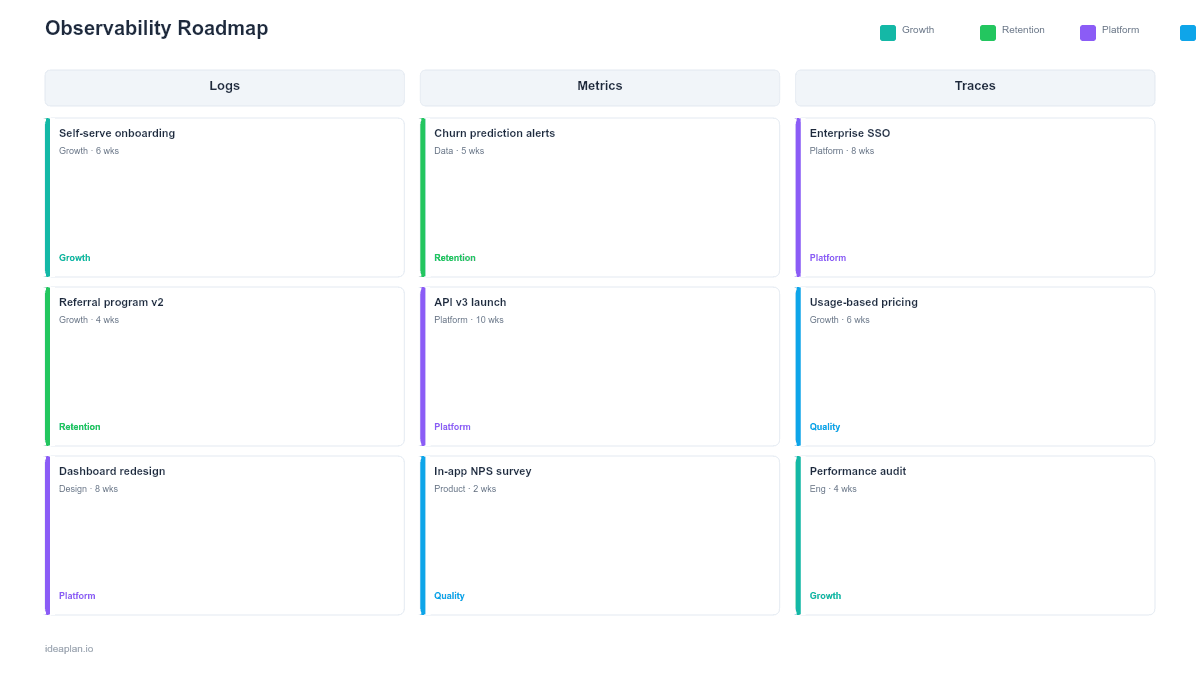
- Filled example slide. A SaaS platform observability roadmap showing structured logging rollout, Prometheus/Grafana migration, OpenTelemetry tracing adoption, and PagerDuty integration with escalation policies, with MTTR reduction targets at each milestone.
Why Observability Needs Its Own Roadmap
Most teams add monitoring reactively. After an outage exposes a blind spot. The result is a patchwork of tools, inconsistent log formats, alerts that fire too often or not at all, and traces that cover some services but not others. When the next incident hits, engineers spend more time figuring out where to look than fixing the problem.
An observability roadmap replaces reactive patching with systematic coverage. It ensures that logging, metrics, tracing, and alerting mature together rather than in isolation. A team with excellent metrics but no tracing can see that latency spiked but cannot determine which service caused it. A team with detailed traces but noisy alerts wastes hours investigating false positives.
The business case is straightforward: every minute of MTTR costs money. For a B2B SaaS product, a 30-minute outage affects customer trust, triggers SLA credits, and generates support tickets. Reducing MTTR from 45 minutes to 15 minutes is worth quantifying. And an observability roadmap is how you get there.
Template Structure
Logging Layer
Covers structured logging standards, log aggregation, log retention policies, and search capabilities. Each initiative card specifies: services affected, log format standard (JSON structured vs. unstructured), aggregation tool (ELK, Loki, CloudWatch), and retention period. The goal is consistent, searchable logs across every service so engineers can answer "what happened?" within minutes of an incident.
Monitoring & Metrics Layer
Covers application metrics, infrastructure metrics, business metrics, and dashboards. Initiatives include: instrumenting key services with RED metrics (Rate, Errors, Duration), building service-level dashboards, defining SLIs and SLOs, and setting up capacity planning views. Each card tracks which services are instrumented and which remain blind spots.
Distributed Tracing Layer
Covers request tracing across service boundaries, trace sampling strategies, and trace-to-log correlation. For microservices architectures, tracing is what connects a slow API response to the specific downstream service that caused it. Initiatives include: adopting OpenTelemetry, instrumenting critical request paths, configuring sampling rates, and building trace-based debugging workflows.
Alerting & Incident Response Layer
Covers alert rules, escalation policies, runbooks, and post-incident review processes. The most common observability failure is not missing data. It is too many alerts. Initiatives include: auditing and reducing alert noise, implementing severity-based routing, writing runbooks for top 20 alert types, and automating common remediation steps. Each card tracks alert volume, signal-to-noise ratio, and mean time to acknowledge.
How to Use This Template
1. Assess current maturity per layer
Rate each observability layer on a 1-5 maturity scale. Level 1: ad hoc (some logs exist, no consistency). Level 3: standardized (structured logs, basic dashboards, partial tracing). Level 5: optimized (full correlation across all four layers, automated remediation, proactive anomaly detection). Most teams are between Level 2 and Level 3 across layers, with significant gaps in tracing and alerting quality.
2. Identify your biggest blind spots
Ask engineers: "During the last three incidents, what information did you need that you did not have?" The answers point directly to observability gaps. If the answer is "we could not tell which service was slow," tracing is the priority. If it is "we did not know there was a problem until a customer reported it," alerting is the priority.
3. Sequence by incident impact
Prioritize the layer that would have prevented or shortened your worst recent incidents. If your last outage lasted 2 hours because engineers could not find the failing service, tracing and correlation capabilities should be Q1 work. Use MTTR reduction as the primary justification for each initiative.
4. Set quarterly reliability targets
Define measurable targets that connect observability investment to business outcomes. Examples: "Reduce MTTR from 42 minutes to 20 minutes by Q2," "Achieve 95% structured logging coverage by Q3," "Reduce false-positive alert rate from 60% to 15% by Q4." The product metrics guide covers how to select reliability indicators that resonate with leadership.
5. Review with on-call engineers
The people who respond to incidents at 3 AM know exactly where observability falls short. Present the roadmap to your on-call rotation and ask them to rank the proposed initiatives. Their prioritization will differ from management's. And theirs is usually more accurate.
When to Use This Template
An observability roadmap is essential when:
- MTTR is too high and incident resolution depends on tribal knowledge rather than tooling
- Alert fatigue is causing engineers to ignore pages, increasing the risk of missed real incidents
- Microservices adoption has created blind spots where no single team sees the full request path
- SLA commitments to enterprise customers require demonstrable reliability improvements
- Observability tooling is fragmented across teams with no consistent standards or correlation
If your focus is on broader infrastructure planning that includes observability as one component, the infrastructure roadmap PowerPoint template covers all four infrastructure layers. For application-level performance work, the performance optimization roadmap PowerPoint template focuses on latency and throughput.
Featured in
This template is featured in Technical and Engineering Roadmap Templates, a curated collection of roadmap templates for this use case.
Key Takeaways
- Observability roadmaps coordinate logging, monitoring, tracing, and alerting improvements so they mature together rather than in isolation.
- MTTR reduction is the primary metric for justifying observability investment in business terms.
- Assess maturity on a 1-5 scale per layer and prioritize the layer with the widest gap to current needs.
- On-call engineers are the best source of prioritization input. They know where the blind spots are.
- PowerPoint format lets you present observability plans to engineering leadership, SRE teams, and executives who approve infrastructure budgets.
- Compatible with Google Slides, Keynote, and LibreOffice Impress. Upload the
.pptxto Google Drive to edit collaboratively in your browser.