Quick Answer (TL;DR)
This free PowerPoint template organizes your data governance strategy into four pillars: ownership, quality, discoverability, and security. Each slide maps initiatives to the problems they solve. Conflicting metrics across dashboards, nobody knowing which dataset is authoritative, compliance risks from untracked data access, and analytics teams spending more time cleaning data than analyzing it. Download the .pptx, audit your current data state, and present a governance plan that turns data chaos into a trusted, well-cataloged asset.
What This Template Includes
- Cover slide. Organization name, number of critical data domains, current data quality score (if known), and the planning horizon.
- Instructions slide. How to identify data domains, assign stewards, and define quality thresholds. Remove before presenting.
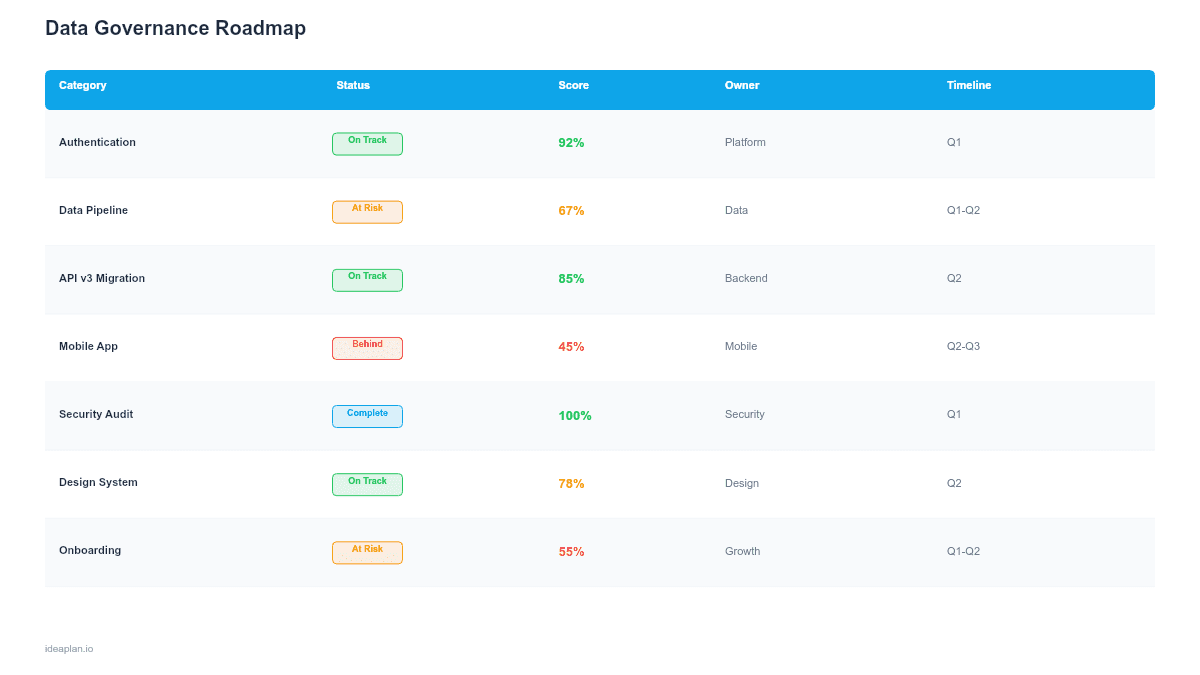
- Blank template slide. Four-pillar layout (Ownership, Quality, Discoverability, Security) across quarterly columns with initiative cards, steward assignments, and maturity indicators per pillar.
- Filled example slide. A mid-stage SaaS company governing five data domains (customers, revenue, product usage, marketing, support) over four quarters. Shows domain steward assignment and ownership RACI in Q1, quality rules and automated monitoring in Q2, data catalog launch in Q3, and access policy enforcement with lineage tracking in Q4.
Why Data Governance Needs a Roadmap
Every company that reaches a certain scale discovers the same problem: nobody trusts the data. The marketing team's customer count does not match the finance team's. Two dashboards show different revenue numbers for the same period. An analyst spends a week building a report only to discover the source table was deprecated months ago without anyone knowing.
These are not technology problems. They are governance problems. And they compound as the organization grows. More data sources, more consumers, more dashboards, more ways for things to diverge. A data governance roadmap treats this as a structural challenge that requires ownership, standards, and processes, not just a better database.
The roadmap is especially critical for companies building data products or AI features. Machine learning models trained on inconsistent data produce inconsistent results. Analytics dashboards built on ungoverned sources erode trust in data-informed decisions. Governance is the foundation that makes everything downstream reliable. For a framework on building a data strategy, see the AI data strategy guide.
Template Structure
Four Governance Pillars
The roadmap covers the full scope of data governance:
- Ownership. Defining who is accountable for each data domain. Data stewards (business owners who define what data should look like), data custodians (technical owners who maintain pipelines and storage), and a governance council that resolves cross-domain conflicts. Without clear ownership, data quality issues have no one to fix them.
- Quality. Establishing what "good data" means and measuring it. Quality dimensions include completeness (no missing fields), accuracy (values match reality), consistency (same metric, same number across systems), timeliness (data arrives on schedule), and uniqueness (no unintended duplicates). Each dimension gets measurable thresholds.
- Discoverability. Making data findable and understandable. A data catalog that indexes every dataset with descriptions, owners, freshness, and lineage. Without a catalog, teams duplicate datasets because they cannot find existing ones, or use the wrong version because they cannot tell which is current.
- Security. Controlling who accesses what data and tracking that access. Access policies by role, data classification tiers (public, internal, confidential, restricted), masking rules for sensitive fields, and audit logs. This pillar is non-negotiable for companies handling personal data or operating in regulated industries.
Data Domain Inventory
The filled example starts with a domain inventory table listing each critical data domain, its current steward (or lack thereof), quality score, and number of downstream consumers. This inventory drives prioritization. Domains with the most consumers and lowest quality scores get governed first.
Maturity Indicators
Each pillar has a four-level maturity scale: Ad Hoc, Defined, Managed, Optimized. The roadmap shows current maturity per pillar and the target maturity by end of the planning horizon. This gives leadership a simple view of progress without requiring them to understand every initiative.
How to Use This Template
1. Identify and inventory critical data domains
List the 5-10 data domains that matter most to the business: customer data, revenue data, product usage data, and whatever else drives decisions. For each domain, document where it lives, who uses it, and what the known quality issues are. Do not try to govern everything at once. Start with the domains that have the highest business impact.
2. Assign data stewards per domain
Each domain gets one business-side steward (typically a director or senior manager who depends on the data) and one technical custodian (the engineer or data team member who maintains the pipeline). The steward defines what "correct" means. The custodian ensures the systems deliver it. This pairing is essential. Governance without technical execution produces policies that nobody follows.
3. Define quality rules and thresholds
For each priority domain, specify measurable quality rules. "Customer email must be non-null and match a valid format." "Revenue figures must reconcile within 0.1% between source systems." "Product usage events must arrive within 4 hours of occurrence." These rules become automated checks that run on every data pipeline execution.
4. Build or adopt a data catalog
Choose a catalog tool (open source options like DataHub or commercial tools like Atlan) and populate it with your priority domains. Each catalog entry includes a description, owner, quality score, update frequency, lineage diagram, and access classification. The catalog becomes the single place anyone goes to find and understand data.
5. Enforce access policies and track compliance
Define access tiers based on data classification. Implement role-based access controls. Enable audit logging. Review access reports quarterly with the governance council. Compliance is not a one-time setup. It requires ongoing monitoring and periodic access reviews, especially as people change roles. Track this alongside your product analytics to ensure governance supports rather than blocks data use.
When to Use This Template
Data governance roadmaps fit when:
- Different teams report different numbers for the same metric and nobody knows which source is authoritative
- Compliance requirements demand data lineage and access controls (SOC 2, GDPR, HIPAA, or industry-specific regulations)
- Analytics teams spend more time cleaning and validating data than analyzing it, reducing the value of your data investment
- The company is building AI or ML features that require high-quality, well-documented training data
- A data team or data platform function is being established and needs a structured governance framework from the start
If your focus is specifically on privacy compliance rather than full data governance, the data privacy roadmap template is more targeted.
Key Takeaways
- Data governance roadmaps cover four pillars: ownership, quality, discoverability, and security. Each requiring dedicated initiatives and metrics.
- Start with a domain inventory: identify the 5-10 most critical data domains and govern those first instead of trying to cover everything.
- Assign steward pairs (business owner + technical custodian) to each domain for accountability that spans policy and execution.
- Build or adopt a data catalog as the single place to find, understand, and assess the quality of any dataset.
- PowerPoint format supports governance council meetings and executive reviews where cross-functional alignment on data investment is the primary goal.
- Compatible with Google Slides, Keynote, and LibreOffice Impress. Upload the
.pptxto Google Drive to edit collaboratively in your browser.