Quick Answer (TL;DR)
To conduct effective customer interviews, start with a specific product decision you need to make, recruit 5-10 participants from your target segment, and ask open-ended questions about their real past behavior rather than hypothetical scenarios. Use the 5 Whys technique to dig past surface-level requests, then code your findings into themes and convert them into product opportunities using an Observation-Problem-Opportunity framework.
Customer interviews are a powerful way to understand what your users need, where they struggle, and how they interact with your product. They are a core user research practice within product discovery. As Teresa Torres writes in Continuous Discovery Habits, weekly customer touch-points are the foundation of good product decisions. Unlike surveys or analytics, interviews let you dig deeper into motivations and challenges, providing insights that can shape smarter product decisions. Here's a quick breakdown:
To start, pick a specific product decision you're working on, interview 5. 10 users, and focus on their real experiences. Keep reading for step-by-step guidance to make these interviews a key part of your product strategy. For more resources on collecting and acting on feedback, see our product feedback hub. And if you need a PM assistant that tracks your research tasks and does background research from your inbox, try Loop.
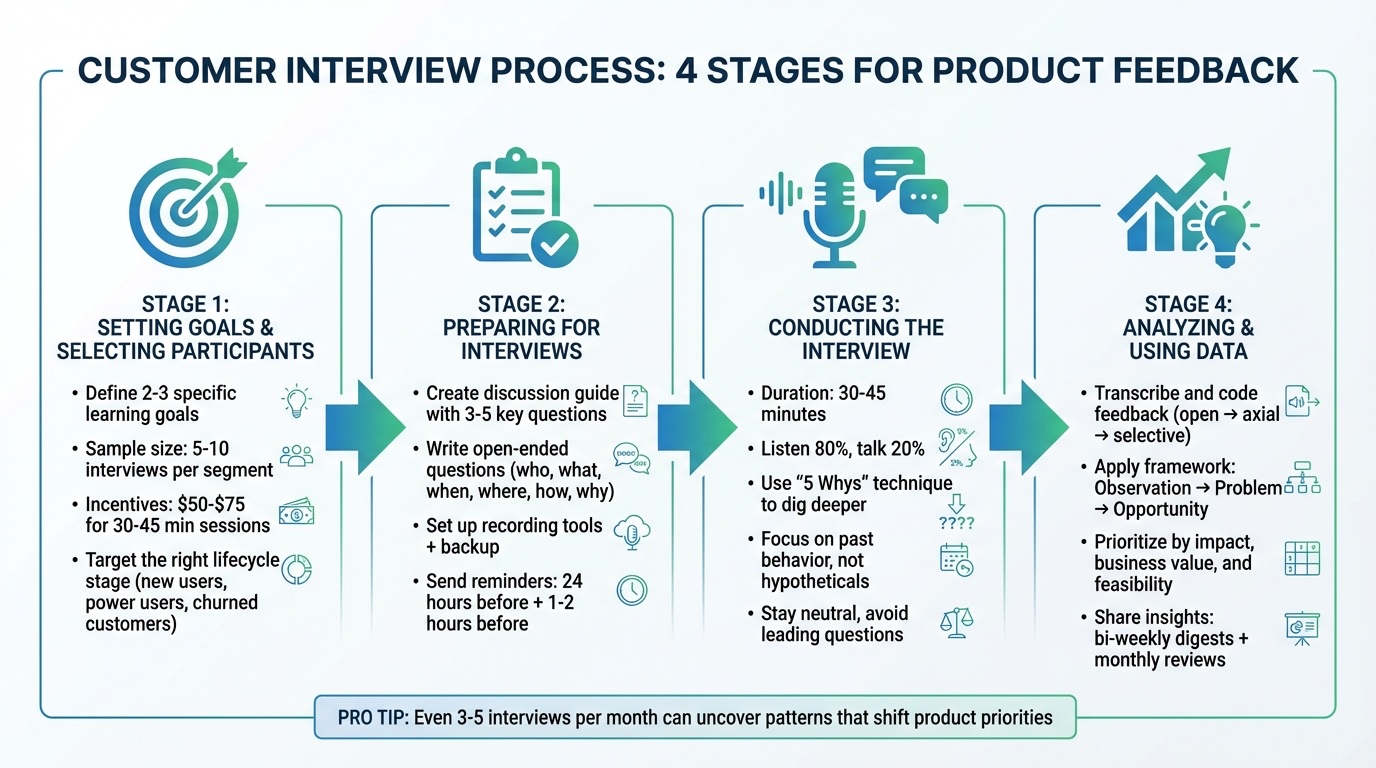
Customer Interview Process: 4-Stage Framework from Planning to Action
Setting Goals and Selecting Participants
Defining Your Interview Objectives
Start by identifying a single key product decision you need to make in the next 30. 90 days. Tie each interview objective to this decision (e.g., whether to discontinue, redesign, launch, or invest in a feature, pricing tier, or segment). Use 2. 3 specific learning goals to guide your focus. For example, instead of vaguely seeking "feedback on onboarding", aim to pinpoint "the top 3 reasons trial users don't activate within the first 7 days." A straightforward template can help you stay on track:
"After these interviews, we will be able to decide whether to [discontinue / redesign / launch / increase investment in] [feature / pricing / segment] because we understand [specific user problem or behavior]."
Common objectives fall into categories like:
Focus on real-world behavior rather than hypothetical scenarios. Steve Blank, who pioneered the Customer Development methodology, emphasizes the importance of getting out of the building to validate assumptions with real users. For instance, ask, "Describe the last time you considered canceling - what ultimately made you decide to leave?" Clear objectives like these will help you gather actionable insights.
Once your objectives are set, the next step is to identify the right participants to bring these goals to life.
Finding and Recruiting Participants
With your objectives in place, define a participant profile by outlining criteria like lifecycle stage, usage level, and role. For example:
Use product analytics and CRM tools to create targeted lists. For instance, filter for "U.S. customers who signed up in the past 14 days and didn’t complete onboarding step 3." Reach out to these users through in-app messages, targeted emails, or post-survey invitations - like asking NPS survey respondents if they’d join a 30-minute call. For B2B products, account managers and customer success teams can nominate power users or at-risk accounts.
When contacting participants, be clear about who you’re looking for, why their input matters, what’s in it for them, and how much time they’ll need to commit. Tailor your outreach based on the audience:
Always include session details like duration, format (e.g., Zoom call), time zone clarity, and the incentive amount in U.S. dollars.
After defining your audience, you’ll need to determine the ideal sample size and choose incentives to encourage participation.
Deciding Sample Size and Incentives
For each segment, aim for 5. 10 interviews. If you notice recurring themes by the fifth interview, it may be time to shift focus or refine your questions.
Offer incentives that match the time and effort required:
Cash-equivalent rewards like digital gift cards from major retailers or prepaid Visa/Mastercard cards are preferable. Avoid offering product discounts, as they might exclude non-customers and bias feedback. Make sure to clearly communicate the type, amount, and delivery timeline of the incentive in your invitation.
To ensure a balanced participant pool, define inclusion and exclusion criteria upfront. For example, recruit at least three participants from small (<50 employees), mid-market (50. 500), and large (>500) U.S. companies. Don’t limit yourself to your most engaged users - make an effort to include low-engagement users and recent churns, even if they’re harder to schedule. Randomize your selection from eligible lists to avoid over-relying on familiar names. Keep a log of participants (including segment, company size, geography, role, and date) to identify any gaps.
To streamline the process, consider tools like IdeaPlan to centralize interview notes, auto-tag insights by problem area, and directly connect feedback to roadmap decisions.
Preparing for Customer Interviews
Creating a Discussion Guide
Start your interview by introducing yourself, explaining the purpose of the conversation, and mentioning any incentive upfront (e.g., a $50 digital gift card). Let participants know there are no right or wrong answers - this helps set a relaxed tone.
Begin with warm-up questions to make participants comfortable. Ask about their role, a typical day, or use prompts like, "Tell me about the last time you did X", to anchor the discussion in recent, tangible experiences. Organize 3. 5 key questions by topic, such as workflows, challenges, existing solutions, or reactions to a concept. Use follow-up questions like, "Walk me through the last time this happened", or "What happened next?" Wrap up by asking, "What important topics did I miss?" and "Who else should I speak with?" to uncover additional insights.
Instead of following a rigid script, outline your guide in bullet points. This keeps the conversation natural while ensuring consistency across interviews. For a 30. 45 minute session, block out a 45-minute time slot (e.g., 10:00. 10:45 AM) to allow for a smooth start and proper wrap-up.
Writing Open-Ended Questions
Focus on open-ended questions that explore specific past events. These typically start with words like who, what, when, where, how, or why. For instance, instead of asking, "Would you use a feature like this?" try, "Tell me about the last time you tried to solve this problem - what did you do first?" This approach avoids unreliable predictions about future behavior.
Steer clear of questions that suggest a preferred answer, assume a problem exists, or seek direct validation. For example, instead of asking, "Do you like our new dashboard?" say, "Can you walk me through how you used the dashboard this week?" When discussing pricing, avoid questions like, "Would you pay $99 for this?" Instead, ask, "How do you currently budget for tools like this? What are you paying for similar products today?" These types of questions often lead to richer, more actionable feedback.
To dig deeper, try techniques like the 5 Whys, originally developed by Sakichi Toyoda at Toyota. When a participant mentions a problem, follow up with, "Why does that happen?" and continue probing with questions like, "What makes that difficult?" or "What's the impact when that happens?" Aim for two to four layers of "why" to uncover root causes. Use follow-ups like, "Can you give me an example?" or "How often does that happen - daily, weekly, monthly?" to gather more context.
Handling Interview Logistics
For remote interviews, choose a reliable video platform like Zoom. Confirm time zones (e.g., PT vs. ET) and send a calendar invite with the meeting link, duration, and incentive details. Test audio, screen sharing, and recording settings 10. 15 minutes before the session, and have a backup dial-in number ready in case of technical issues.
For in-person interviews, book a quiet, comfortable room and arrange seating to create a relaxed, conversational environment. If you plan to record, ensure you follow consent protocols for video or audio recording.
Use a primary recording tool - such as a video conferencing recorder or a dedicated app - and always have a secondary backup, like an audio recorder or a second device. At the start of the interview, ask for explicit permission to record and explain how the recordings will be stored and who will have access.
Clearly assign roles within your team. Designate a primary interviewer and a note-taker or observer. Decide if additional team members will join live or review recordings later to avoid making participants uncomfortable. Note-takers should use a standardized template to capture participant profiles, key quotes, behaviors, and timestamps, making analysis smoother. The user feedback template provides a structured format for capturing interview notes, key insights, pain points, and feature requests in a consistent format that makes synthesis easier.
Consider tools like IdeaPlan to centralize notes and tag insights, which can streamline product management with AI-assisted prioritization. Once participants book their session, send a confirmation email and follow up with reminders - one 24 hours before and another 1. 2 hours prior to the interview. Include the meeting link, expected duration, and any preparation instructions to improve attendance rates.
With everything in place, you'll be ready to transition smoothly into the interview itself.
Conducting the Interview
Starting the Interview
Setting the right tone at the start of a customer interview is essential for gathering clear and actionable feedback. Begin by introducing yourself, explaining the purpose of the conversation, and confirming that it’s okay to record the session. Reassure participants that recordings are strictly for internal analysis. You might say something like, "Thanks for joining me today. This is a 30-minute chat about your experiences with [topic]. There are no right or wrong answers - I’m just here to learn from you."
To help participants feel at ease, kick things off with a simple icebreaker. Ask about their role or what a typical day looks like for them. This not only helps them relax but also transitions naturally into the main topics of discussion.
Once introductions are out of the way, shift your focus entirely to listening and asking thoughtful questions.
Best Practices During the Interview
Your primary role during the interview is to listen - let the participant do most of the talking. Use open-ended questions to encourage detailed responses, and resist the urge to fill silences. Those quiet moments often lead to the most insightful answers as participants take time to organize their thoughts.
Avoid steering the conversation with leading questions. For example, instead of asking, "Don’t you think this feature is great?", try, "Can you share a time when you found this feature useful?" Use neutral affirmations like "I see" or "That makes sense" to acknowledge their input without influencing their responses. If you need clarity, paraphrase what they’ve said: "So, it seems like you’re saying X - did I get that right?" This not only confirms your understanding but also invites them to elaborate further.
To dig deeper, rely on follow-up techniques like the "5 Whys." If someone mentions a problem or suggests a feature, ask questions like, "Why is that important to you?" or "What happens if this problem isn’t resolved?" Encourage storytelling with scenario-based prompts such as, "Can you describe the last time you encountered this issue?" These approaches help uncover underlying pain points and provide richer insights.
Adapting these practices to different communication styles will ensure more productive conversations.
Managing Difficult Interview Situations
Some participants may dominate the conversation, veering off track and making it hard to stick to your discussion guide. In such cases, politely redirect them by acknowledging their input - "Thanks for sharing that detail" - and then steering the conversation back with, "To make sure we cover everything, let’s shift to how you handle X." Summarizing their key points can also help refocus the discussion: "So it sounds like speed is your main concern. How does that affect your daily workflow?"
For quieter or hesitant participants, create a comfortable space by saying things like, "Take your time - there’s no rush." Scenario-based questions such as, "Can you walk me through a typical day using our product?" can help them open up. If they’re still struggling, offer simple multiple-choice options to get the conversation going: "Would you say it’s more about speed or ease?" Once they engage, follow up with more probing questions to gather deeper insights.
Throughout the interview, stay neutral. Avoid showing enthusiasm for specific ideas or features. If a participant suggests a new feature, ask, "What problem are you trying to solve?" rather than validating their idea outright. Focus on their real-world behaviors rather than assumptions or predictions. For instance, if someone says, "I would definitely use that", follow up with, "Tell me about the last time you tried to solve this problem - what steps did you take?" Observing past behavior often reveals more reliable insights than future intentions.
sbb-itb-7c23fa1
Analyzing and Using Interview Data
Organizing and Coding Your Data
Start by transcribing your interview recordings using tools like Otter.ai, Rev, or Descript. Afterward, clean up the transcripts - fix obvious mistakes and highlight key quotes. Keep everything organized in a centralized folder, and use consistent file naming, such as 2025-12-15_CustomerName_Segment_FeatureX, to make searching and comparing across interviews easier.
When analyzing the data, use a three-step coding process: open, axial, and selective coding. In the open coding phase, label short excerpts with descriptive tags like "onboarding confusion" or "workaround (spreadsheet)." During axial coding, group these raw codes into broader themes, such as "activation barriers", and create a codebook with clear definitions to ensure consistency across your team. Finally, in selective coding, focus on identifying the most significant patterns. For instance, determine which themes are common across many interviews, which are specific to certain segments, and which are rare but potentially important. Frequency tables can help quantify these patterns (e.g., "15 out of 24 interviews mentioned trouble importing data").
Once you've established the main themes, use them to uncover actionable opportunities.
Converting Feedback into Product Opportunities
With the coded themes in hand, apply the Observation → Problem → Opportunity framework to turn customer feedback into actionable insights. Start by documenting a specific observation from the interview. For example: "Customer manually exports CSVs daily and pastes data into a spreadsheet to get weekly performance metrics." Next, reframe this as a customer problem: "I spend too much time manually compiling reports and worry they're inaccurate." Finally, define an opportunity that’s not tied to any specific solution: "Help customers generate accurate, up-to-date performance reports automatically, without manual exports."
This structured approach ensures you don’t jump prematurely from anecdotal feedback to feature requests. This aligns with the Jobs to Be Done approach: focus on the underlying job the customer is hiring your product to do, not the specific feature they request. For instance, if a customer asks for "dark mode", deeper questioning might reveal they work late at night and experience eye strain. The observation might be: "Customer often works in low-light conditions and finds the bright UI tiring." The problem could be: "Using the product for long sessions is physically uncomfortable, especially at night." From there, you can identify multiple opportunities, such as introducing dark mode, adjustable contrast, font-size controls, or session-timed themes - offering various ways to address the same underlying issue.
Tracking and Prioritizing Feedback
Centralize your insights by maintaining a structured repository. Include metadata (e.g., customer profile, date, interviewer), key observations, coded themes, linked problem statements, and top opportunities. Use tags for product areas, customer segments, journey stages, and themes to make filtering easier (e.g., "US mid-market customers + billing + churn risk"). Connect individual insights to roadmap items or OKRs so stakeholders see how customer feedback drives decisions.
To prioritize opportunities, evaluate them across three key dimensions:
A scoring model like RICE or impact/effort scoring can help you maintain a prioritized backlog. Even low-priority problems shouldn't be discarded - tag and archive them so they can be revisited if your strategy or focus shifts later. Tools like IdeaPlan can also help centralize feedback, link it to opportunities, and prioritize with AI, keeping your decisions rooted in real customer data. For a systematic approach to connecting feedback to OKRs and driving continuous iteration, see how to use feedback for continuous product improvement.
Finally, make it a habit to share insights regularly. After each interview batch (e.g., every two weeks), send a brief "insights digest" summarizing key patterns and quotes. Additionally, hold a monthly "customer voice review" with your product, design, and engineering teams. Use this time to share real customer stories and clips, ensuring these insights directly inform your product backlog and decision-making process.
The Art of Customer Interviews | Erin May
Conclusion
Customer interviews aren’t just a one-time task - they’re an ongoing practice that connects product decisions to real user needs. The Product Discovery Handbook covers the full discovery workflow, from framing assumptions through continuous interview cadences. By setting clear goals, selecting the right participants, asking open-ended questions, and analyzing feedback systematically, you create a feedback loop that helps reduce risks and uncovers opportunities you might have overlooked.
The best product teams make interviews a regular part of their process, not an occasional effort. Even scheduling just 3. 5 conversations a month can uncover patterns that shift priorities in meaningful ways. Wrap up interviews with open-ended prompts to surface deeper insights. Seasoned product leaders, after conducting 100+ interviews, know better than to take feature requests at face value. Instead, they dig into the core needs behind those requests.
Ready to act on feedback? Start small. Pick one key product question you’re grappling with this week. Find 5. 8 customers from your target audience, schedule 30. 45 minute conversations, and focus on listening. Ask about their real experiences - what they tried, what didn’t work, and why - rather than hypothetical “Would you use this?” questions. Analyze the insights immediately and turn them into actionable product opportunities.
To make the most of your findings, organize your insights by tagging, grouping, and linking them directly to your roadmap. Customer interviews have the greatest impact when their insights directly inform your backlog and strategy. Tools like IdeaPlan can simplify this process by centralizing notes, tagging feedback by theme or segment, linking insights to roadmap items, and using AI to highlight patterns across conversations. This structured method reinforces the power of data-driven decision-making and continuous improvement.
When teams across your organization engage in customer conversations, interviews become a driving force for smarter decisions and better outcomes. Start today, build the habit, and see how regular customer insights can transform your product strategy.
Explore More
- Top 10 Customer Feedback Tools and Methods (2026) - 10 tools and methods for collecting, organizing, and acting on customer feedback.
- Top 10 User Research Methods for PMs (2026) - 10 user research methods every PM should know.
- Discovery for Mid-Level Product Managers - Build a continuous discovery practice.
- Discovery for New Product Managers - Learn product discovery fundamentals as a new PM.
Related Blog Posts
- Essential Product Management Checklist for 2025
- How to Build a Product Roadmap in 5 Simple Steps
- Ultimate Guide to Idea Generation for Product Managers
- How to Align Stakeholders with Product Vision