Quick Answer (TL;DR)
Remote product roadmap planning works best when you host roadmaps on cloud-based tools for a single source of truth, use visual hierarchies and color-coding so priorities are clear at a glance, and track milestones instead of fixed deadlines. Combine structured async reviews with monthly and quarterly syncs to keep distributed teams aligned across time zones.
Remote product roadmap planning ensures your team stays aligned, even when spread across time zones. The key? Using the right tools, clear communication, and flexible processes. Here's what works:
- Host roadmaps online: Use cloud-based tools to avoid versioning headaches and keep everyone updated in real time.
- Focus on visual clarity: Use themes, color-coding, and concise labels to make priorities easy to understand.
- Track milestones, not rigid deadlines: Broad timeframes like "Now / Next / Later" work better for remote teams.
- Organize with filters and swimlanes: Tailor views based on team, customer segment, or goals to reduce information overload.
- Hold regular reviews: Monthly and quarterly meetings ensure alignment and allow for adjustments.
Using tools like IdeaPlan can simplify everything - centralizing feedback, prioritization, and real-time updates. Strong communication habits, like weekly syncs and shared documentation, also keep teams connected and productive. By combining the right tools with clear workflows, remote teams can stay on track and deliver results efficiently.
Discover the Award-Winning Agile Product Roadmap Template
Best Practices for Remote Product Roadmap Planning
When working remotely, product teams face unique challenges in keeping everyone aligned. The remote product management guide covers the full set of practices for distributed teams. For specific tactical patterns on async standup formats, video call efficiency, and maintaining team culture across time zones, see the remote product management playbook. Without the ability to simply walk over to a colleague's desk, it's essential to adopt methods that ensure clarity, encourage collaboration, and allow flexibility. Below are some practical strategies to enhance your remote roadmap planning process.
Host Roadmaps Online for Easy Access
Using cloud-based tools for roadmaps eliminates version control headaches. When team members in various locations make updates, conflicting versions can cause confusion. Online platforms solve this by offering a single, real-time source of truth that everyone can access.
Many of these tools include role-based permissions, so managers can make edits, engineers can leave comments, and executives can view progress summaries. Some teams even create customer-facing versions of their roadmaps, using a "Now / Next / Later" format to share upcoming features without revealing sensitive information. This approach can cut down on repetitive customer inquiries. Tools like IdeaPlan even integrate AI to help distributed teams align strategically while collaborating asynchronously.
Use Clear Visual Hierarchies in Your Roadmaps
A well-organized visual hierarchy makes it easier for remote teams to quickly understand priorities - whether during a video call or while reviewing asynchronously. Start with high-level strategic themes like "Improve onboarding" or "Enterprise scalability", and group related epics or initiatives under these themes. You can further organize them into time buckets, such as Q1 and Q2 2026, or a simple "Now / Next / Later" structure.
Color-coding is another way to enhance clarity. For instance, you can assign colors to strategic themes or use shades to indicate priority levels - red for high, yellow for medium, and green for low. Research shows that visuals are processed much faster than text - up to 60,000 times faster. Keep roadmap cards concise with one-line outcome statements instead of technical jargon. For those who want more details, include links to documentation in tools like Jira or GitHub, so the main roadmap remains uncluttered while offering deeper insights when needed.
Track Milestones and Progress Instead of Fixed Dates
For remote teams, outcome-driven roadmaps work better than those tied to rigid deadlines. Fixed delivery dates can create unrealistic expectations, especially when work is still in discovery or prone to changes. Instead, use broader timeframes like "Now / Next / Later" or H1/H2 2026, and focus on milestones such as "Beta ready for first 10 customers" or "Performance under 2 seconds."
Tracking progress with indicators like completion percentages or status labels (e.g., Not Started, In Development, Released) helps everyone stay informed. This approach keeps stakeholders connected to the overall goals without the pressure of specific deadlines that may shift.
Use Filters and Swimlanes to Help Teams Focus
To avoid information overload, organize roadmaps using filters and swimlanes. These tools let teams zero in on what’s relevant while still maintaining a unified overview.
Swimlanes can be categorized by team (e.g., Web, Mobile, Platform), customer segment (e.g., SMB, Enterprise), or strategic objective (e.g., Retention, Revenue). Filters can further refine the view by status, timeframe, or priority. For example, a leadership-focused view might highlight major themes and milestones, while a technical team might filter only for items marked "In Development."
Hold Regular Roadmap Review Meetings
Regular review meetings - both monthly and quarterly - are essential for keeping distributed teams aligned. These sessions provide a chance to update milestones, adjust priorities, and ensure everyone is on the same page.
Monthly tactical meetings might include a recap of strategic themes, updates on progress, and discussions about new developments like customer insights or technical challenges. These meetings should result in clear decisions, with owners assigned to action items and deadlines set in the MM/DD/YYYY format. Screen-sharing the live roadmap ensures everyone is aligned, and recording the session allows those in different time zones to catch up later.
Quarterly reviews take a broader view, focusing on themes for the next three to six months, evaluating impact metrics, and reallocating resources as needed. Syncing these reviews with quarterly OKR sessions and annual planning ensures the roadmap stays connected to company-wide goals. Sharing meeting notes and updated roadmap links fosters transparency and supports asynchronous collaboration.
Tools for Remote Roadmap Planning
When it comes to planning roadmaps with distributed teams, having the right tools can make all the difference. Cloud-based platforms solve version control issues by offering a single source of truth that everyone can access, no matter where they are.
These tools don’t just centralize information - they also bring together key features that simplify decision-making for remote teams. Most modern roadmap platforms combine multiple functions in one place: visual roadmapping, backlog management, feedback collection, prioritization frameworks, and progress tracking. This all-in-one setup minimizes the need to constantly switch between apps, allowing teams to focus on making decisions. Many platforms also integrate directly with engineering tools like Jira, so updates are automatic, and stakeholders can see changes in real time without manual input.
This cohesive toolset ensures that every remote team member stays on the same page, accessing the latest roadmap updates without any hassle.
Integrations make the biggest difference. The best tools link roadmaps to engineering systems for tracking execution and to customer feedback tools for prioritizing tasks. According to Atlassian's 2020 research, 76% of software teams use some form of agile methodology, relying on connected tools to stay aligned across distributed environments. These integrations reduce manual work and ensure everyone stays informed, even when working across time zones.
Equip Teams with IdeaPlan
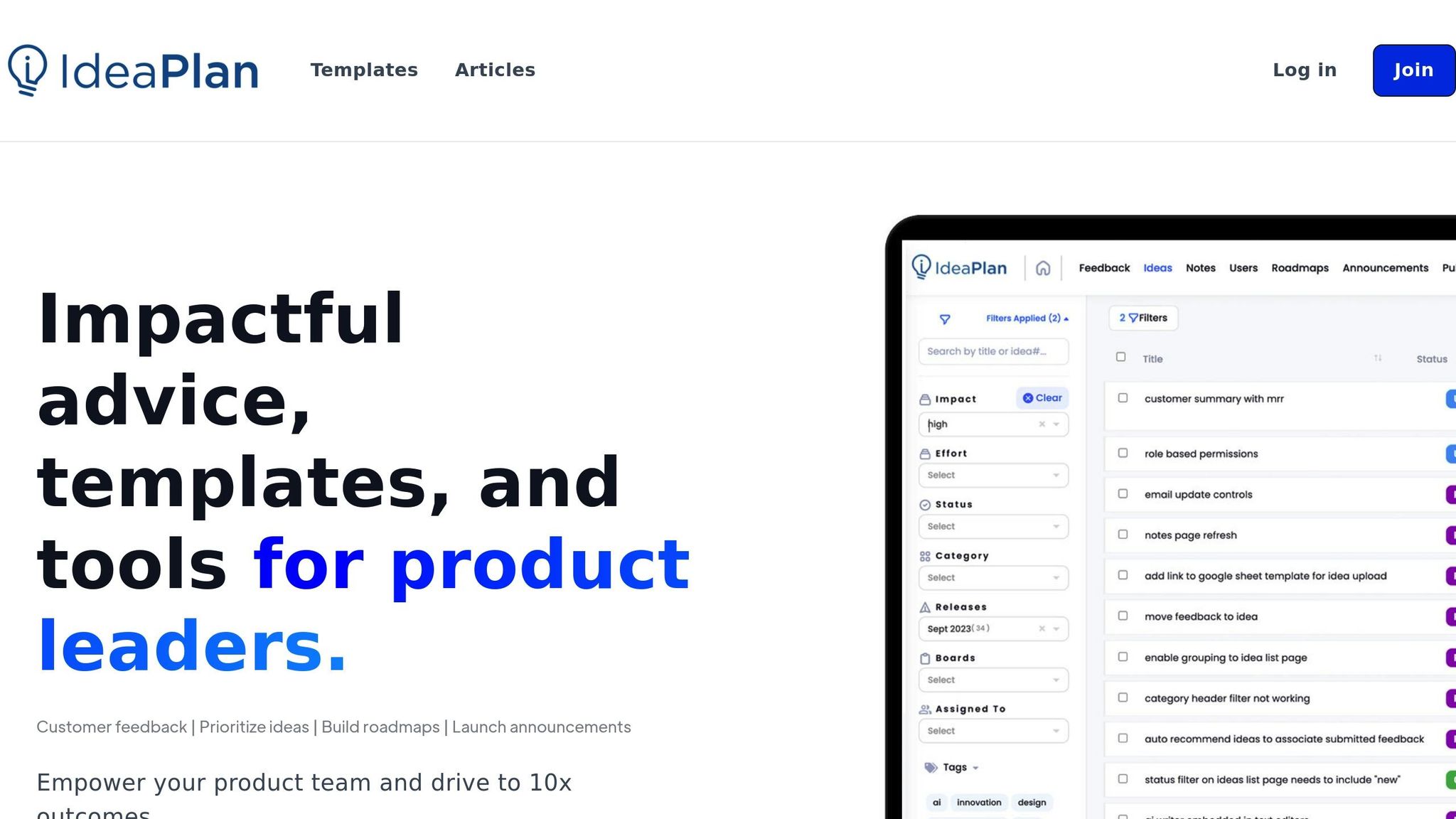
Taking these capabilities further, IdeaPlan offers features specifically designed to support remote product teams. Built to help product leaders scale their efforts and achieve exceptional outcomes, IdeaPlan uses AI-powered product management to streamline workflows.
The platform includes templates, playbooks, and collaboration tools that make organizing roadmaps, collecting feedback, and prioritizing initiatives easier - especially in remote settings. Roadmaps are managed in a central location with dynamic updates, keeping both internal teams and external stakeholders in the loop. Features like status updates, private comments, and internal notes improve communication across distributed teams. Public roadmaps and changelogs also enhance transparency with customers, cutting down on repetitive questions about upcoming features.
Additionally, IdeaPlan integrates with tools like Zapier and Jira, natively connecting your roadmap to existing workflows. This ensures data flows smoothly between systems, reducing redundancies. IdeaPlan’s Growth plan starts at $20 per user/month, offering unlimited roadmaps, changelogs, and users - an accessible option for companies looking to optimize their remote planning processes.
sbb-itb-7c23fa1
Communication Workflows for Distributed Teams
When working with remote teams, having a strong communication strategy is just as important as using the right tools and roadmaps. Without clear communication rituals and well-documented practices, even the most advanced roadmap tools won't prevent teams from falling out of sync across different time zones.
Weekly Syncs and Status Updates
Weekly video syncs, typically lasting 30. 45 minutes, are a cornerstone for keeping remote teams aligned. For instance, a team spread across the U.S. might schedule their sync at 9:00 AM PT / 12:00 PM ET. These meetings focus on critical decisions, priority reviews, and assigning next steps. To make these sessions more effective, teams often use a live board to connect discussions directly to ongoing tasks.
For routine status updates, asynchronous communication is often the go-to choice. Instead of traditional round-robin updates during meetings, many teams rely on tools like Slack bots or shared templates. A popular format for these updates includes categories such as "Done / In progress / At risk / Next week", allowing stakeholders to stay informed without needing additional meetings. According to GitLab's 2020 Remote Work Report, 52% of remote workers prefer asynchronous communication because it offers flexibility and helps maintain focus, although 38% still point to unclear communication as a major hurdle.
Kanban boards are another vital tool for distributed teams. They provide a visual overview of workflows and help identify shifting priorities quickly. Product managers often structure these boards with "Now / Next / Later" lanes, ensuring engineers know which tasks to tackle as capacity becomes available. To further support alignment across time zones, some teams conduct asynchronous reviews, like recording short Loom videos to walk through the board, reducing the need for additional meetings.
Clear and consistent updates, whether synchronous or asynchronous, create a solid foundation for collaboration.
Shared Documentation for Collaboration
Good documentation is key to capturing decisions and their reasoning. Tools like Confluence or Notion help organize this information effectively. A common approach is to structure documentation with a clear hierarchy: start with the product vision, followed by roadmap themes, then initiatives, and finally detailed specifications. Many teams also create a central "Product Home" page that links to essential resources like the live roadmap, current OKRs, and release calendar. Initiative pages often follow a consistent template, covering elements such as the problem statement, hypothesis, scope, success metrics, and a decisions log.
For globally distributed teams, using comment threads in documentation allows for asynchronous discussions without requiring everyone to attend the same meeting. Once decisions are finalized, it's important to resolve these threads and link meeting notes to relevant roadmap items. This practice ensures that team members can trace decisions back to specific conversations. Microsoft's 2022 Work Trend Index highlights that 42% of employees feel they "lack essential information" due to fragmented communication and tools - a problem that can be mitigated by centralizing information in a single, searchable hub. Rotating the responsibility for summarizing or presenting decisions in writing also ensures team members across different time zones stay informed and have the opportunity to weigh in asynchronously.
Online vs. Static Roadmaps: A Comparison

Online vs Static Roadmaps Comparison for Remote Teams
Static roadmaps often create headaches when it comes to managing versions, especially across different time zones. Imagine team members trying to figure out which email attachment contains the latest update - it's a common struggle when static files are shared across various locations. These roadmaps are generally tailored for one-off presentations rather than the ongoing collaboration that modern, distributed teams rely on.
Enter online roadmaps, which address these challenges head-on. These tools serve as a single, real-time source of truth, constantly evolving to reflect the latest updates. No more downloading files or waiting for someone to send the next version. This real-time functionality is critical for teams working on fast-moving projects, where static documents quickly become outdated. Online tools thrive in environments that demand flexibility and frequent updates.
Access is another critical factor. Static files, often saved locally or locked behind a VPN, limit accessibility. In contrast, browser-based roadmaps allow team members to check in anytime, anywhere, as long as they have the proper permissions. For teams spread across the U.S. or even globally, this means stakeholders can review progress whenever it suits their schedule, whether it's early morning or late at night.
Comparison Table
| Factor | Online Roadmaps | Static Roadmaps |
|---|---|---|
| Access Method | Browser-based; accessible anywhere with an internet connection and permissions. | Files shared via email or shared drives, requiring manual distribution. |
| Version Control | Single source of truth with instant updates, eliminating duplicate copies. | Multiple copies (e.g., "v1", "v2", "final_final") create confusion. |
| Update Efficiency | Real-time edits with changes instantly visible to all stakeholders. | Requires manual edits and re-sending files for every change. |
| Remote Suitability | Designed for distributed teams, supporting asynchronous updates and comments. | Primarily a presentation tool, making asynchronous collaboration difficult. |
| Progress Tracking | Dynamic updates, visual markers, and changelogs that sync with delivery tools. | Relies on fixed dates that quickly become outdated. |
While static roadmaps still have their place - think PDFs for investor decks or client presentations - they should always stem from an online source to minimize discrepancies. By treating the online roadmap as the central hub and using static exports only for specific communication needs, teams can stay aligned and avoid the chaos of version mismatches. This approach highlights why online roadmaps are essential for teams spread across multiple locations.
Conclusion: Key Takeaways for Remote Roadmap Success
Dynamic and collaborative roadmaps are the backbone of successful remote product teams, acting as a centralized hub that everyone can access, no matter where they are. Gartner projected that by 2024, 80% of product organizations would transition from project-based to product-based delivery - a shift that underscores the importance of adaptable roadmaps for teams working across different time zones.
Focusing on outcomes rather than rigid deadlines is crucial. Take Wildbit (Postmark) as an example: by replacing fixed deadlines with weekly meetings to reassess priorities, they managed to maintain both focus and quality. Dynamic roadmaps prioritize progress and outcomes over static visuals or fixed timelines. Regular communication, such as weekly syncs and periodic reviews, ensures remote teams stay aligned on both daily tasks and overarching goals. Pairing these meetings with shared documentation and asynchronous workflows is especially effective for distributed teams, creating a foundation for scalable collaboration.
Using the right tools can make a significant difference. Platforms like IdeaPlan use AI to centralize feedback, prioritize ideas, and enable real-time collaboration. The best software options are those that integrate natively into your existing workflows, automatically update, and support transparency across your team.
Flexibility is non-negotiable. As customer needs, market trends, and company strategies evolve, so must your roadmap. Assigning a dedicated roadmap champion helps maintain its relevance and ensures it remains a dynamic, living document. With consistent updates and strong leadership support, roadmaps transition from static plans to strategic assets. This approach, combined with the right tools and workflows, turns roadmap planning into a competitive edge for remote teams, enabling them to adapt and thrive in an ever-changing environment.
Explore More
- Top 8 Agile Frameworks for Product Teams (2026) - 8 agile frameworks compared side by side for product teams.
- Top 10 AI Tools for Product Managers (2026) - 10 AI-powered tools that save product managers hours every week.
- Top 10 Customer Feedback Tools and Methods (2026) - 10 tools and methods for collecting, organizing, and acting on customer feedback.
- Top 15 Free Product Management Templates (2026) - 15 free PM templates covering roadmaps, PRDs, strategy docs, sprint plans, and retrospectives.
Related Blog Posts
- Essential Product Management Checklist for 2025
- Align Product Roadmaps with Business Goals
- How to Adapt Product Roadmaps for Change
- How to build a SaaS roadmap