


Change is inevitable - whether it’s market shifts, customer feedback, or internal constraints like budget cuts. A rigid product roadmap won’t survive these challenges. Here's a quick guide to keeping your roadmap effective and aligned with your goals:
- Start with Strategy: Revisit your product vision and business objectives. Every roadmap update should tie back to these core principles.
- Prioritize with Data: Use frameworks like RICE (Reach, Impact, Confidence, Effort) or MoSCoW (Must-have, Should-have, Could-have, Won’t-have) to focus on high-impact work.
- Review Regularly: Compare current progress with performance metrics. Remove or delay initiatives that no longer align with priorities.
- Focus on Outcomes: Shift from feature-specific plans to goal-oriented roadmaps. Example: Instead of “Build Feature X,” aim for “Increase activation rate by 15%.”
- Use Flexible Timeframes: Replace rigid deadlines with categories like “Now, Next, Later” to accommodate changes without chaos.
- Communicate Clearly: Explain trade-offs to stakeholders and provide tailored roadmap views for different teams (e.g., executives, delivery teams, sales).
Tools like IdeaPlan can simplify these processes by centralizing feedback, simulating scenarios, and tracking metrics in real time. Regular updates and clear communication ensure your roadmap stays useful, even when priorities shift.
Key Takeaway: A flexible, outcome-driven roadmap keeps your team focused on what matters most - delivering measurable results while staying responsive to change.
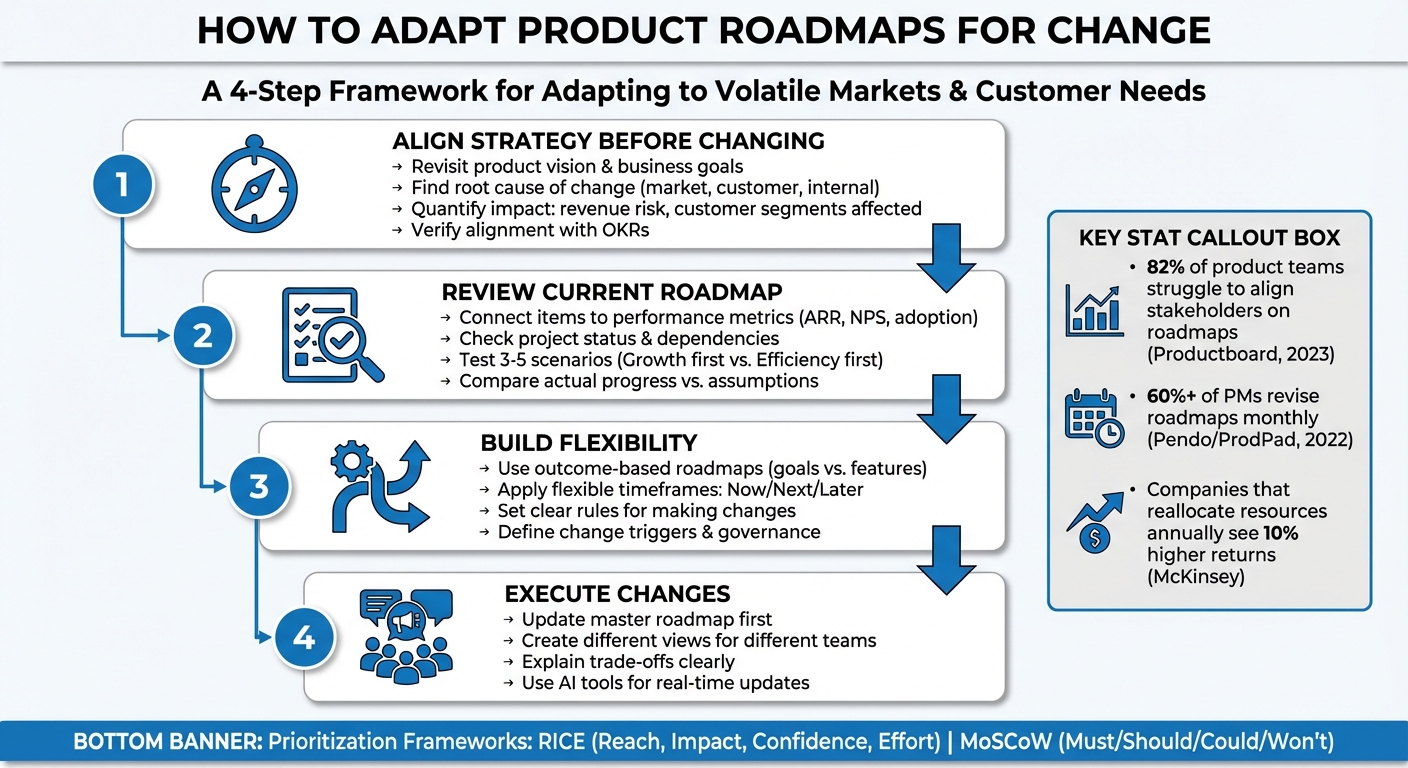
4-Step Framework for Adapting Product Roadmaps to Change
How to Convert Your Timeline Roadmap to a Now-Next-Later
Align Strategy Before Changing the Roadmap
Before diving into updates on your roadmap, take a step back and revisit your strategy. A roadmap is the execution arm of your strategy; if you tweak the roadmap without aligning it to your strategy, you risk creating a disconnect. This can lead to shipping features that don’t meaningfully affect business metrics, confusing stakeholders with shifting priorities, and wasting resources on work that doesn’t pay off.
The solution? Make sure every change you make ties back to your product vision, business goals, and customer value. This keeps your team on track, even when external conditions shift. Focus on initiatives that drive revenue, improve retention, or cut costs. If something doesn’t contribute to these priorities, it’s time to reconsider its place on your roadmap.
Find the Root Cause of Change
Not all changes require the same level of response. For instance, a single customer complaint doesn’t justify a roadmap overhaul, but a trend of churn among your most valuable accounts might. Start by identifying the type of trigger behind the change:
- Market trends (e.g., a competitor’s new feature)
- Customer signals (e.g., recurring support tickets or NPS feedback)
- Internal drivers (e.g., updated OKRs or budget adjustments)
Once you’ve categorized the trigger, gather data to back it up. For market-related changes, look at competitor launches, industry reports, or how your performance compares to market benchmarks. For customer-driven changes, dig into NPS comments, support tickets, churn reasons, product usage analytics, and feedback from your sales team. For internal factors, review new company objectives, budget shifts, compliance deadlines, or technical updates.
Finally, quantify the impact. Assess the revenue at risk or potential gain, identify the number of customers or segments affected, and estimate the effect on key metrics like retention or activation rates. This analysis helps you avoid overreacting to isolated incidents and ensures your roadmap adjustments address broader, high-impact issues.
Verify Your Product Vision and Business Goals
Take the time to restate your product vision and align it with your company’s current goals - whether that’s achieving revenue targets, entering new markets, or improving operational efficiency. For each roadmap theme or epic, link it to a strategic objective or OKR. If something doesn’t align, it’s a candidate for deprioritization or removal.
Also, consider whether shifts in the business require refining your vision or success metrics. For example, if your company has targeted a new customer segment, updated its pricing model, or pivoted its go-to-market strategy, your product vision might need an update too. Work with key stakeholders to confirm alignment on the revised vision and goals. This helps minimize conflicts when tough trade-offs arise later. Tools like lean canvases or strategy one-pagers can make this alignment clearer, while platforms like IdeaPlan can centralize feedback and simulate impact scenarios to ensure your strategy stays connected to execution.
Choose Criteria for Prioritizing Changes
Evaluate each proposed change using a clear set of criteria. Ask yourself:
- Does the change directly support a top-level company objective or OKR?
- Does it solve a validated problem for an important customer segment (measured by revenue, volume, or strategic relevance)?
- Is there solid data - such as customer research, analytics, or experiments - backing it up, rather than just opinions?
- Can it be delivered with the resources you have, within a time frame that still captures its value?
- What high-priority items would need to be delayed or dropped to make room for this?
If a change doesn’t pass these checks, keep it in discovery, leave it in the backlog, or reject it entirely. This ensures your roadmap remains focused on high-impact, strategic work. For changes that do make the cut, use frameworks like RICE or MoSCoW to prioritize them.
- RICE (Reach, Impact, Confidence, Effort) scores changes based on their potential reach and impact, the confidence in your data, and the effort required. This creates a transparent, data-driven way to prioritize and helps explain to stakeholders why certain requests are delayed or declined.
- MoSCoW (Must-have, Should-have, Could-have, Won’t-have) is particularly useful for quick, qualitative prioritization during urgent situations like regulatory shifts. Define Must-haves as essential items (e.g., compliance fixes for a new U.S. regulation), Should-haves as high-value items that can be delayed if necessary, Could-haves as lower-priority improvements, and Won’t-haves (for now) as ideas to acknowledge but not commit to. Pairing MoSCoW with an impact-versus-effort discussion helps clarify trade-offs and keeps conversations grounded, especially when under time constraints.
Once you’ve aligned your strategy and sharpened your prioritization criteria, revisit your current roadmap to ensure it reflects these refined conditions.
Review Your Current Roadmap Against New Conditions
Once you've aligned your strategy and set priorities, it's time to revisit your roadmap. Think of your roadmap as a flexible guide, not a rigid plan. The goal here is to decide what stays, what moves faster, what gets delayed, and what no longer makes sense to pursue.
Start by gathering up-to-date performance data. This helps you compare actual progress against your original assumptions and recalibrate timelines based on reality. A detailed review like this ensures each initiative aligns with clear performance metrics and addresses any practical dependencies. Leading product teams in the U.S. emphasize transparency about trade-offs when adjusting roadmaps. Explaining why certain items are delayed or removed - and how those decisions support company goals - helps maintain trust with stakeholders and teams.
Connect Roadmap Items to Performance Metrics
Every initiative on your roadmap should have clear, measurable outcomes tied to key metrics. For example, instead of a vague "Improve onboarding" goal, you could define it as: "Improve onboarding to raise activation rates from 45% to 60% and boost Net ARR by 5%." This approach connects the work directly to business results, whether that's ARR (Annual Recurring Revenue), NPS (Net Promoter Score), adoption rates, churn reduction, or time-to-value.
Start by listing your initiatives and assigning one or two key metrics to each. Then benchmark current performance and estimate the potential impact of each item. This process highlights misaligned efforts - like a feature with low adoption that’s draining resources while your market shifts. If you can’t tie an initiative to strategic or metric goals, it’s likely a candidate for deprioritization.
Here’s a practical example: A SaaS company introduced a new dashboard feature, aiming to improve NPS by 15 points and achieve 30% adoption. After a market shift, data showed only 10% adoption and no ARR growth. They quickly pivoted, shifting resources to integrations requested by high-ARR customers, which drove a 25% revenue increase. The key? They had metrics in place from the start, enabling them to make data-driven decisions instead of relying on opinions.
With metrics defined, you can assess project status and identify any dependencies, keeping your roadmap grounded in what's achievable.
Check Project Status and Dependencies
Use your project management tools to check real-time progress, completion rates, blockers, and team velocity. For each initiative, identify dependencies - whether they involve other teams, platforms, data sources, or external vendors. Pay special attention to dependencies where priorities may have shifted or risks have increased under new conditions.
Here’s an example: Imagine a UI redesign is 80% complete but relies on a delayed backend API from a vendor. If new market priorities emerge, you might need to pause the redesign to avoid wasting two weeks of team time. Dependencies can create bottlenecks, and risks like skill shortages or vendor delays only make matters worse. You can address this by cross-training team members or using tools like the MoSCoW framework to shift "Should-haves" into "Won't-haves (for now)", freeing up resources for more impactful work.
It’s also helpful to create a risk register for your roadmap. Document the probability, potential impact, and mitigation plans for risks tied to key initiatives. Adjust the sequencing of your roadmap to spread out risks and avoid bottlenecks. By identifying blocked or at-risk work and understanding the root causes - whether it’s dependencies, staffing, or technical challenges - you can prevent delays from snowballing across your roadmap.
Test Different Scenarios
Scenario planning helps you model potential outcomes before committing to a path. Develop 3–5 scenarios, such as "Growth first" or "Efficiency first", to evaluate their impact on key metrics, resource needs, and trade-offs. For each scenario, estimate how it will affect key metrics over the next one to four quarters, the team’s capacity and skills, and potential risks, like postponing a high-profile feature.
These comparisons can guide leadership and cross-functional teams in selecting the best path - or even combining elements into a hybrid approach that balances competing priorities.
Tools like IdeaPlan can simplify this process by using AI to connect metrics in real time, map dependencies, and simulate scenarios. With features like real-time ARR and NPS dashboards, product managers can quickly predict the impact of changes, gather feedback, and adapt plans more efficiently than manual spreadsheets. These scenario tests help keep your roadmap flexible and aligned with shifting priorities. Once you’ve chosen the best path forward, you can focus on building flexibility into your roadmap for the future.
sbb-itb-7c23fa1
Build Flexibility Into Your Roadmap
Once you've reviewed your roadmap to ensure it aligns with your strategy and metrics, the next step is to make it adaptable. A roadmap that can evolve with new information is far more effective than one that's rigid. This adaptability reduces friction during pivots and helps keep stakeholders on the same page, even when tactics need to shift. Here are some key ways to ensure your roadmap stays flexible while remaining aligned with your goals.
Flexibility in roadmaps comes down to three core practices: focusing on outcomes rather than features, using flexible time horizons instead of fixed dates, and setting clear guidelines for managing changes. These practices allow teams to adjust to market demands, customer feedback, and internal shifts, all while maintaining strategic focus and trust within the team.
Use Outcome-Based Roadmaps
Structure your roadmap around goals, themes, and measurable outcomes instead of locking in specific features or dates. For instance, instead of committing to "Build onboarding wizard by Q2", shift the focus to "Increase self-serve activation from 45% to 60% by mid-year." This approach gives you flexibility in how you achieve the goal - whether through a wizard, video tutorials, or something else - without needing to rewrite the roadmap or renegotiate with stakeholders.
Outcome-based roadmaps organize work under broader themes like "Improve Conversion", "Reduce Churn", or "Expand Enterprise Features." These themes are tied to measurable business metrics, such as revenue, NPS scores, adoption rates, or a reduction in support tickets. When priorities shift, you can adjust the initiatives or experiments within a theme while keeping the overall outcome consistent.
To transition your roadmap to this model, start by grouping existing features into problem areas or strategic themes. Then, define measurable outcomes for each theme, such as "Reduce billing-related support tickets by 30% by year-end" or "Increase expansion revenue by $500,000 in Q3." Evaluate features based on how they contribute to these outcomes. Tools like IdeaPlan can help you link initiatives to outcomes, monitor real-time metrics like ARR and NPS, and quickly adjust priorities when needed - all while keeping your strategic goals intact.
Apply Flexible Time Frames
Instead of anchoring your roadmap to precise delivery dates, use time horizons like "Now, Next, Later." In this framework, "Now" covers work that's actively in progress or firmly planned for the current quarter, "Next" includes high-priority initiatives expected to start in the next one or two quarters, and "Later" holds validated ideas that require further exploration or depend on future capabilities. This setup reduces the need for constant renegotiation and allows for smoother adjustments as new information becomes available.
Align these horizons with quarterly planning cycles, but avoid tying them to fixed calendar dates. To make this approach effective, define what "Now", "Next", and "Later" mean for your organization and share those definitions with stakeholders. Set limits, such as capping the number of initiatives in the "Now" category, and review progress regularly - either monthly or at the end of each sprint. This ensures that priorities can be reassessed in light of new data, customer feedback, or market changes.
Once you've adopted flexible time frames, it's essential to establish clear rules for making adjustments.
Set Rules for Making Changes
To keep your roadmap adaptable without creating chaos, establish clear governance. Start by identifying change triggers - specific events that warrant adjustments. These might include shifts in revenue forecasts, the loss of a key customer, new competitive threats, regulatory changes, or significant user feedback. Define who has the authority to make changes at different levels: for example, a Chief Product Officer might oversee strategic shifts, while directors handle theme adjustments, and managers deal with feature-level changes.
For major adjustments, require a concise "change brief" that outlines the rationale, supporting metrics, affected initiatives, and any tradeoffs. This documentation promotes transparency and helps stakeholders understand why changes are being made, reducing the perception of instability. Additionally, publishing a roadmap change policy that clarifies what remains stable (like the vision and long-term outcomes) versus what can change frequently (like features or sequencing) builds trust and ensures flexibility is seen as a structured process rather than reactive chaos.
Execute Roadmap Changes with Your Team
Once you’ve established a flexible roadmap, the next step is rolling out changes across your organization in a way that minimizes confusion and maintains trust. The process boils down to three key actions: update the master roadmap, communicate changes clearly, and customize details for specific groups.
Start by updating the master roadmap in your primary tool before sharing anything with the team. Make sure changes align with your strategy and OKRs, and identify all the groups impacted - product squads, engineering, design, marketing, sales, and support. Plan briefings in stages: begin with product and engineering teams, then move to cross-functional groups, and finally loop in executives. Prepare a clear change summary that explains what’s changing, why (with data, customer feedback, or market trends to back it up), how it affects timelines and scope, and what actions each group needs to take. Be precise: use US date formats (MM/DD/YYYY), express financial impacts in USD, and specify time zones for distributed teams (e.g., "3:00–3:30 PM PT"). Document every decision in a shared space - like Confluence, Notion, or your roadmap tool - along with owners and review dates to keep everything auditable.
Once the master roadmap is updated, adjust the views to suit the needs of different teams.
Create Different Roadmap Views for Different Groups
Keep one master roadmap that contains every detail, but create customized views for different audiences. Executives care about outcomes, business impact, and major milestones by quarter - things like revenue changes in USD, shifts in NPS, or market share goals - without diving into feature specifics. Delivery teams, on the other hand, need granular details, including initiatives, dependencies, risks, and capacity assumptions, broken down by sprint or iteration. For customer-facing teams like sales, customer success, and marketing, provide a simplified view grouped by the problems being solved and broader time frames like "Now / Next / Later", avoiding exact dates to prevent overpromising.
Use consistent IDs or tags across all roadmap views so every item links back to the master roadmap. Integrated tools can ensure that when the master roadmap is updated, all tailored views refresh automatically. This approach keeps everyone aligned without overwhelming them with unnecessary details or causing version mismatches across teams.
Explain What You're Trading Off
When priorities shift, it’s essential to explain what’s being prioritized, delayed, or removed. Transparency about trade-offs builds trust and prevents teams from working with outdated assumptions. Use a before-and-after comparison to show which initiatives have moved, been removed, or added, and explain why. For major changes, outline the expected impact on customers and the business. For instance, “We’re delaying Feature A by one quarter to prioritize Feature B, which is projected to generate an additional $500,000 ARR.” Be clear about the risks involved in the new decision versus the old one.
Document these trade-offs using frameworks like RICE or MoSCoW to ensure decisions are based on objective criteria. In team meetings, encourage open discussions around trade-offs by asking questions like, “What are we giving up to do this?” This can help uncover hidden dependencies or misalignments. Whenever possible, track and share the actual impact of these decisions post-launch to demonstrate that trade-offs were guided by data, not assumptions.
To make this process even smoother, consider using technology for real-time updates.
Use AI Tools for Roadmap Management
AI-powered platforms like IdeaPlan can simplify roadmap management by analyzing customer feedback, usage data, and market trends to spotlight high-impact opportunities and risks. These tools can help product teams adjust roadmaps dynamically, relying on live data instead of intuition. They can suggest priority scores, group similar requests, and estimate effort or impact, cutting down manual work and making trade-offs more transparent for stakeholders.
For example, if new data shows a spike in churn or a surge in demand for a feature, AI tools can notify product leaders, recommend adjustments, and automatically update plans across teams. This enables adaptive, outcome-driven roadmapping that helps teams stay responsive without losing sight of their strategic goals.
Conclusion
Main Takeaways for Roadmap Changes
To refine your roadmap, start by ensuring your product vision, business goals, and customer outcomes are aligned. Then, take a hard look at your current plan - review progress, dependencies, and performance data to figure out what adjustments are realistic without compromising existing commitments. Shift your focus to flexibility by structuring your roadmap around outcomes and themes, not rigid feature lists. Broad timeframes like Now/Next/Later or quarterly groupings can make adapting easier. Finally, keep stakeholders in the loop by clearly explaining any changes and why they’re necessary. This approach not only addresses immediate challenges but also lays the groundwork for long-term adaptability.
A recent Productboard report (2023) revealed that 82% of product teams struggle to align stakeholders on a single roadmap. This underscores how crucial clear communication and dynamic, living documents are. Additionally, a 2022 Pendo/ProdPad survey found that over 60% of product managers revise their roadmaps monthly, showing that frequent updates have become standard practice.
Prepare Your Roadmaps for Future Changes
To handle future shifts effectively, build on these adaptive strategies. Standardize templates for different roadmap types to ensure clarity and resilience. For example:
- Strategic roadmaps: Focus on themes and key priorities by quarter.
- Delivery roadmaps: Highlight epics, dependencies, and capacity.
- Go-to-market roadmaps: Emphasize launches and enablement milestones.
Each template should include clear ownership and status fields to streamline updates and reduce confusion.
Set up a quarterly strategic review process and hold monthly delivery reviews. Make roadmap discussions a regular part of leadership meetings so that adjustments become routine rather than a reaction to crises. After significant changes, conduct retrospectives to capture lessons learned and refine your planning approach for better risk management.
Leverage modern tools to keep your roadmap up-to-date. Platforms like IdeaPlan can analyze customer feedback, usage data, and market trends using AI, helping you identify high-impact opportunities and adjust priorities based on real-time insights. These tools can also automate status updates, create tailored roadmap views for different audiences, and even suggest scenario plans when conditions change. This frees your team to focus on strategic decisions. According to McKinsey, companies that regularly reallocate resources across product portfolios (at least annually) see up to 10% higher total returns to shareholders - proof that consistent roadmap updates deliver measurable results.
FAQs
How can I keep my product roadmap aligned with business goals during changes?
To ensure your product roadmap stays in sync with shifting business objectives, it’s crucial to revisit and adjust it regularly. Factor in customer feedback, keep an eye on market trends, and make sure it aligns closely with your organization’s goals.
Leverage tools that centralize feedback, simplify prioritization, and allow for dynamic updates to your roadmap. These tools not only help you remain adaptable but also ensure clear and consistent communication with stakeholders. Regular updates and collaborative efforts are essential to keeping your roadmap on track for long-term success.
What are the most effective ways to prioritize changes in a product roadmap?
To prioritize updates in your product roadmap effectively, consider using frameworks like the Value vs. Effort Matrix, Kano Model, MoSCoW Method, RICE Scoring, or Opportunity Scoring. These tools are designed to help you evaluate factors like impact, feasibility, and urgency, ensuring that your updates align with both business objectives and market demands.
Each of these frameworks brings its own strengths to the table. For instance, the Value vs. Effort Matrix is great for identifying quick wins while balancing them against long-term goals. On the other hand, RICE Scoring provides a structured way to prioritize by evaluating Reach, Impact, Confidence, and Effort. Choosing the right approach allows you to make well-informed decisions and maintain flexibility as priorities shift.
What’s the best way to communicate changes to a product roadmap with stakeholders?
To share roadmap changes effectively, focus on crafting messages that resonate with each stakeholder group. Use clear, straightforward language to outline what’s changing, why it’s happening, and how it affects them. Regular updates are essential - visual tools like dashboards or concise summary reports can help keep everyone on the same page.
Get stakeholders involved early by opening up discussions to address concerns and collect feedback. Explaining the reasoning behind changes builds trust and ensures everyone understands the goals behind the adjustments. Keeping communication consistent encourages collaboration and makes it easier to navigate any resistance to change.

