


40% of new products fail. Why? Weak ideas. Strong idea generation isn’t just brainstorming - it’s a continuous process that connects customer problems to business goals. This guide simplifies how product managers can create, refine, and prioritize ideas to build better products.
Key Takeaways:
- Idea generation vs. management: Generating ideas is about creating possibilities; managing them is about organizing and prioritizing.
- Techniques to generate ideas: Use methods like brainstorming, SCAMPER, and Jobs-to-Be-Done to address customer pain points.
- Data-driven ideation: Leverage customer feedback, product usage data, and competitive analysis for insights.
- Structured prioritization: Frameworks like RICE and ICE help evaluate ideas objectively.
- Validation: Test ideas with lightweight experiments like prototypes or A/B tests to ensure they solve real problems.
Actionable Tip: Build a system to consistently gather, organize, and refine ideas. Tools like IdeaPlan can centralize workflows, apply scoring models, and automate processes, helping you focus on what matters most.
This guide breaks down everything you need to know to master ideation and turn raw concepts into successful product opportunities.
How to Establish a Product Idea Intake Process
Techniques for Generating Product Ideas
Choosing the right approach for generating product ideas depends on the problem you're tackling and the dynamics of your team. Each technique builds on the principles of understanding customer needs, fostering collaboration, and refining ideas iteratively. Let’s explore some methods that can help streamline the idea generation process.
Brainstorming is a great starting point when you need to explore a wide range of ideas quickly. Bring together a diverse team, clearly define the problem, and set a "no judgment" rule for 15–30 minutes. During this time, participants share as many ideas as possible - no matter how wild they might seem. The goal is quantity over quality at this stage. Afterward, group similar ideas to identify patterns or themes.
Brainwriting, on the other hand, offers a quieter alternative. Instead of discussing ideas out loud, participants write their thoughts down for 5–10 minutes. These sheets are then passed around, allowing others to build on the initial ideas. This method minimizes groupthink, ensures everyone gets a voice, and can be particularly effective in teams where hierarchy or dominant personalities might stifle contributions.
Mind mapping is a visual tool that helps connect challenges, user needs, and potential solutions. For example, if your challenge is to "improve user onboarding", write it at the center of a canvas and branch out to related pain points, constraints, and feature ideas. This approach often reveals gaps or opportunities. Let’s say you map out "retention drop-off" - you might uncover a specific issue like "tutorial gaps", which could inspire solutions like interactive demos or gamified tutorials.
The SCAMPER method encourages you to rethink products or processes by asking targeted questions:
- Substitute: What could you swap out?
- Combine: What features could you merge, perhaps with tools like AI?
- Adapt: What ideas could you borrow from other industries?
- Modify: What can be enhanced or scaled down?
- Put to another use: How else might this be used?
- Eliminate: What’s unnecessary?
- Reverse: What happens if you flip the approach?
For instance, a team applied SCAMPER to an outdated CRM system. By eliminating redundant fields and integrating AI, they created a streamlined dashboard that increased adoption rates by 25%.
When visual tools or systematic approaches fall short, focusing directly on customer challenges can be more effective.
Problem-Focused and Jobs-to-Be-Done Approaches
Problem-focused ideation ensures that your ideas address real customer needs instead of vague concepts. Start by gathering data on user pain points through interviews, surveys, or support tickets. Then, reframe these challenges into actionable "How might we" questions, like "How might we reduce cart abandonment at payment?" From there, run focused brainstorming sessions, prioritize the best ideas, and rapidly prototype solutions. This approach helps avoid the trap of building features based on assumptions - especially when 40% of new products fail for this reason.
The Jobs-to-Be-Done (JTBD) framework digs deeper into what customers are trying to achieve. For example, Slack identified the "job" of enabling team coordination without the chaos of email. This insight led to features like channels and bots, which helped them scale to millions of users. By interviewing customers to understand their functional, emotional, and social goals - like "staying fit without the gym" or "getting home safely after late events" - you can design features that directly address these needs. This method not only helps refine your product but also uncovers opportunities for growth that align with your business goals.
Creating a System for Ongoing Idea Generation
The best product teams don’t rely on sporadic brainstorming sessions to keep their pipeline full. Instead, they build systems that continuously gather, sort, and refine ideas. Without a structured process, valuable insights can get buried in scattered conversations or forgotten emails. A solid system ensures every idea is captured, evaluated, and turned into something actionable.
Where to Find Good Ideas
Customer feedback is one of the richest sources of inspiration. Regularly review support tickets, NPS (Net Promoter Score) comments, and notes from customer advisory board meetings. For instance, analyzing support ticket tags monthly can reveal recurring pain points - like noticing that 15% of tickets mention issues with a specific workflow. Sales team win/loss interviews are another goldmine, offering insights into why deals are won or lost, which often highlights unmet customer needs.
Product usage data is equally valuable. It shows what users actually do versus what they say. Pay attention to areas like high drop-off rates in conversion funnels, underused features despite active promotion, or unexpected trends in user behavior. For example, a 60% drop-off at a particular form step signals a problem worth investigating. Additionally, keep an eye on competitors by reviewing their release notes, user reviews, and market analysis reports. And don’t forget to tap into your internal teams - regular check-ins can surface insights from those closest to the work.
How to Organize and Maintain an Idea Backlog
A great backlog isn’t just about collecting lots of ideas - it’s about organizing them in a way that makes them manageable and actionable. Tag each idea consistently with details like product area, user persona, lifecycle stage, potential impact (e.g., revenue, retention, satisfaction), and estimated effort (e.g., XS to XL). Use a defined workflow to track the status of each idea, such as “new,” “triaged,” “exploring,” “validated,” “planned,” or “rejected.”
To keep your backlog focused, set up retention rules. For example, automatically archive ideas that haven’t gained traction after a year, and merge duplicate requests instead of letting them pile up. Create a schedule for reviewing ideas: weekly or bi-weekly triage sessions for tagging and routing new submissions, monthly grooming sessions to prioritize using scoring frameworks like RICE (Reach, Impact, Confidence, Effort), and quarterly strategic reviews to ensure alignment with company goals.
Establish clear thresholds to make decision-making consistent. For example, ideas linked to more than $50,000 in annual recurring revenue (ARR) or addressing top NPS detractors could automatically move to an “explore” status. This approach removes guesswork and ensures high-priority ideas are addressed promptly.
To make this system even smoother, consider using a dedicated tool to centralize and automate these processes.
Using IdeaPlan to Manage Ideas
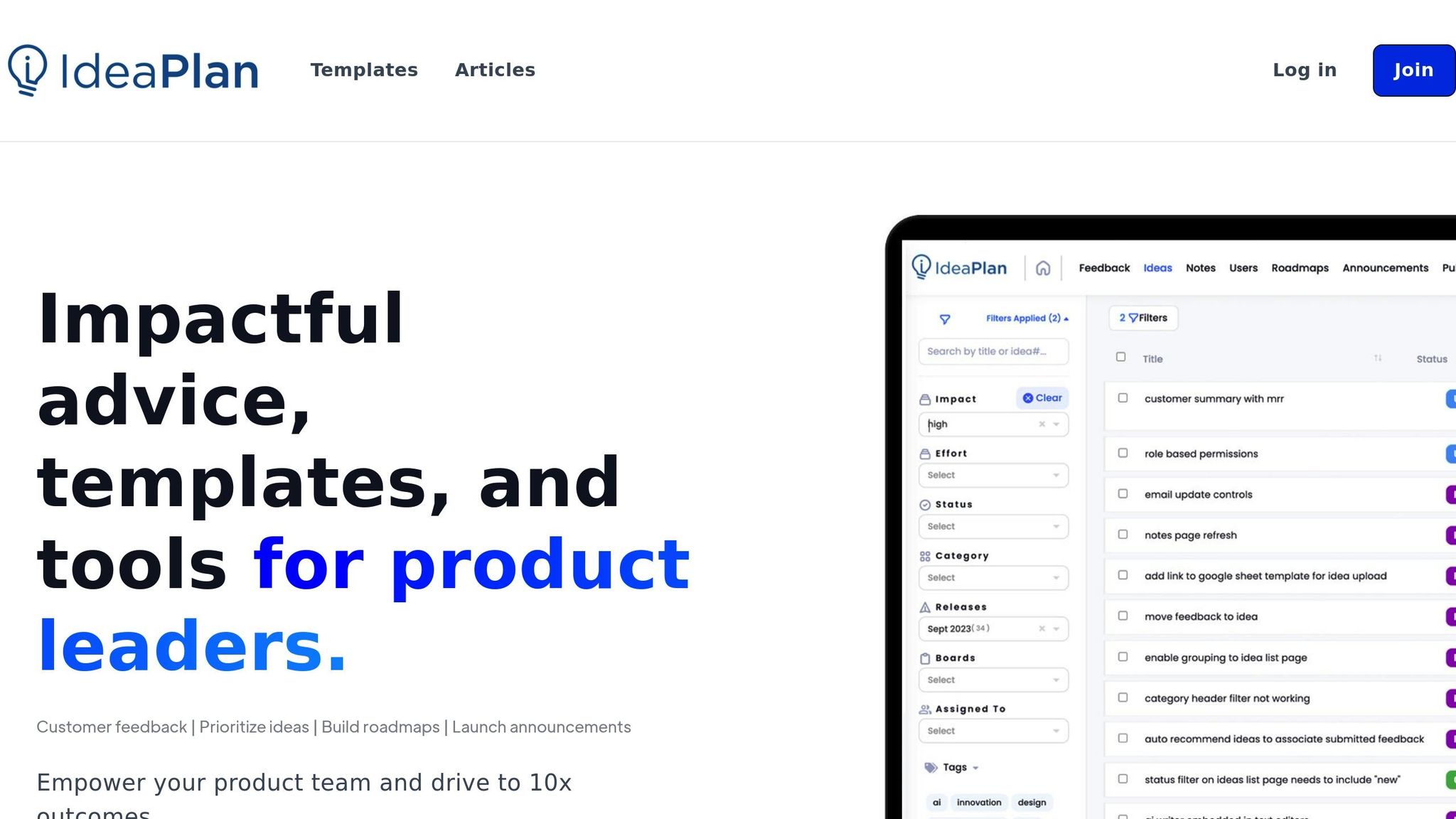
Once you’ve built a structured backlog, a centralized platform like IdeaPlan can take your process to the next level. IdeaPlan consolidates scattered information into one workspace, making it easier to manage your idea pipeline. You can capture ideas from various sources - customer feedback, internal suggestions, or meeting notes - using templates that include key details like the problem, affected users, potential impact, and supporting evidence. Tagging ideas by product area, user persona, or strategic theme simplifies searching and filtering.
IdeaPlan’s AI tools make managing feedback and ideas even more efficient. The AI can summarize raw feedback into clear themes, automatically tag ideas, and even suggest prioritization based on available data - essentially providing rough RICE-like scores without the manual effort. It can also help generate experiment ideas or draft user stories from promising concepts, speeding up the journey from idea to actionable hypothesis. With built-in templates for discovery briefs, validation plans, and decision logs, IdeaPlan ensures consistency across your team, making it easier to scale your idea generation process while maintaining quality and traceability.
sbb-itb-7c23fa1
Converting Ideas into Product Opportunities
Product Idea Prioritization Frameworks: RICE vs ICE Comparison
You’ve set up a system to gather and organize ideas - now comes the challenging part: figuring out which ones are worth pursuing. Mismanaging resources on ideas that don’t align with your strategy is a common cause of product failure. Research shows that only about 5–10% of ideas actually evolve into viable product initiatives.
Screening and Framing Ideas
Start by filtering out ideas that don’t align with your strategic goals. Define specific themes, like "improve activation" or "expand to SMB", and tag each idea to one or more of these themes. If an idea doesn’t fit any of them, it might be time to archive it. Evaluate each idea based on these questions:
- Does it align with your product vision and KPIs?
- Does it solve validated user problems supported by data?
- Is it technically and financially feasible?
If an idea fails on two or more of these points, it’s a clear sign to move on.
Next, refine raw ideas into clear problem statements. For instance, instead of a vague suggestion like "add a chat feature", reframe it as: "How can we reduce user support tickets by 30% through real-time assistance?" This approach shifts the focus from a specific solution to a measurable outcome, making it easier to assess the idea’s potential. Using a structured template that highlights the target user, the problem, the proposed solution, and the expected outcome (like improved retention or a higher conversion rate) simplifies prioritization and validation later on.
Prioritizing Ideas with Scoring Frameworks
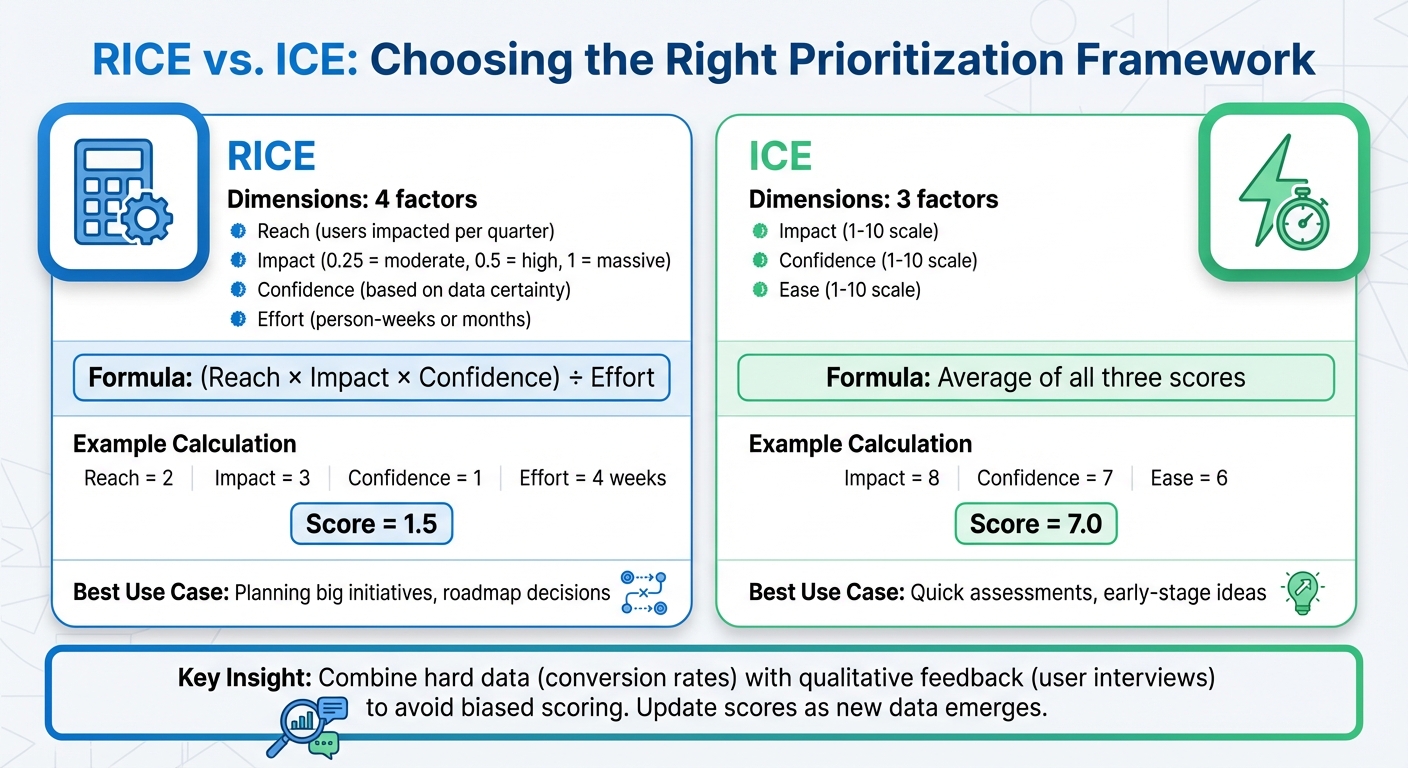
Once you’ve framed your ideas, the next step is prioritization. Scoring frameworks like RICE and ICE can help you evaluate ideas objectively:
-
RICE: This method considers four factors:
- Reach: How many users will be impacted (e.g., 50,000 users per quarter)?
- Impact: The effect on a key metric (scored as 0.25 for moderate, 0.5 for high, or 1 for massive).
- Confidence: How certain you are, based on available data.
- Effort: The resources needed, often measured in person-weeks or months.
- ICE: This simpler framework scores ideas on Impact, Confidence, and Ease (1–10 scale) and averages the scores. For example, if a feature scores Impact = 8, Confidence = 7, and Ease = 6, the average score is 7.0.
To avoid biased scoring, combine hard data (like conversion rates) with qualitative feedback from user interviews or sales teams. Keep in mind that scores should evolve as new data or experiments provide fresh insights.
| Framework | Dimensions | Best Use Case |
|---|---|---|
| RICE | Reach, Impact, Confidence, Effort | Planning big initiatives, roadmap decisions |
| ICE | Impact, Confidence, Ease | Quick assessments, early-stage ideas |
| 2×2 | Value vs. Effort | Workshops, team discussions |
Validating and Refining Ideas
After prioritizing, it’s time to validate and refine your ideas to ensure they’re actionable. Start with lightweight experiments:
- Problem Validation: Conduct 5–10 user interviews to understand how often users face the issue, how severe it is, and what workarounds they use. Use surveys to measure how widespread the problem is.
- Solution Validation: Create clickable prototypes using tools like Figma and test them with a similar number of users. This helps identify usability issues and gauge interest. Try fake-door tests, where you advertise a feature that doesn’t yet exist, to measure interest through click-through rates. For example, Dropbox validated its concept with a simple explainer video that led to 75,000 sign-ups.
Finally, run small-scale experiments like A/B tests, concierge tests (manually performing the service for a few users), or wizard-of-Oz tests (where users think they’re interacting with a fully developed system, but a human handles key functions behind the scenes). Look for metrics like prototype conversion rates above 40%, an NPS of 7 or higher, or measurable improvements in KPIs. Based on results, you can refine the idea by narrowing its scope, repositioning it, or targeting a different audience - or decide to discard it altogether.
Tools like IdeaPlan can simplify this entire process by managing your idea backlog, applying scoring frameworks automatically, and tracking validation experiments, ensuring only the strongest ideas make it to your roadmap.
Leading Ideation as a Product Manager
Moving beyond just gathering and organizing ideas, effective leadership in ideation ensures these concepts transform into actionable opportunities.
Running Productive Ideation Sessions
As a product manager, your job isn’t to own every idea but to create an environment where your team can contribute their best thinking. Start by framing ideation sessions with a clear, measurable problem statement. For instance, instead of saying "improve onboarding", set a defined goal like, "increase onboarding activation rate from 45% to 60% for self-serve SMB customers in Q3". This kind of specificity keeps the conversation focused on impactful solutions.
Lay down some ground rules before you begin. Delay judgment during brainstorming, ensure everyone has equal time to share, and use techniques like brainwriting to give quieter team members a chance to contribute. It’s also essential that participants come prepared with relevant data to inform their ideas.
During the session, stick to a structured timeline - spend about 10 minutes on silent idea generation, 20 minutes grouping similar ideas, and 15 minutes for dot-voting to prioritize. Use tools like shared whiteboards or digital platforms to keep the process visible and organized. Wrap up the session with clear next steps: identify which ideas will move forward, assign responsibilities, and outline how these ideas will be validated. Finally, document and share outcomes quickly so the team sees how their input drives progress.
Building a Culture of Experimentation
Once you’ve nailed structured ideation sessions, the next step is fostering a culture of continuous experimentation. A team grounded in experimentation doesn’t wait for grand product launches - it thrives on small, frequent tests. Encourage practices like A/B testing, creating prototypes, or using concierge tests to manually validate ideas with select users. Beyond tracking features shipped, monitor how quickly your team learns - for example, by measuring the number of experiments completed each quarter.
It’s critical to create an environment where failure is part of the process. Share lessons from unsuccessful experiments openly, without assigning blame. Whether a prototype falls short or a test yields negative results, celebrate the effort and thoughtful design of the experiment. This focus on learning can have a big impact - companies that embrace this mindset are up to three times more likely to lead in innovation. Make experiment logs and dashboards a regular feature in product meetings to reinforce transparency and learning.
To further enrich this culture, involve team members from various departments to bring in diverse perspectives. Using anonymous channels for idea submissions can also help surface insights from junior team members and reduce the risk of groupthink.
Scaling Ideation with AI and Templates
Once you’ve built a strong foundation with structured sessions and a culture of experimentation, it’s time to scale the process. Standardized playbooks and templates ensure consistent, high-quality ideation across teams and time zones. Develop reusable formats for tasks like new-feature brainstorming, opportunity evaluations, and experiment planning. Templates for problem framing, hypothesis testing, and retrospective analysis can help any product manager hit the ground running without starting from scratch.
AI tools can also play a supportive role by generating alternative problem statements or drafting hypotheses. However, it’s important to remember that AI is a tool to enhance efficiency, not a replacement for human judgment, especially when it comes to prioritization and ethical decision-making.
Platforms like IdeaPlan can streamline the process by centralizing idea collection, applying structured scoring models, and offering AI-assisted playbooks. This allows U.S.-based product teams to scale best practices, drive outcomes at a much larger scale, and directly align ideation with quarterly roadmaps and business goals.
Conclusion: Key Takeaways for Product Managers
Generating ideas isn’t a one-time task - it’s an ongoing process powered by customer feedback, market insights, and teamwork across departments. The most effective product managers approach ideation as a continuous practice, not something reserved for quarterly planning. Simple habits, like holding weekly customer calls or regularly reviewing support tickets, can turn raw ideas into actionable strategies.
When it comes to techniques, flexibility is key. Whether you’re brainstorming, brainwriting, using SCAMPER, or applying Jobs-to-Be-Done, choose the method that fits the problem at hand. Great product managers know when to encourage free-flowing creativity for groundbreaking ideas and when to focus on solving specific challenges with precision. They also create environments where every voice is heard, ensuring quieter team members contribute and minimizing groupthink or dominance by a few individuals.
But ideation is just the start - screening and validation are equally important. By using structured prioritization methods and testing ideas on a small scale, you can identify which concepts hold real value before making significant investments. This disciplined approach ensures your backlog stays focused on what matters most to your customers.
In your first 30 days, set the foundation for success. Audit your idea sources, centralize your backlog with key details like problem statements and impact estimates, and ensure nothing valuable gets lost in casual channels like Slack or email. Run a targeted ideation session, then use a scoring model to prioritize top ideas. Tools like IdeaPlan can help you capture ideas, leverage AI-driven scoring, and align them directly with your quarterly roadmaps. The goal? Build a system that grows and improves as your team uncovers new insights.
FAQs
What are the best techniques for coming up with product ideas?
Generating meaningful product ideas often begins with paying attention to your customers. Dive into their feedback to identify pain points, unfulfilled needs, and areas where improvements could make a difference. Pair this with team brainstorming sessions, which can be especially productive when anchored by clear objectives and real user insights.
Collaborative tools are a great way to organize, sort, and refine ideas efficiently. These tools simplify the process, helping your team stay aligned and focused on the most promising concepts. By blending customer feedback, teamwork, and streamlined workflows, you can consistently develop ideas that deliver genuine value.
How can product managers leverage data to generate better ideas?
Product managers can tap into the power of data to inspire and refine their ideas. By digging into customer feedback, studying usage patterns, and keeping an eye on market trends, they can uncover gaps, challenge assumptions, and spot opportunities that align with the company’s objectives.
Centralizing these insights and evaluating ideas based on their potential impact allows product managers to concentrate on initiatives that truly matter. This approach not only keeps the development process focused on delivering value but also ensures it remains centered around customer needs, leading to impactful outcomes.
What are the best frameworks for prioritizing product ideas?
When it comes to prioritizing product ideas, methods like analyzing customer feedback, using voting systems, and employing categorization techniques can make a big difference. These strategies help ensure that your ideas are not just creative but also aligned with what customers want and what your business aims to achieve.
Leveraging product management tools can take this process to the next level. These tools help you organize ideas into clear categories, keep track of feedback, and make decisions based on real data. This way, your team can concentrate on the projects that matter most and deliver the biggest impact.

