

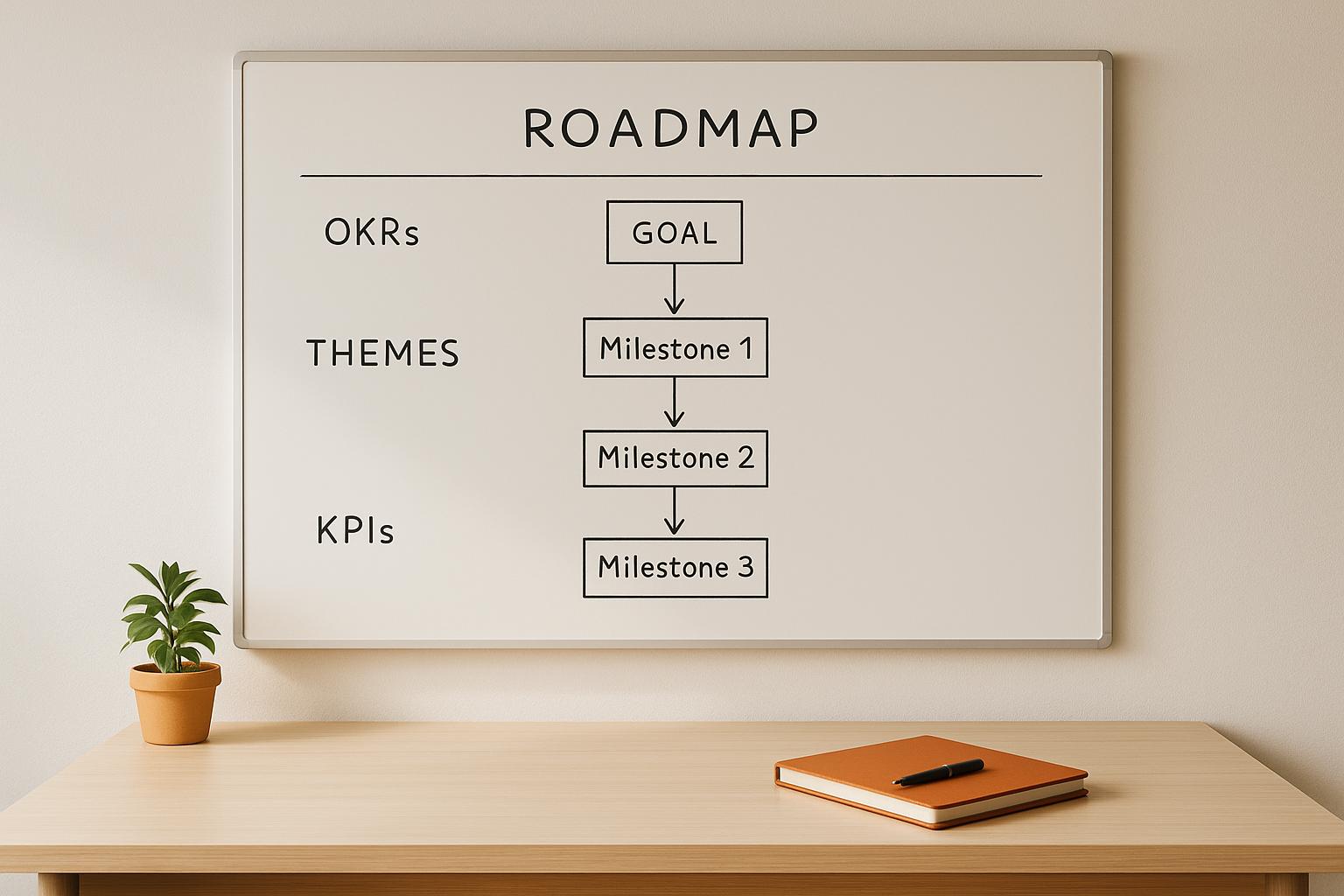
Most product roadmaps fail because they don’t connect to business goals. Without alignment, teams waste time on features that don’t drive results, causing missed opportunities and poor outcomes. Here’s how to fix that:
- Tie initiatives to measurable goals: Example: “Increase ARR by $5M” or “Reduce churn from 8% to 5%.”
- Prioritize effectively: Use frameworks like RICE to focus on high-impact, low-effort tasks.
- Use themes to organize work: Group initiatives under goals like “AI-powered insights” or “Onboarding improvements.”
- Track progress with metrics: Use OKRs and KPIs like NRR or activation rates to measure success.
- Review regularly: Hold quarterly strategy reviews and monthly KPI check-ins to stay aligned.
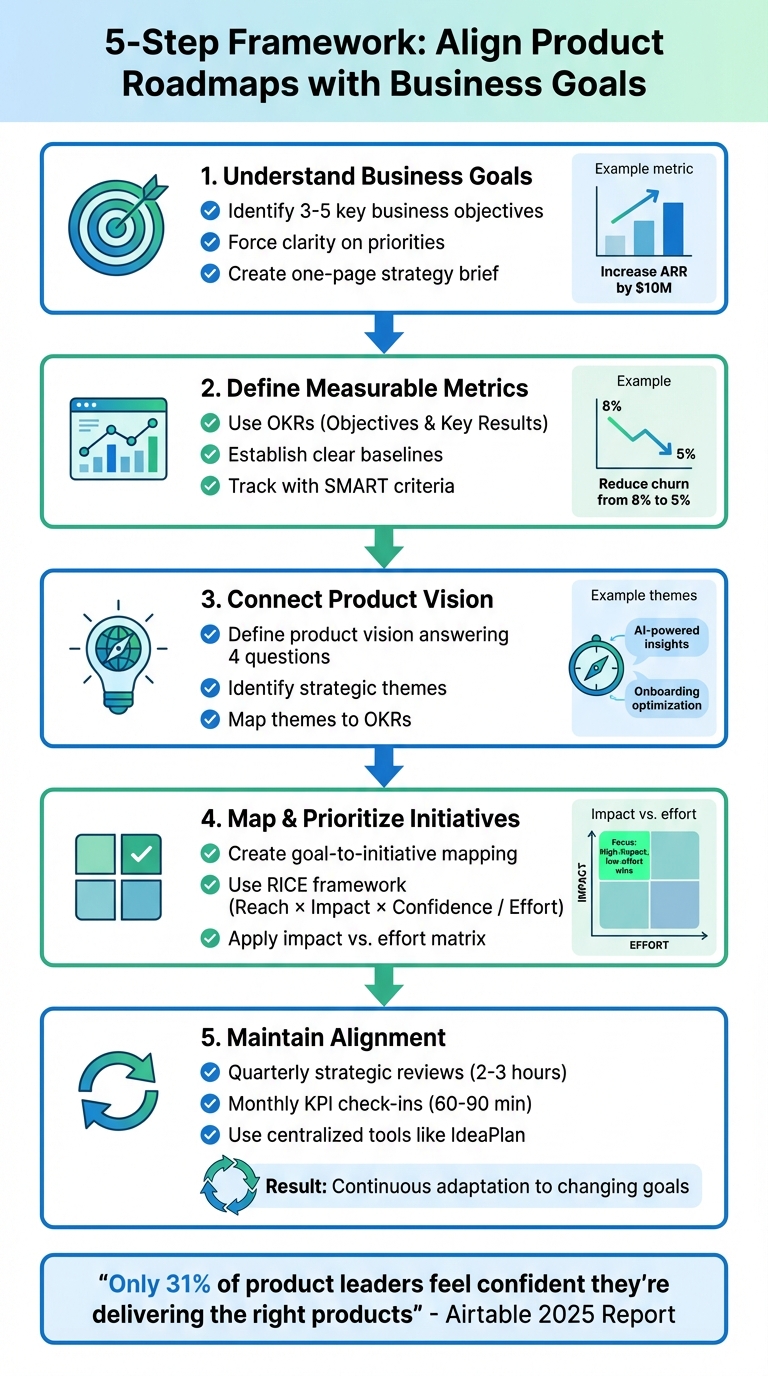
5-Step Framework for Aligning Product Roadmaps with Business Goals
Case Study: Strategy And Roadmap Alignment With KPI Trees
Understand Business Goals and Priorities
Before crafting your roadmap, it’s essential to identify your company’s top goals. This involves digging into strategic plans, board presentations, and quarterly reports to pinpoint the 3–5 key business objectives for the next 12–24 months. These goals often include things like boosting revenue, improving customer retention, expanding into new markets, increasing profitability, or streamlining operations.
It’s also crucial to force clarity when it comes to priorities. If your executive team labels everything as a priority, then nothing truly is. Gather key executives to rank these goals and define what success looks like in specific terms. This step ensures that your roadmap reflects actual priorities - not assumptions. With this clarity, you’ll be better positioned to evaluate and prioritize initiatives effectively.
Define Business Goals
Start by outlining clear, actionable objectives. For instance, a SaaS company might aim to increase annual recurring revenue (ARR) by $10,000,000, tap into new market segments, or improve gross margins. These goals should strike a balance - specific enough to guide decision-making but broad enough to allow for flexibility in execution.
Document these objectives in a concise, one-page strategy brief that product teams can easily reference when assessing features or initiatives. This document acts as a filter, helping you deprioritize or eliminate items that don’t align with the company’s goals. By doing so, you prevent your roadmap from turning into a haphazard wish list. From there, break down these goals into measurable metrics to ensure accountability.
Translate Goals into Measurable Metrics
Broad goals are only useful if they’re translated into specific, trackable metrics. Measurable targets ensure that every initiative ties back to leadership priorities, maintaining alignment across your roadmap. A great way to achieve this is by using OKRs (Objectives and Key Results). For example:
- Objective: "Grow ARR in FY2026."
- Key Result 1: "Increase ARR by $5,000,000 by December 31, 2026."
- Key Result 2: "Increase average contract value by 15%."
- Key Result 3: "Achieve 30% of new ARR from self-service signups".
For retention-focused goals, you might define:
- "Reduce logo churn from 8% to 5% annually."
- "Increase net revenue retention (NRR) from 105% to 115%".
To make these metrics actionable, establish a clear baseline - such as your current ARR, churn rate, or NPS - so you can accurately track progress. Use tools like your CRM, analytics stack, or data warehouse to monitor these metrics, updating them monthly using U.S. number formats (e.g., 1,000.50).
Effective metrics should be specific, measurable, achievable, relevant, and time-bound (SMART). They also need to be directly influenced by product decisions rather than external factors. For each KPI, identify 2–3 controllable sub-metrics. For example, you could track key feature adoption or onboarding completion rates to address churn. Use historical data and small-scale experiments to set realistic targets, ensuring that your goals are grounded in what your product changes can genuinely impact - not in wishful thinking.
Connect Product Vision to Business Goals
Once you've nailed down your business goals and metrics, the next step is connecting your strategy to the day-to-day decisions your product team makes. This is where your product vision comes into play - it bridges the gap between big-picture business objectives and actionable direction for your team. Without this alignment, roadmaps often fall flat. Let’s break down how to craft a strong product vision and identify strategic themes that tie everything together.
According to research from Accenture, only 29% of product launches succeed, with misaligned roadmaps being a major culprit. A well-thought-out product vision can help avoid this pitfall by linking initiatives to measurable outcomes, optimizing resources, and improving ROI.
Define Your Product Vision
A solid product vision should answer four key questions: Who is your target customer? What problems are they facing? How does your product solve these issues? And what does success look like for your customers? This clarity ensures that all product efforts stay rooted in company goals.
To get started, break down your company’s high-level OKRs into product-specific objectives. For example, if growing enterprise revenue is a top business goal, your product vision might focus on “Helping enterprise teams achieve 10x faster insights”. This vision can then be tied to key results, like reducing new user churn by 15%. Use customer feedback to validate your vision and ensure it addresses real-world challenges.
Once you’ve established a clear vision, you can use high-level themes to connect your strategy to actionable items on your roadmap.
Identify Themes
Themes group initiatives that address specific user needs. Examples might include “onboarding optimization,” “AI-powered insights,” or “enterprise admin workflows”. These themes provide flexibility to adapt priorities while keeping everything aligned with your product vision and business goals.
To identify themes, analyze your backlog and group items based on customer data and problem areas. Then, map each theme to your company’s OKRs. For instance, a theme like “Reduce new user churn” could support a goal to increase market share by driving initiatives that improve first-run experiences and activation flows. Similarly, a theme like “AI-powered insights” might align with revenue growth objectives, focusing on boosting user engagement.
Visual tools, like a matrix, can help you map themes to OKRs, highlighting intersections and prioritizing high-impact initiatives. Color-code your themes using “now, next, later” timeframes to make priorities clear.
When defining themes, be specific about desired outcomes. For example, instead of vaguely stating “onboarding improvements,” aim for something measurable like “Increase onboarding completion rates from 45% to 65% by June 30, 2026”. This ensures every initiative under a theme contributes to measurable business results. Review your themes monthly to refine objectives, incorporate new feedback, and stay aligned with evolving priorities. These refined themes will serve as the foundation for mapping initiatives to business goals in your roadmap.
Map Business Goals to Roadmap Initiatives
Once you've outlined your themes, it's time to connect your business goals with the actionable items on your roadmap. This step is where strategy turns into execution. Without this alignment, teams might end up working on features that seem productive but fail to impact key priorities like revenue growth, customer retention, or market share. By clearly linking each initiative to a business goal, you ensure that every effort directly supports what matters most.
Create Goal-to-Initiative Mapping
Start by identifying your top three to five company objectives for the year or quarter. These are often expressed as OKRs (Objectives and Key Results), such as "Increase ARR by $5,000,000" or "Reduce logo churn from 10% to 7%." For each objective, pinpoint product-driven key results your roadmap can influence. For instance, if growing ARR is a priority, a relevant key result might be "Increase trial-to-paid conversion from 12% to 18%."
Next, bring together teams from product, engineering, sales, customer success, and finance for brainstorming sessions. The goal is to generate initiatives that can realistically move the needle on these metrics. For example, to improve trial-to-paid conversion, potential initiatives could include "Redesign trial onboarding", "Add in-app upgrade prompts", or "Introduce a usage-based starter plan." Document each initiative's expected impact (e.g., a 3–4% conversion boost) and assign a target timeline, such as Q2.
To visualize the connections, create a grid where each row represents a business goal or key result, and each column corresponds to a roadmap initiative or epic. Use symbols to indicate the relationship - checkmarks for primary impacts and dots for secondary ones. This approach highlights which initiatives support specific goals and reveals any gaps. Add details like initiative owner, timeline, and expected impact to help prioritize effectively.
For example, a SaaS company aiming to increase ARR by $5,000,000 might link "Redesign trial onboarding" to a projected $750,000 ARR boost. Similarly, a goal to reduce churn to 7% could be tied to initiatives like implementing a customer health score with proactive outreach or creating a customer education hub. Each initiative should be linked to measurable KPIs, such as monthly active usage or renewal rates, to track progress.
Use Visualization Tools for Clarity
After mapping out the connections, visualization tools can make it easier for stakeholders to review and make decisions. Use color-coding or icons to show primary and secondary impacts. Within roadmap software, organize initiatives into swimlanes based on strategic themes or business goals, so it's clear how each epic aligns with broader objectives.
Portfolio or "roll-up" views are particularly useful during executive reviews or resource allocation discussions. These views provide a high-level picture of how various product roadmaps contribute to company-wide goals. Tools like IdeaPlan can help by allowing you to tag initiatives with goal labels (e.g., "Revenue", "Retention", "Market Expansion") and filter or group the roadmap accordingly during planning sessions. This centralized system ensures everyone stays on the same page and can easily adapt as priorities evolve.
Maintaining this mapping in a shared tool also reinforces discipline. Require every new roadmap item to link to a specific business goal. This approach helps prevent the addition of unnecessary features and keeps the team focused on initiatives that drive meaningful results.
sbb-itb-7c23fa1
Prioritize and Sequence Roadmap Items
Once you've aligned your initiatives with business goals, the next step is to prioritize and arrange them in a way that maximizes their impact. Proper sequencing ensures resources aren't spread too thin, while effective prioritization keeps the focus on tasks that deliver the greatest return on your company's key objectives.
Use Prioritization Frameworks
Prioritization frameworks help evaluate initiatives objectively by applying consistent criteria. One widely used framework is RICE, which scores initiatives based on four factors:
- Reach: How many users or customers will this initiative affect over a specific period (e.g., three months)?
- Impact: The business value it delivers, scored on a scale from 0.25 (minimal) to 3 (massive).
- Confidence: How reliable is your data? Expressed as a percentage.
- Effort: The time required to complete the initiative, measured in person-months.
The RICE formula is straightforward:
(Reach × Impact × Confidence) / Effort
For example, consider two initiatives for a SaaS product:
- Initiative A: A new onboarding flow with a Reach of 10,000 users, Impact of 2 (high retention boost), Confidence of 80%, and Effort of 3 months. Its RICE score is:
(10,000 × 2 × 0.8) / 3 = 5,333 - Initiative B: A minor UI tweak with a Reach of 1,000 users, Impact of 0.5, Confidence of 90%, and Effort of 1 month. Its RICE score is:
(1,000 × 0.5 × 0.9) / 1 = 450
Clearly, Initiative A ranks higher, making it the better candidate for prioritization based on these criteria.
Another effective tool is the impact vs. effort matrix, which organizes initiatives on a 2×2 grid. The vertical axis represents the initiative's impact (e.g., contribution to revenue growth), while the horizontal axis shows the required effort. Initiatives that fall into the high-impact, low-effort quadrant should be tackled first. On the other hand, low-impact, high-effort items are typically deprioritized unless they’re essential for compliance or technical reasons. This approach ensures your resources are directed toward the initiatives that matter most.
Consider Impact on Business Goals
In addition to scoring frameworks, think about how each initiative supports your company's business goals. Not all goals are equally important. For example, a mature SaaS company prioritizing profitability might focus more on retention, while a startup in growth mode could prioritize acquisition. To reflect these priorities, assign weights to your goals based on your current strategy.
For instance, if reducing churn is your top priority, you might allocate 60% weight to retention and 40% to acquisition. When scoring initiatives, multiply their impact scores by these weights. A retention feature scoring 8 would become 4.8 (8 × 60%), while an acquisition feature scoring 8 would drop to 3.2 (8 × 40%).
Finally, focus on initiatives that directly influence measurable outcomes. If your goal is to "Increase trial sign-ups by 50,000 this quarter", prioritize features like viral sharing tools or paid ad integrations that can be implemented quickly and reach a broad audience. This alignment between prioritization and measurable results keeps your team focused and ensures your roadmap delivers on your business objectives.
Maintain Alignment Through Tools and Processes
Creating a roadmap that aligns with your business goals is just the beginning. The real challenge lies in keeping everything on track as priorities shift, markets evolve, and new data comes to light. Once you've mapped your business objectives to your roadmap, maintaining that connection requires a combination of structured processes and the right tools.
Establish Planning and Review Schedules
To ensure alignment, you need a regular schedule of reviews that bring the right stakeholders together. A tiered approach works best:
- Quarterly strategic reviews (2–3 hours): These sessions with executives focus on evaluating whether the roadmap supports annual OKRs and revenue goals.
- Monthly KPI check-ins (60–90 minutes): Product managers, engineering leads, designers, data analysts, and go-to-market teams review progress against key outcome metrics like conversion rates, churn, NPS, and feature adoption.
- Sprint or bi-weekly tactical syncs (30–60 minutes): These shorter meetings connect day-to-day tasks with broader strategic initiatives.
Rather than just sharing status updates, these meetings should prioritize alignment by incorporating insights from user research, sales feedback, and market trends. Once you’ve established this review cadence, the next step is using the right tools to keep everything running smoothly.
Use Tools Like IdeaPlan

Traditional tools often fall short when it comes to maintaining alignment, as they lack the structure and traceability needed to connect the dots between goals and execution. A solution like IdeaPlan can fill this gap. It serves as a centralized hub where goals, initiatives, feedback, and decisions are all linked together.
With IdeaPlan, you can tie each roadmap item to specific company OKRs - such as "Increase net revenue retention to 115%" - and track related KPIs in one place. This ensures everyone understands the purpose of each initiative and how its success will be measured. The platform’s AI capabilities analyze customer feedback, identify recurring pain points, and suggest ways to group initiatives into broader strategic themes. This reduces the time spent manually reconciling data across tools, allowing your team to stay focused on driving results.
IdeaPlan also provides dynamic views tailored to different audiences. Executives can see high-level themes and milestones, while engineering teams get detailed delivery plans. By centralizing feedback, prioritization, and roadmap management, IdeaPlan helps product leaders align their teams and focus on initiatives that deliver measurable results.
Adapt to Changing Goals
Even with strong processes in place, business priorities can shift - whether due to a focus on profitability over growth, a major market event, or missing a revenue target by more than 10%. When these shifts happen, having a structured approach to adapt is key.
Start by defining clear criteria for when off-cycle reviews should occur, ensuring changes aren’t made on a whim. Within one to two weeks of a strategic shift, hold a re-prioritization workshop using a consistent framework, like WSJF (Weighted Shortest Job First) or impact vs. cost, to reassess initiatives against the new objectives.
Leverage your roadmapping tool to create "what-if" scenarios, such as comparing an "Efficiency-first scenario" with a "Growth scenario", to evaluate the potential impacts before making decisions. Keep a transparent change log that documents what was adjusted, why it was necessary, and who made the call. This record becomes invaluable during retrospectives, helping you analyze which decisions had the greatest impact and refine your planning process for the future.
Conclusion
Using the strategic framework outlined above, aligning your roadmap with business goals ensures your efforts translate into tangible results.
Benefits of Alignment
When your product roadmap aligns closely with business objectives, every initiative contributes directly to measurable outcomes like revenue growth, improved customer retention, or market expansion. This approach eliminates wasted effort and keeps your team focused on what truly matters.
Shifting from a "feature factory" mindset to outcome-driven planning transforms how success is defined. Your roadmap becomes a clear, measurable narrative of progress. Alignment impacts all teams in meaningful ways. According to Airtable's 2025 Predictions for Product Teams report, only 31% of product leaders feel confident they’re delivering the right products to their customers - a statistic that highlights the importance of proper alignment.
This alignment also leads to faster innovation cycles, smarter resource allocation, and better ROI on every initiative. When your roadmap is tied directly to OKRs and KPIs, it allows you to demonstrate impact rather than just track activity. A data-driven approach builds trust with stakeholders and helps secure their support.
Keep Improving
While the benefits are undeniable, maintaining alignment requires ongoing effort.
Business environments are constantly evolving due to market shifts, competitive pressures, or internal changes in strategy. To stay relevant, your roadmap must adapt while remaining tied to core objectives.
Regular reviews - both strategic and tactical - are essential to ensure your roadmap evolves alongside changing priorities. These reviews offer opportunities to integrate customer feedback, market trends, and performance data. Tools like IdeaPlan can help centralize goals, initiatives, and feedback, enabling quick adjustments as conditions change. Companies that treat roadmaps as living processes, rather than static documents, often report stronger alignment and more effective execution.
FAQs
How do I align my product roadmap with business goals?
To make sure your product roadmap lines up with your business objectives, begin by pinpointing your organization's main strategic goals. Regularly assess and rank initiatives to confirm they directly contribute to these targets. Bring in stakeholders from various teams to collect input and create alignment during the planning phase.
Leverage tools to gather feedback in one place, track progress, and adapt your roadmap as priorities shift. This approach keeps your roadmap flexible and responsive to changes while maintaining a clear focus on achieving meaningful results.
What metrics should you track to evaluate the success of your product roadmap?
To determine whether your product roadmap is hitting the mark, keep an eye on a few critical metrics:
- Customer feedback: Pay attention to how users react to new features or updates. Their input can highlight what’s working and what needs tweaking.
- Progress toward strategic goals: Check if your roadmap is delivering measurable outcomes that align with your business objectives.
- Feature adoption rates: Measure how frequently users engage with new features and evaluate their influence on overall satisfaction.
These metrics offer practical insights, helping you ensure your roadmap aligns with both user expectations and your company’s goals.
What’s the best way to prioritize initiatives on a product roadmap?
To prioritize initiatives effectively, start by paying close attention to customer feedback - it’s a goldmine for understanding what truly matters. Make sure every idea aligns with your business goals and evaluate how much impact it could have. Tools like IdeaPlan can help you stay organized by tracking ideas and letting your team collaboratively vote on what matters most. This way, you can focus your efforts on the projects that offer the greatest value and drive meaningful results.

