


Alignment is the glue that holds product teams together. Without it, your product vision risks being misunderstood, misprioritized, or ignored. Here's the core idea: stakeholder alignment ensures everyone - executives, engineers, designers, marketers, and more - shares a clear understanding of your product's goals and purpose. This clarity reduces wasted effort, accelerates progress, and improves outcomes.
Key takeaways:
- A strong product vision is customer-focused, outcome-driven, and tied to business goals.
- Use roadmaps to translate vision into actionable plans.
- Identify and prioritize stakeholders based on their influence and interest.
- Tailor communication to each group and centralize updates for consistency.
- Maintain alignment with regular check-ins, conflict resolution, and measurable progress tracking.
Why it matters: Misalignment leads to delays, resource waste, and competing agendas. By actively aligning stakeholders, you improve efficiency, reduce friction, and create a shared sense of purpose. Start with a clear vision, map your stakeholders, and communicate effectively to keep everyone moving in the same direction.
Using Your Roadmap to Drive Stakeholder Alignment | Featured Product Makers, Bruce McCarthy
Step 1: Clarify and Operationalize Your Product Vision
Before rallying your stakeholders, ensure your product vision is clear and actionable. The key here is turning an inspiring idea into a practical plan that teams can execute and executives can measure. Let’s break down how to make that happen.
What Defines a Strong Product Vision
A strong product vision always puts the customer at the center. It should clearly define your target users and the specific problem your product solves for them. More importantly, it should explain how your product will improve their lives or workflows. Instead of focusing on features, your vision should be outcome-driven, emphasizing the value you aim to create. For instance, think along the lines of "cut onboarding time by 50%" or "boost self-service resolution to 80%", rather than a laundry list of functionalities.
Your vision must also align with your company’s broader strategy. Whether the focus is growth, profitability, or entering new markets, your product vision should tie directly to these priorities. This connection helps stakeholders see how your product contributes to the company’s overall success. Keep the vision short and memorable - a concise paragraph or narrative that’s easy to repeat. A helpful method is using a "from–to" statement, showing the transformation from today’s reality to your desired future state. This makes the journey crystal clear for everyone involved.
To check if your vision is understood, try a vision comprehension test. Ask team members across departments - executives, engineers, designers, sales, and support - to describe the vision in one or two sentences. If their answers are all over the place, it’s a sign that your vision needs refining.
Link Your Vision to Business Goals
Once your vision is solid, connect it to measurable business outcomes. This means identifying key metrics like annual recurring revenue (ARR), customer acquisition cost (CAC), churn rate, customer lifetime value (LTV), and market share. Break your vision into strategic themes, and assign two or three SMART KPIs (Specific, Measurable, Achievable, Relevant, Time-bound) to each.
For example, you might set objectives like "Increase self-service resolution from 40% to 70% within 12 months" or "Grow U.S. SMB subscriptions from $5M to $8M ARR by FY2026." These goals should align with your company’s financial cycles, typically reviewed quarterly or annually. When presenting to executives, always frame customer-focused outcomes in terms of financial impact. For instance, a vision to "enable self-service onboarding for U.S. mid-market customers" could be tied to reducing onboarding costs, speeding up revenue generation, and allowing sales teams to focus on larger deals.
Bring the Vision to Life with Roadmaps
A roadmap is your tool for turning an abstract vision into a clear, visual plan. Instead of listing features in chronological order, organize your roadmap by strategic themes that directly support your vision. For each theme, define the outcomes you’re aiming for, the metrics that will track progress, and a sequence of high-level initiatives over the next 12 to 18 months. Use quarters to structure timelines rather than fixed dates to keep things flexible.
Tailor your roadmap to your audience. Executives care about strategic themes and high-level outcomes, like "Q2: Launch self-service analytics to increase upsell ARR by $1M." Meanwhile, engineering and design teams need more detailed initiatives. Formats like Now–Next–Later or goal-oriented roadmaps work well because they highlight priorities and trade-offs without locking you into specific release dates.
Keep your roadmap dynamic with regular updates - monthly reviews and quarterly planning sessions ensure it evolves alongside your vision. Tools like IdeaPlan can help by integrating your vision, outcomes, and roadmap items in one place, making it easier for distributed teams to stay aligned, even asynchronously.
Step 2: Map and Prioritize Your Stakeholders
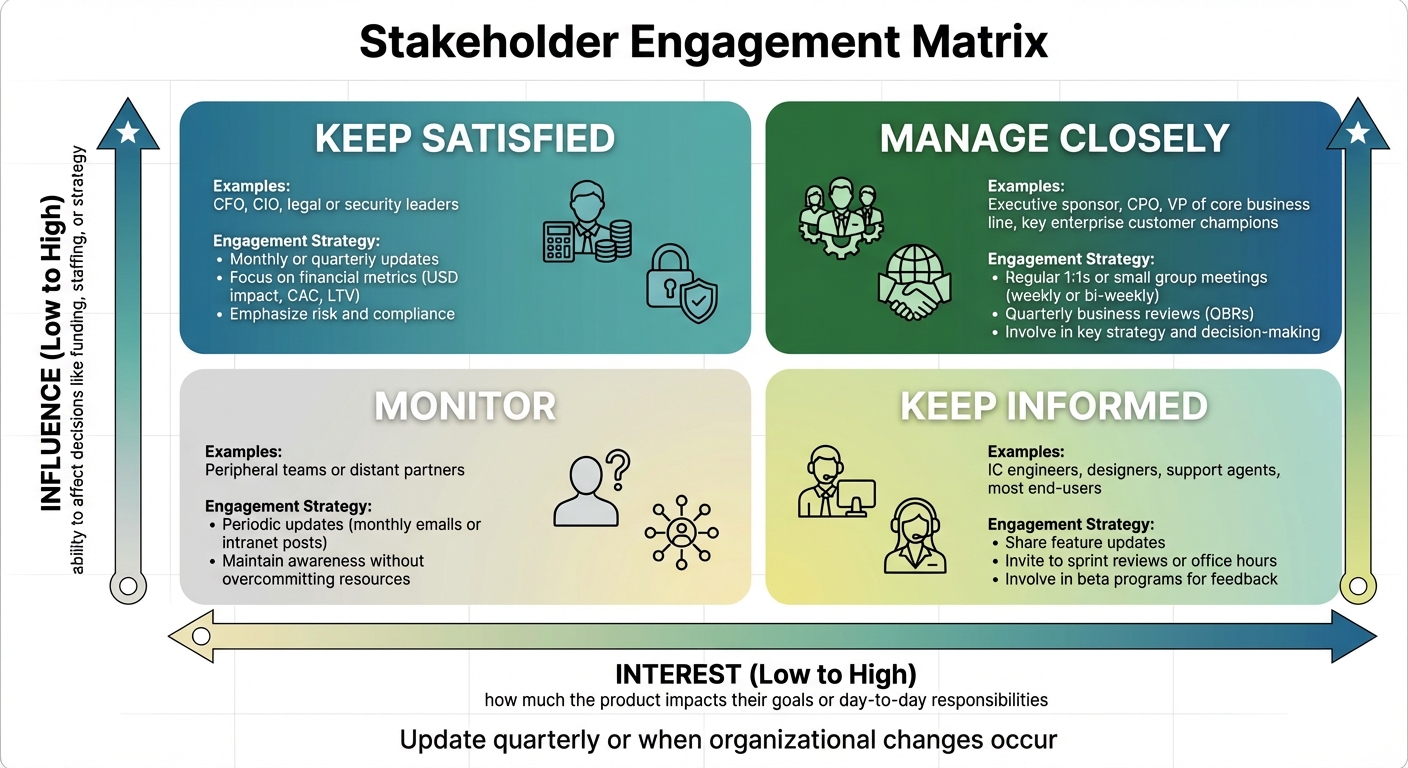
Stakeholder Engagement Matrix: How to Prioritize Communication by Influence and Interest
Once your product vision is clear, the next step is figuring out who your stakeholders are and how to engage with them effectively. Not every stakeholder holds the same level of influence or interest in your product, so understanding these dynamics helps you focus on the right relationships without wasting time on less impactful ones.
Identify Your Key Stakeholders
Start by listing everyone who plays a role in or is affected by your product. Internally, this includes groups like executives, product management, engineering, design, analytics, marketing, sales, and support teams. Each of these groups contributes to or is influenced by the product lifecycle. Don’t forget external stakeholders, such as customers, design partners, channel partners, and regulators. In many U.S.-based companies, these external groups often shape critical decisions around budgets, hiring, and go-to-market strategies, so it’s crucial to identify them early.
Take a close look at your product lifecycle to identify which teams are involved at each stage. Use organizational charts and OKRs to pinpoint leaders whose goals are tied to your product. For example, a Sales VP with revenue targets linked to your product line is a key stakeholder. Update this list regularly - quarterly is a good rule of thumb - or whenever there are major changes in your organization or strategy, as stakeholder roles often shift with the growth of your product or company.
Map Stakeholders by Influence and Interest
Once you’ve identified your stakeholders, the next step is to evaluate their impact on your product. This is where an influence/interest matrix comes in handy. This tool helps you categorize stakeholders based on two factors: influence (their ability to affect decisions like funding, staffing, or strategy) and interest (how much your product impacts their goals or day-to-day responsibilities).
- Stakeholders with high influence typically control budgets, headcount, or strategic decisions.
- High-interest stakeholders are those whose OKRs - like annual recurring revenue (ARR), net promoter score (NPS), churn rate, or active users - are directly tied to your product, or whose teams rely on it heavily.
Here’s a breakdown of how to engage with stakeholders based on their position in the matrix:
| Quadrant | Examples | Engagement Strategy |
|---|---|---|
| High influence / High interest | Executive sponsor, CPO, VP of core business line, key enterprise customer champions | Manage closely: Hold regular 1:1s or small group meetings (weekly or bi-weekly), conduct quarterly business reviews (QBRs), and involve them in key strategy and decision-making processes. |
| High influence / Low interest | CFO, CIO, legal or security leaders | Keep satisfied: Provide monthly or quarterly updates, focusing on financial metrics (e.g., USD impact, CAC, LTV), risk, and compliance. |
| Low influence / High interest | IC engineers, designers, support agents, most end-users | Keep informed: Share feature updates, invite them to sprint reviews or office hours, and involve them in beta programs to gather feedback and ensure usability. |
| Low influence / Low interest | Peripheral teams or distant partners | Monitor: Send periodic updates, such as monthly emails or intranet posts, to maintain awareness without overcommitting resources. |
This mapping helps you allocate your time and resources effectively, ensuring each stakeholder group gets the level of engagement they need.
Track Stakeholder Goals and Alignment Status
To manage stakeholders effectively, create a stakeholder alignment canvas. This tool captures essential details for each group, such as:
- Their role and level of influence
- Key metrics (e.g., ARR in USD, churn rate, NPS, system uptime)
- Constraints (e.g., budget limits, regulatory requirements like HIPAA, technical challenges, or deadlines)
- Expected outcomes
- Engagement plans (e.g., communication channels, meeting frequency, decision-making forums)
- Alignment status (e.g., Green, Yellow, or Red), along with the last updated date and next steps
This canvas takes the guesswork out of stakeholder management, turning it into a structured and dynamic part of your planning process. Tools like IdeaPlan can centralize this canvas alongside your product vision and roadmap, making it easier for distributed teams to stay updated and provide feedback in real time, even across different U.S. time zones.
Make it a habit to refresh your canvas quarterly, syncing updates with your OKR cycles. After executives finalize quarterly OKRs, revisit each stakeholder group’s goals and constraints, updating the canvas as needed. During QBRs or monthly stakeholder reviews, ask questions like, “What’s changed in your priorities, KPIs, or constraints since our last meeting?” and record the updates immediately. This practice ensures your stakeholder map stays accurate and your engagement strategy evolves alongside your business needs. By keeping this canvas dynamic, you set the foundation for ongoing alignment and effective collaboration.
sbb-itb-7c23fa1
Step 3: Communicate the Product Vision Effectively
After identifying your stakeholders and understanding their positions, the next step is ensuring your product vision connects with them. Communicating your vision effectively is key to aligning everyone around shared goals.
Core Principles for Clear Communication
At the heart of effective communication is focusing on the value your product brings to customers. Every discussion about your vision should tie back to the problems you're solving and the outcomes you're aiming to achieve. When you frame your message around customer challenges and measurable results, stakeholders can move beyond feature lists and grasp the "why" behind your strategy.
Consistency in messaging is just as important. Whether you're delivering a presentation, sending a Slack update, or having a quick conversation, the core story - problem, vision, strategy, roadmap, and metrics - should remain the same. Adjust the level of detail based on the context, but keep the narrative intact. Use straightforward language, avoid unnecessary jargon, and focus on overarching themes and outcomes rather than diving into individual features.
Encourage feedback early and document decisions to build a sense of ownership and avoid misalignment. Regular check-ins allow stakeholders to challenge assumptions and suggest alternatives, reducing the need for rework down the line. Centralizing updates related to the vision ensures everyone stays on the same page.
Tailor Your Message for Different Audiences
Customizing your message for each stakeholder group ensures they understand how the vision aligns with their priorities. Different audiences require different approaches.
For executives:
Keep it high-level and focused on outcomes that tie directly to business strategy and financial goals. Start with company objectives - like revenue growth, market share, or customer satisfaction - and show how your vision supports these targets. Use concise materials like a one- to two-page narrative or a single-page roadmap. Highlight risks, tradeoffs, and timelines, emphasizing metrics such as retention, lifetime value, and customer acquisition costs. Quarterly reviews should focus on strategic outcomes and key insights rather than granular sprint details.
For technical teams (engineering, design, product):
Explain how the vision impacts system requirements and technical tradeoffs. Provide details on user journeys, edge cases, service-level agreements (SLAs), and dependencies to guide decisions on architecture and user experience. Use tools like problem statements, opportunity canvases, and technical vision slides to show how today's work connects to long-term goals. Regular sessions - like backlog refinement, design reviews, and technical discovery meetings - help teams align on the vision while maintaining autonomy in execution.
For go-to-market teams (sales, marketing, customer success):
Translate the vision into customer-facing narratives, market positioning, and enablement materials. Connect the vision to ideal customer profiles, core value propositions, and differentiators in language that mirrors how customers describe their challenges. Provide clear timelines and phased plans (e.g., "now / next / later") to help sales set realistic expectations. Create practical tools like battlecards, FAQs, narrative decks, and demo scripts to support their efforts. Involving these teams early ensures the messaging resonates and reflects their input.
| Stakeholder Group | Tailored Message Focus | Recommended Artifacts |
|---|---|---|
| Executives | Business goals, ROI, strategic themes, financial impact | Portfolio roadmaps, high-level metrics, one-pagers |
| Technical Teams | Feasibility, timelines, technical tradeoffs, system implications | Wireframes, prototypes, technical vision slides, architecture diagrams |
| Go-to-Market Teams | Customer value, market positioning, release plans, differentiation | Roadmaps with customer insights, battlecards, demo scripts, FAQ documents |
Once you've tailored your messages, the next step is ensuring all communications are centralized and up to date.
Use Platforms to Centralize Vision Artifacts
Customizing messages is crucial, but having a single source of truth is equally important. Misalignment often stems from stakeholders relying on different versions of information. Platforms like IdeaPlan solve this by serving as a centralized hub where your product vision, strategy, roadmap, customer insights, and decisions are continuously updated. By storing key artifacts - such as vision statements, OKRs, roadmaps, discovery notes, and decision histories - in one place, you eliminate the need for scattered slide decks or emails. Everyone has access to the latest information.
These platforms allow you to tailor views for specific audiences. Executives can access high-level dashboards, engineers can see detailed dependencies and release plans, and go-to-market teams can focus on launch and messaging strategies - all drawn from the same data. Integrations with tools like Jira, Slack, and CRM systems ensure updates and feedback flow seamlessly into the platform, keeping your "source of truth" dynamic and relevant.
A balanced communication cadence combines asynchronous updates with regular check-ins. For executives, schedule monthly or quarterly reviews focused on strategic progress, supported by a brief report and updated roadmap. For product, engineering, and design teams, hold weekly standups and biweekly planning sessions that frame progress in terms of the vision. Keep a living product spec or wiki as a reference. For go-to-market teams, run monthly enablement sessions and launch reviews, paired with an updated "vision + roadmap" deck and short video walk-throughs. Across all groups, maintain a single digital roadmap and decision log, and send brief biweekly updates summarizing key changes and insights.
Step 4: Maintain Alignment and Measure Success
After establishing clear communication and mapping out stakeholders effectively, the next step is to ensure alignment remains strong over time. This involves setting up consistent routines, addressing conflicts head-on, and keeping track of progress through measurable data. Let’s dive into how to make this happen.
Set Up Regular Alignment Rituals
Consistency keeps everyone on the same page. During active project phases, schedule weekly check-ins with key stakeholders - these could be quick 15-minute syncs, brief Slack updates, or concise emails. Once the project moves into maintenance mode, bi-weekly or monthly check-ins help maintain visibility without overwhelming the team.
Monthly roadmap reviews provide an opportunity for cross-functional teams to come together, review progress, and discuss trade-offs. These sessions work best when supported by updated roadmaps or prototypes, giving teams something concrete to discuss. Quarterly planning sessions, on the other hand, bring broader groups - engineering, design, sales, marketing, and customer success - together to align on future priorities. For distributed teams, tools like Miro or Mural can make real-time collaboration easier.
Don’t forget to schedule post-launch retrospectives within two weeks of a major release. These sessions are critical for comparing outcomes to your original goals, reinforcing how your vision connects to results, and giving stakeholders a chance to share feedback for future planning.
For larger or distributed teams, supplement these rituals with dashboards and asynchronous updates. Automated reports on delivery rates, satisfaction scores, and key milestones can keep everyone informed without adding extra manual work.
Once these rituals are in place, it’s important to quickly address any signs of misalignment.
Address Misalignment and Resolve Conflicts
Misalignment is inevitable, but it doesn’t mean failure - it’s a chance to clarify objectives and strengthen collaboration. When disagreements arise, address them promptly. Start with open conversations and active listening to identify the root cause, whether it’s resource limitations, differing interpretations of customer needs, or conflicting business priorities.
Data-driven discussions can help move past subjective opinions. For instance, if engineering flags concerns about timelines, use data to explore trade-offs. One example involved a product manager who resolved a conflict by creating a shared MVP scope document. This document prioritized three key metrics critical to sales while postponing a complex fourth metric for a later release, turning potential blockers into team advocates.
When debates get stuck on details, refocus the conversation on customer outcomes. Ask questions like, “What problem are we solving for customers?” or “How will we know if we’ve succeeded?” This shifts the discussion from internal preferences to external impact. Always document decisions and their rationale to avoid revisiting the same issues later.
For more persistent disagreements, use an influence/interest matrix to prioritize conflicts. Focus first on resolving issues with high-impact stakeholders. Collaborative workshops can also be helpful, allowing teams to work through disagreements together instead of relying on endless email threads.
Once conflicts are addressed, turn your attention to measuring and scaling alignment practices.
Track and Scale Alignment Practices
To improve alignment, you need to measure it. Start by conducting quarterly surveys to gauge stakeholder satisfaction. Ask them to rate their understanding of the vision, confidence in the roadmap, and whether they feel heard, using a simple 1–10 scale. This feedback can reveal trends and highlight areas needing more attention.
Track operational metrics like on-time delivery rates tied to roadmap commitments. If deadlines are consistently missed, it could indicate unrealistic planning or misalignment on priorities. Monitor resource allocation to ensure budgets are on track and scope changes aren’t causing overruns. These metrics provide insight into how well alignment translates into execution.
You can also measure internal NPS (Net Promoter Score) by asking stakeholders how likely they are to recommend the product vision. Avoid vanity metrics that don’t connect to actionable outcomes - focus only on data tied to customer results and business goals.
As your team grows, revisit your stakeholder map regularly. New hires, organizational changes, and shifts in product direction can all impact who needs to be involved. Update your engagement strategy quarterly, using personas and scoring to prioritize your efforts. This ensures high-influence stakeholders get the attention they need without overwhelming your team’s capacity.
Conclusion
Bringing stakeholders on board with your product vision isn’t a one-and-done task - it’s an ongoing effort that evolves over time. Start by defining a clear, outcome-focused vision and identifying stakeholders based on their influence and interest. This allows you to approach engagement with purpose. Use tools like roadmaps and visual aids to communicate the vision in ways that resonate with different audiences, and keep everyone aligned through regular check-ins and discussions backed by data.
When stakeholders are aligned, they become advocates for your product. They help secure funding, remove roadblocks, and ensure smoother launches with fewer setbacks - key factors that directly influence revenue, user adoption, and retention. Without alignment, even the most well-thought-out strategies can falter due to internal conflicts and competing goals.
If your current alignment feels disjointed, don’t worry - small steps can lead to big improvements. Start by refining your vision, identifying key stakeholders, and testing new practices. You don’t need everything to be perfect or unanimous to make progress; you just need to take the next actionable step.
This quarter, try scheduling a cross-functional alignment session, updating your roadmap to focus on outcomes rather than features, and creating a simple stakeholder map before your next planning cycle. Consider piloting a quick ritual, like a brief monthly stakeholder sync or a quarterly vision update tied to your OKRs. Tools like IdeaPlan (https://ideaplan.io) can simplify the process by helping you share vision artifacts, gather feedback, and track alignment - all from a centralized platform.
FAQs
How can I create a product vision that meets customer needs while supporting business goals?
To create a product vision that aligns customer needs with business goals, start by actively listening to your audience. Dive into their feedback, uncover their challenges, and understand what they truly want. These insights should directly shape your product roadmap, ensuring you're solving real problems.
Next, make sure stakeholders see the connection between meeting customer needs and achieving tangible business results. When everyone understands how addressing user pain points translates into growth or success, it fosters alignment and keeps the team focused on delivering value. Using centralized tools can simplify feedback management and ensure everyone stays informed and aligned.
What are the best ways to communicate your product vision to stakeholders effectively?
To share your product vision effectively, it's important to adapt your message for different groups of stakeholders. Tools like visual roadmaps or dashboards can simplify complex concepts and give a clear snapshot of your ideas. Regular alignment meetings also play a key role in keeping communication open and ensuring everyone is aligned.
Using storytelling can make your vision more compelling and easier to relate to, helping stakeholders feel a stronger connection to the product's objectives. And don’t forget to welcome feedback - it encourages collaboration and ensures your message is clear and well-received by everyone involved.
How can I track and maintain stakeholder alignment over time?
To keep stakeholders on the same page, set up regular feedback sessions. These meetings provide a chance to gather input, address any concerns, and ensure everyone feels heard. Shared dashboards can be a great tool to track progress and keep everyone informed about key updates. Also, maintain some flexibility in your roadmap - priorities can shift, and staying adaptable helps encourage open communication and transparency.

