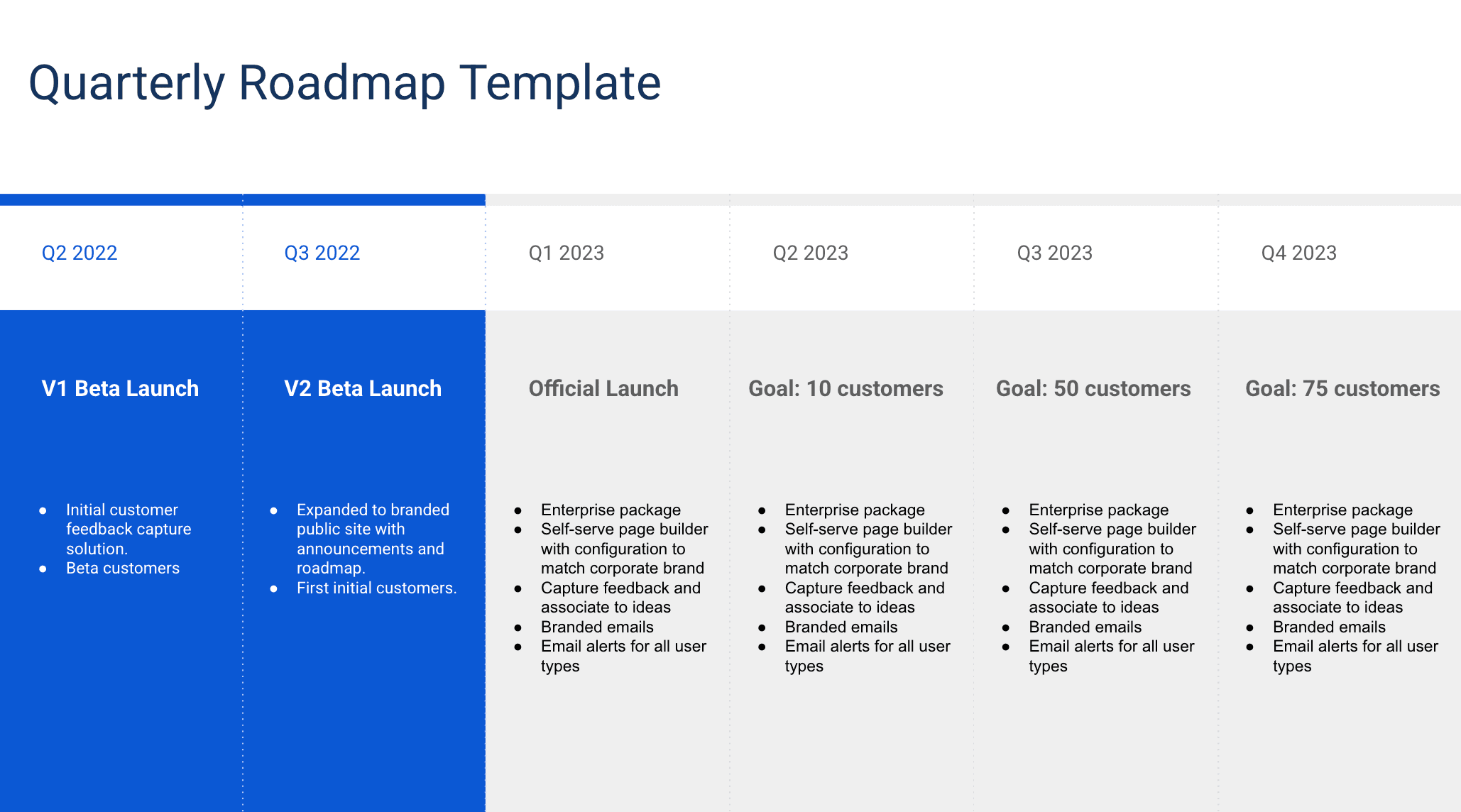
Quick Answer (TL;DR)
This free Google Slides quarterly roadmap template organizes your product plan into Q1, Q2, Q3, and Q4 columns with strategic themes and key initiatives per quarter. It is the standard format for annual planning, board reviews, and OKR-aligned planning conversations, and any conversation about where the product is heading over the coming year. For more on the quarterly roadmap format and how to choose the right structure for your team, see our guide to building a product roadmap.
What This Template Includes
- Quarterly columns. Four-column layout showing Q1 through Q4 with key initiatives listed under each quarter, providing a full annual view on a single slide.
- Strategic themes. Theme labels (Growth, Retention, Platform, Innovation) that group initiatives by strategic intent so investment balance is visible across the year.
- Initiative cards. Styled cards per initiative showing name, team owner, estimated effort in weeks, and status. Each initiative maps to a parent objective with a clear key result it is expected to move.
- Annual objectives banner. A header section linking the quarterly plan to annual company or product objectives, ensuring no work is orphaned from strategic goals.
- Risk register. A section for surfacing and tracking threats to quarterly commitments, with likelihood, impact, and mitigation actions.
- Progress tracking. For completed quarters, status indicators (Shipped, Partial, Deferred) replace planned status, turning the roadmap into a performance record.
Why Use Google Slides for Quarterly Roadmaps
Quarterly roadmaps are the primary artifact for strategic product planning. They are shared with executives, presented at board meetings, and referenced in annual reviews. Google Slides produces the polished, professional format these audiences expect.
The four-column quarterly layout fits perfectly on a single slide, giving leadership a complete annual view at a glance. This single-slide overview is the most referenced format in product management. It appears in planning decks, investor updates, and company all-hands presentations.
Google Slides collaboration features make quarterly planning more efficient. Product managers can draft their section, engineering leads can review capacity assumptions, and leadership can comment on strategic direction. All in the same document with full version history.
Template Structure
Quarterly Objectives
The roadmap opens with a clear statement of what the team intends to accomplish in the next 90 days. These are not feature names; they are outcomes. For example, "Reduce onboarding drop-off by 20%" or "Launch self-serve billing for mid-market accounts." Each objective should be measurable so that the team knows whether it succeeded at the end of the quarter. Limiting the number of objectives to three or four forces the team to make real prioritization decisions rather than listing everything it hopes to do.
Initiative Mapping
Each quarterly objective breaks down into one or more initiatives. An initiative is a body of work large enough to require multiple sprints but small enough to complete within the quarter. The template provides a mapping table that connects each initiative to its parent objective, its owner, its estimated effort in weeks, and the key results it is expected to move. This mapping ensures that no work is orphaned. If an initiative does not ladder up to a quarterly objective, it either belongs in a different quarter or the objectives need to be revisited.
Capacity Planning
Knowing what you want to accomplish is only half the equation. The other half is knowing whether you have the people and time to accomplish it. The capacity allocation grid asks you to estimate the percentage of each team's bandwidth that will be devoted to each initiative. Common categories include new feature development, technical debt, operational support, and unplanned work. Most teams find that reserving 15 to 20 percent of capacity for unplanned work keeps the plan resilient. If total allocation exceeds 100 percent, the plan is already broken and needs to be descoped before the quarter begins.
Monthly Checkpoints
The template includes structured checkpoints at the end of month one, month two, and month three. Each checkpoint prompts the team to assess progress against objectives, update initiative statuses, and decide whether any mid-quarter adjustments are needed. Checkpoints prevent the common failure mode where the team builds in a tunnel for 90 days and only discovers at the end that it missed the target. A monthly rhythm gives enough time for course correction without the overhead of weekly planning.
Risk Register
Every quarter carries risks: a key engineer might leave, a partner API might change, market conditions might shift. The risk register asks the team to identify the top risks at the start of the quarter, assess their likelihood and impact, and define mitigation actions. Reviewing the risk register at each monthly checkpoint keeps it alive. A risk register that is filled out once and never revisited provides no value.
How to Use This Template
1. Start with annual objectives
Before filling in quarterly details, document the annual objectives or OKRs on the banner slide. Every initiative in the quarterly plan should trace back to one of these objectives. If it does not, question whether it belongs on the roadmap.
Why it matters: Objectives set the direction. Without leadership alignment at the start, teams optimize for local goals that may not serve the company strategy. This meeting is the most important 60 minutes of the quarter.
2. Define themes per quarter and break objectives into initiatives
Assign 2-3 strategic themes to each quarter. Themes might shift across the year. Q1 might emphasize platform stability while Q4 emphasizes growth experiments. Under each quarter, identify the initiatives required to achieve each objective. Estimate effort in engineer-weeks and assign an owner. List 3-5 key initiatives per quarter.
Why it matters: Initiatives are the unit of accountability. Each one has a clear owner who is responsible for driving it to completion. Without this breakdown, objectives remain aspirational statements with no execution path. Themes give each quarter a narrative beyond just a list of features.
3. Allocate capacity honestly
Fill in the capacity grid by estimating the percentage of each team's bandwidth that each initiative will consume. Include a buffer for unplanned work. Most teams find 15 to 20 percent keeps the plan resilient.
Why it matters: Over-allocation is the number one reason quarterly plans fail. The capacity grid makes over-commitment visible before work begins, giving the team a chance to cut scope or shift timelines proactively.
4. Identify risks and update as quarters complete
Brainstorm the top five to eight risks with the team. For each, note the likelihood (high, medium, low), the impact if it materializes, and one concrete mitigation action. As each quarter finishes, update the initiative status to Shipped, Partial, or Deferred. Add brief outcome notes where available.
Why it matters: Risks that are named and tracked are manageable. Risks that are ignored become surprises. Updating past quarters with actual outcomes turns the roadmap into a performance record, not just a plan. Valuable for retrospectives and demonstrating progress to leadership.
5. Run monthly checkpoint reviews and use for quarterly planning cycles
At the end of each month, gather the team for a 45-minute review. Update initiative statuses, reassess risks, and decide whether to adjust the plan. At the start of each quarter, review the annual plan and adjust. Move initiatives between quarters based on learnings from the previous quarter. The Slides format makes it easy to drag items between columns during planning meetings.
Why it matters: Monthly checkpoints close the feedback loop. They turn the roadmap from a static document into a living plan that adapts to reality while staying anchored to quarterly objectives.
When to Use This Template
Quarterly planning is the backbone of product management at companies that have outgrown purely reactive decision-making but are not yet large enough to require annual planning cycles. If your team ships software continuously and needs a cadence for setting priorities, reviewing progress, and reallocating resources, the quarterly roadmap is your primary planning instrument. Google Slides makes this the polished, presentation-ready format that executives and board members expect.
This template is especially useful during OKR or goal-setting cycles. Many organizations set objectives quarterly and need a way to translate those objectives into a concrete product plan. The initiative mapping and capacity grid bridge the gap between "what do we want to achieve" and "what will we actually build." Without that bridge, OKRs become aspirational slogans that the team cannot act on.
Cross-functional teams benefit significantly from quarterly roadmaps because they create a shared reference point. Design, engineering, marketing, and sales can all look at the same document and understand what the product team is building, why it is building it, and when it will be ready. This alignment reduces the volume of ad-hoc status requests and gives every function a clear planning input for their own quarterly priorities.
It is also the right format for investor updates and board presentations where the audience needs to see that the product team has a thoughtful plan for the year with clear strategic themes and measurable commitments per quarter.
Featured in
This template is featured in:
Key Takeaways
- Quarterly roadmaps translate strategic objectives into 90-day execution plans with clear ownership and capacity constraints.
- Limit objectives to three or four to force genuine prioritization rather than a wish list.
- Reserve 15 to 20 percent of team capacity for unplanned work to keep the plan achievable.
- The four-column layout fits a complete year on a single slide, enabling at-a-glance comprehension for executives and board members.
- Monthly checkpoints prevent tunnel vision and allow course correction before the quarter ends.
- Updating past quarters with actual outcomes turns the roadmap into a performance record, not just a forward-looking plan.