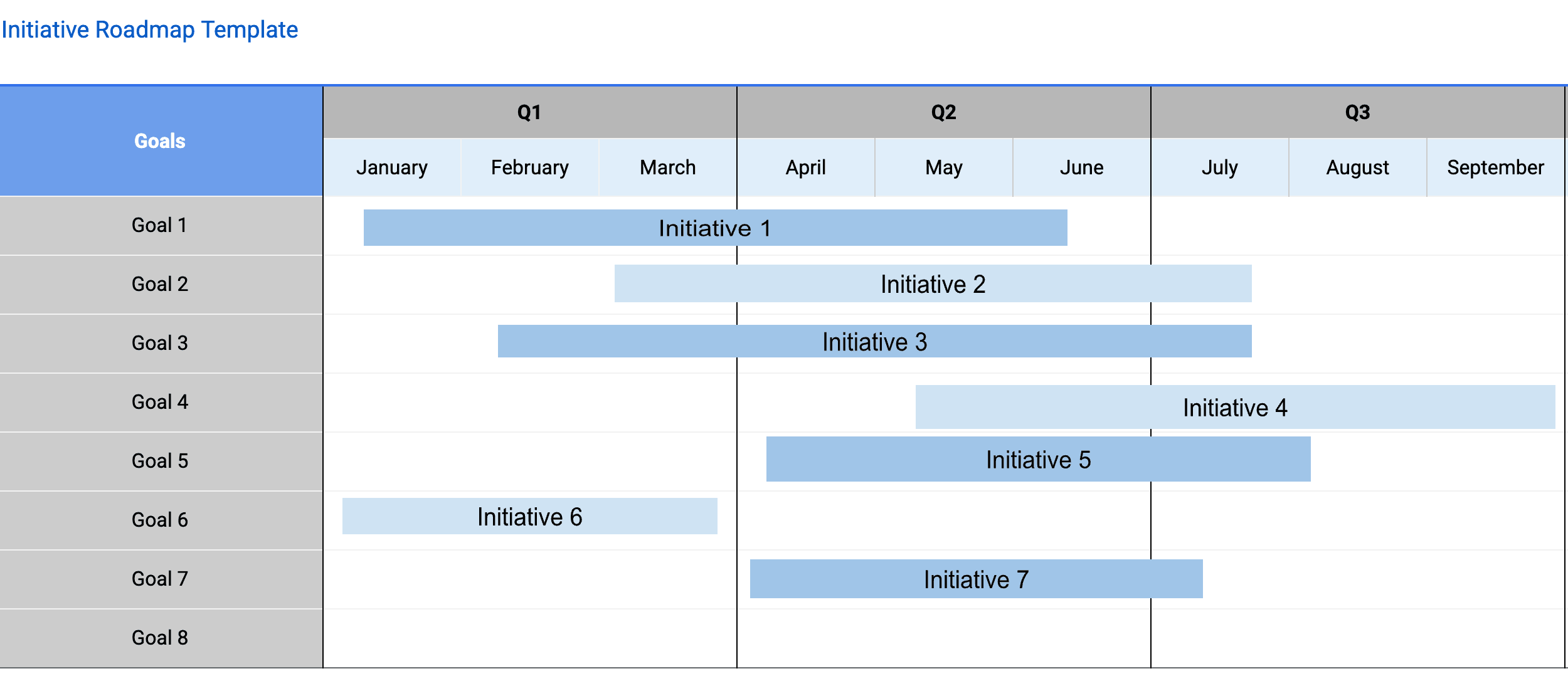
Quick Answer (TL;DR)
This free Google Sheets initiative roadmap template helps product teams plan and track strategic initiatives across quarters. It provides a structured way to document what you are investing in, why it matters, who owns it, and when it will deliver results. All in a collaborative spreadsheet that keeps everyone aligned.
What This Template Includes
- Initiative cards with strategic context. Each initiative includes a title, executive summary, sponsoring goal, success metrics, owning team, estimated duration, and investment level (small, medium, large). In Google Sheets, each initiative maps to a structured row with all fields visible at a glance.
- Strategic pillar alignment. A mapping layer that groups initiatives under 3-5 strategic pillars or themes, ensuring your roadmap tells a coherent strategic story rather than listing disconnected projects.
- Resource allocation view. A summary that shows how your team's capacity is distributed across initiatives and pillars, making over-investment in one area and under-investment in another immediately visible. Sheets formulas sum effort per team per quarter automatically.
- Timeline with investment horizons. Quarter-by-quarter timeline columns that categorize initiatives by investment horizon: Horizon 1 (core business, this quarter), Horizon 2 (emerging opportunities, next 2-3 quarters), Horizon 3 (exploratory bets, 3+ quarters out).
- Cross-team dependency matrix. A matrix showing which initiatives require contributions from which teams (design, engineering, data science, marketing, sales), enabling proactive coordination and flagging sequencing risks.
- Decision log. A chronological record of key decisions made about initiative prioritization, scope changes, and trade-offs, providing institutional memory and accountability.
Why Use Google Sheets for Your Initiative Roadmap
Initiative roadmaps need to balance two competing needs: enough detail for the execution team to plan against, and enough simplicity for leadership to understand at a glance. Google Sheets handles this through tabs. A detail tab for the full picture and a summary tab for executive consumption.
The real power of Sheets for initiative tracking is the ability to perform resource math. Formulas can sum effort across initiatives per team per quarter, flagging impossible commitments before work begins. Dedicated roadmapping tools rarely offer this kind of quantitative planning.
Google Sheets also maintains a complete edit history. When an initiative scope changes or a timeline shifts, you can trace exactly when and why. This audit trail builds organizational trust and supports retrospective analysis.
Template Structure
Strategic Pillars Overview
The opening section defines 3-5 strategic pillars that represent your product organization's highest-level priorities for the planning period. Examples include "Accelerate self-serve growth," "Expand into enterprise segment," or "Reduce operational costs through automation." Each pillar includes a one-paragraph rationale explaining why it matters and how it connects to company-level goals. In Google Sheets, this maps to a dedicated summary tab that provides the organizing framework for everything else in the workbook.
Initiative Portfolio
The core of the template is the initiative portfolio. A structured list of every initiative under consideration or in progress. Each initiative row captures: the initiative name, a two-sentence executive summary, the strategic pillar it supports, success metrics (with targets), the accountable team or leader, estimated investment (in person-months or team-quarters), current status, and confidence level. This is the section that product leaders spend the most time curating because the quality of initiative definitions determines the quality of every downstream decision.
Investment Allocation Dashboard
A visual summary tab that shows the percentage of total capacity allocated to each strategic pillar and each investment horizon. The most common finding when teams first build this view is that 90% of capacity is allocated to Horizon 1 (keeping the lights on and incremental improvements) with almost nothing going to Horizon 2 or 3 (growth bets and innovation). Sheets formulas calculate these percentages automatically, creating the data foundation for rebalancing conversations with leadership.
Timeline and Sequencing
Initiatives are placed on a timeline showing planned start dates, key milestones, and expected completion. Unlike a feature roadmap where each item might be a two-week effort, initiative timelines span months. The sequencing accounts for dependencies between initiatives, team availability, and strategic priority. Initiatives that must complete before others can begin are connected with dependency references in the matrix tab.
Risk and Assumption Register
Each initiative carries implicit assumptions. About market conditions, customer behavior, technical feasibility, or resource availability. This section makes those assumptions explicit and pairs each one with a risk assessment. For example, an initiative to build a self-serve enterprise tier assumes that enterprise buyers will adopt a self-serve model. If that assumption is wrong, the entire initiative fails. Making assumptions visible enables leadership to evaluate whether the initiative's success depends on conditions that are likely, possible, or speculative.
How to Use This Template
1. Make a copy and define your strategic pillars
What to do: Click "Make a copy" from the Google Sheets menu to create your own editable version. Then collaborate with your product leadership team and executive sponsors to define 3-5 strategic pillars for the planning period (typically annual, refreshed quarterly). Each pillar should represent a major strategic bet, not a department or product area. Write a brief rationale for each pillar explaining the business case.
Why it matters: Strategic pillars prevent your initiative roadmap from becoming a disorganized collection of projects. They force leadership to articulate what matters most and provide a framework for saying "no" to initiatives that do not advance any declared priority.
2. Document and score all candidate initiatives
What to do: Gather proposed initiatives from all sources: engineering proposals, executive directives, customer feedback themes, competitive responses, and tech debt reduction plans. For each initiative, write a two-sentence executive summary, identify the strategic pillar it supports, define 2-3 success metrics with targets, and estimate the investment required. Use the built-in columns for strategic alignment, customer impact, revenue potential, and effort estimate to score each initiative.
Why it matters: Rigorously defining initiatives before prioritizing them prevents the common failure mode where vague, poorly scoped ideas consume planning bandwidth. An initiative that cannot be summarized in two sentences or measured with concrete metrics is not ready for the roadmap.
3. Prioritize using an investment portfolio lens
What to do: Evaluate your initiative portfolio the way a venture capitalist evaluates investments. Consider the expected return (impact on goals), the risk level (confidence in assumptions), the investment required (team capacity), and the strategic fit (alignment with pillars). Sort by composite score. The top 3-5 initiatives per quarter should get green-lit; the rest go into the backlog with documented rationale. Decide on your target allocation across investment horizons.
Why it matters: The portfolio lens shifts the conversation from "should we do this initiative?" (which invites political advocacy) to "given our total capacity, what is the optimal mix of initiatives across risk levels and strategic themes?" This framing produces better decisions because it acknowledges trade-offs explicitly.
4. Track dependencies and assign resources
What to do: For approved initiatives, plot them on the quarterly timeline. Assign a single accountable owner and document which teams need to contribute. Use the effort columns to verify that no team is assigned more work than their capacity allows. If Initiative A requires outputs from Initiative B, document that dependency in the matrix. Dependencies that cross team boundaries are the most dangerous. Surface them early.
Why it matters: Sequencing transforms a priority list into an actionable plan. Two initiatives might both be high priority, but if they require the same team, one must go first. The timeline makes these resource conflicts visible and forces resolution during planning rather than during execution.
5. Run monthly governance reviews
What to do: Schedule a monthly initiative review with all initiative owners and executive sponsors. At each review, update initiative status and confidence levels, review the risk register, evaluate any new initiative proposals, and make explicit decisions about scope changes, pivots, or cancellations. Record all decisions in the Decision Log tab.
Why it matters: Initiatives evolve as new information emerges. A monthly governance cadence ensures that the roadmap reflects current reality and that decisions about pivots and trade-offs are made deliberately by the right people, not unilaterally by individual teams.
When to Use This Template
An initiative roadmap is the right tool when your product organization is large enough (or your strategic agenda is ambitious enough) that you are managing 5+ significant initiatives simultaneously and need to coordinate work across multiple teams. It is the bridge between annual strategic planning and quarterly execution. For step-by-step guidance on structuring any roadmap from scratch, see the guide to building a product roadmap.
This Google Sheets template is especially valuable for VP and Director-level product leaders who need to communicate priorities to C-level executives. Executives do not want to see individual features. They want to see strategic bets, investment allocation, and expected outcomes. The initiative roadmap speaks their language. The spreadsheet format makes it easy to share with leadership and perform the resource math that dedicated roadmapping tools rarely support.
It is also the right format when you are navigating a major strategic shift. Entering a new market, launching a new product line, or executing a platform migration. These situations require the organization to coordinate around a few large, high-stakes initiatives rather than a long list of incremental features. The initiative roadmap provides the structure for that coordination.
This template also works well for product operations teams that support multiple product managers. The initiative roadmap becomes the aggregation layer that rolls up individual team plans into an organizational view, with the multi-tab structure of Google Sheets making it natural to separate detail from summary.
Key Takeaways
- Initiative roadmaps organize work around strategic outcomes, not features, making them the ideal format for executive communication and strategic alignment.
- Defining 3-5 strategic pillars provides a framework for saying "no" to initiatives that do not advance declared priorities.
- Google Sheets enables resource math that catches impossible commitments during planning, before they cause delivery failures.
- An investment portfolio lens (balancing return, risk, capacity, and strategic fit) produces better prioritization decisions than advocacy-based approaches.
- Making assumptions and risks explicit for each initiative enables leadership to evaluate whether success depends on likely, possible, or speculative conditions.
- Monthly governance cadence with a decision log ensures the roadmap evolves with new information and that pivots are deliberate rather than accidental.