Quick Answer (TL;DR)
The top frameworks for product planning are MoSCoW and RICE for short-term prioritization, OKRs and GIST for mid-term goal alignment, and Now-Next-Later roadmapping and Jobs-to-Be-Done for bridging near-term execution with long-term strategy. Use MoSCoW or RICE when you need to rank features quickly, OKRs to tie team work to measurable outcomes, and JTBD when you need to uncover what customers actually need rather than what they request.
Product managers constantly juggle short-term execution and long-term vision. Striking this balance requires frameworks that prioritize immediate needs while maintaining focus on broader goals. This article outlines seven frameworks that help organize priorities, improve decision-making, and align teams effectively:
- IdeaPlan: AI-driven platform for aligning quarterly objectives with long-term goals.
- MoSCoW: Simple prioritization method dividing tasks into Must-have, Should-have, Could-have, and Won’t-have.
- RICE Scoring: Data-based prioritization formula balancing Reach, Impact, Confidence, and Effort.
- GIST Planning: Goal-focused framework emphasizing experimentation through short "Step-projects."
- OKR: Objectives and Key Results framework linking daily tasks to measurable outcomes.
- Now-Next-Later Roadmapping: Flexible roadmap dividing tasks into immediate, mid-term, and future priorities.
- Jobs-to-Be-Done (JTBD): Customer-centric approach focusing on solving users' functional, emotional, and social needs.
Each framework serves different purposes, from sprint planning to long-term strategy. For a side-by-side comparison of all major approaches, see the product management frameworks hub. Whether you need to prioritize features, set measurable goals, or align cross-functional teams, selecting the right tool depends on your specific challenges and objectives.
Quick Comparison
| Framework | Time Horizon | Use Case | Key Advantage | Complexity |
|---|---|---|---|---|
| IdeaPlan | Short to Long-term | AI-powered planning | Aligns strategy with execution | Medium |
| MoSCoW | Short-term | Task prioritization | Easy to implement | Low |
| RICE Scoring | Mid-term | Data-driven prioritization | Removes bias with measurable data | Medium |
| GIST Planning | Short to Long-term | Experiment-focused planning | Encourages iterative testing | Medium |
| OKR | Mid to Long-term | Goal alignment | Links efforts to outcomes | Medium |
| Now-Next-Later | Short to Long-term | Roadmap organization | Focuses on urgency, not deadlines | Low |
| JTBD | Short to Long-term | Customer-focused innovation | Addresses unmet user needs | High |
Understanding your team’s needs and challenges is key to choosing the right framework. Start small, test one approach, and refine based on measurable outcomes.
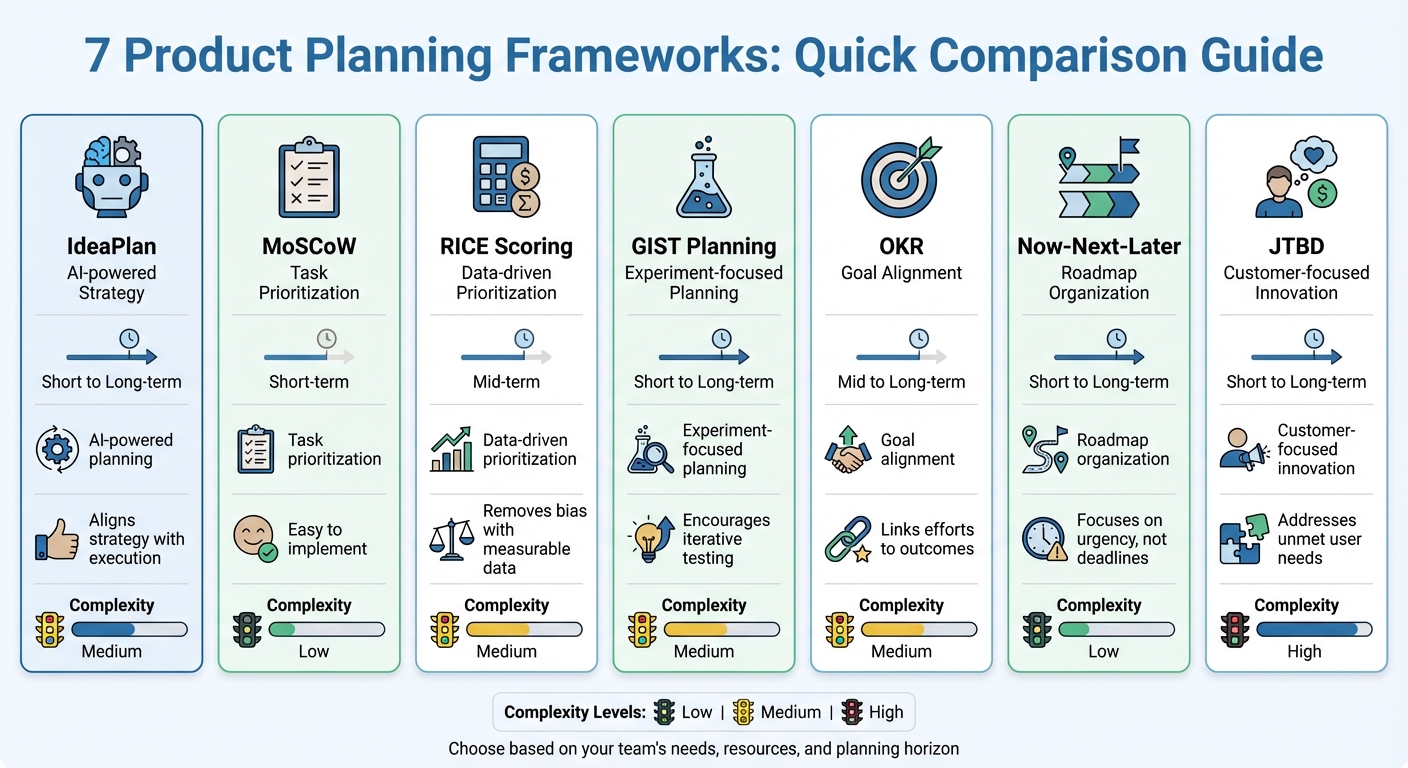
Product Planning Frameworks Comparison: Time Horizon, Use Cases, and Complexity
PRIORITIZATION FRAMEWORKS for your product | Make better decisions as a product manager?
1. IdeaPlan
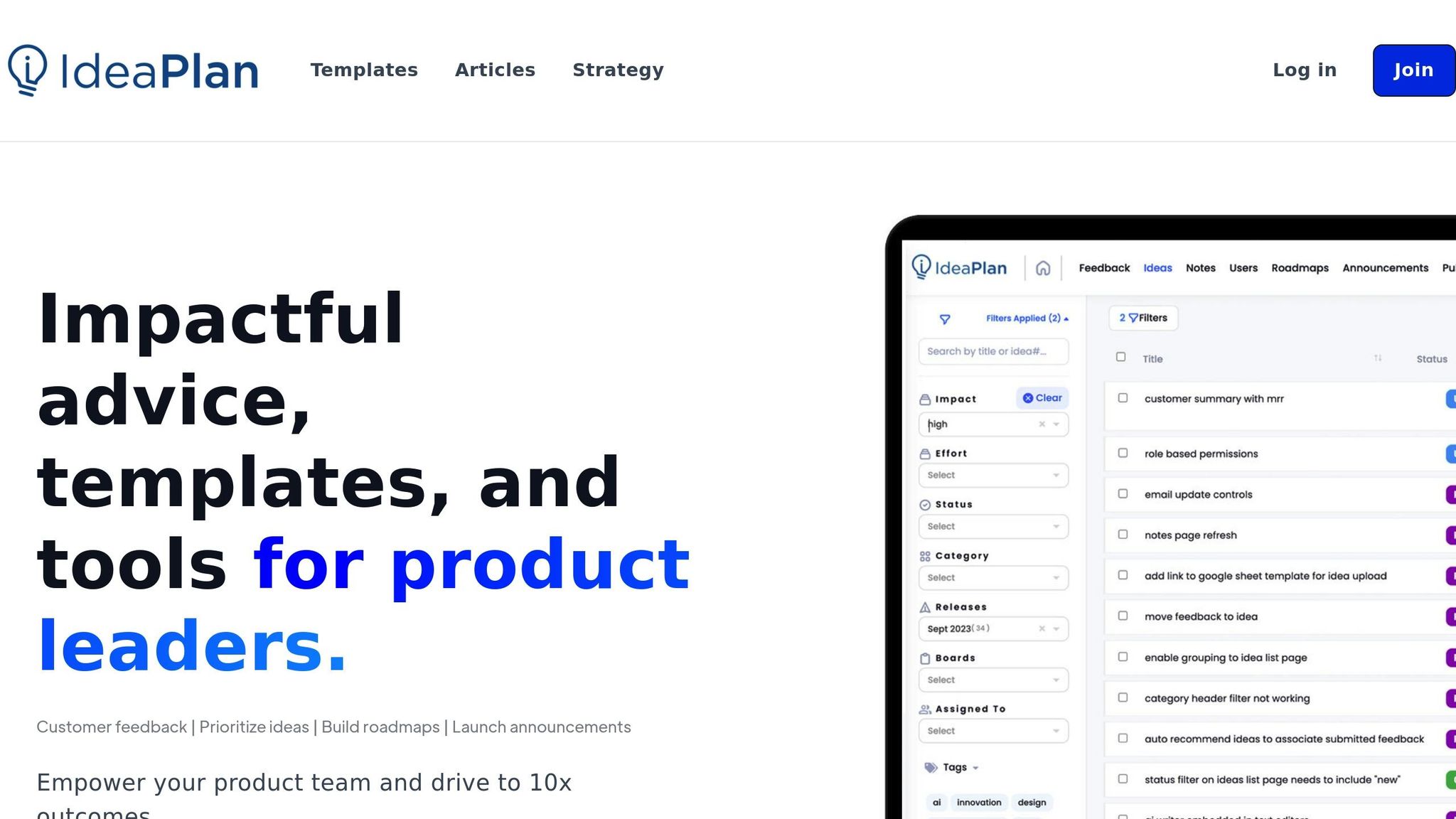
IdeaPlan is a standout framework that bridges the gap between short-term execution and long-term strategy. Designed with AI at its core, this platform helps product leaders align their strategic vision with tactical execution, delivering impactful results. By combining artificial intelligence with time-tested planning methods, IdeaPlan simplifies decision-making for both immediate tasks and future goals.
Time Horizon
With IdeaPlan, you can plan for both quarterly objectives (3. 6 months) and long-term initiatives (2. 5 years). The platform offers biannual strategic alignment while also supporting agile delivery cycles and continuous deployment. This dual focus allows product managers to provide clear, actionable commitments to engineering teams for the near term while presenting a broader strategic vision to executives for the future.
Primary Use Case
IdeaPlan shines when it comes to organizing, evaluating, and prioritizing product ideas based on their potential value to both customers and the business. By collecting feedback from stakeholders, the platform scores and ranks initiatives to ensure they align with overarching business goals. This helps product teams avoid the chaos of constantly reacting to urgent demands and instead focus on a cohesive strategic direction.
Key Advantages
The platform’s AI-driven tools take the guesswork out of decision-making by automating much of the analysis that would otherwise be manual. Standardized templates and visual roadmaps make it easy to communicate priorities and encourage collaboration across teams. By focusing on customer and business value, IdeaPlan helps teams allocate resources to projects that truly matter, avoiding the inefficiency of spreading efforts too thin.
Implementation Complexity
Adopting IdeaPlan does require an initial investment in training and integrating workflows. Product leaders must guide their teams in learning strategic frameworks and adopting AI-assisted planning processes. However, the platform’s structured templates and step-by-step guidance help reduce the challenges typically associated with implementing a new planning system. Teams that dedicate time to this learning phase often experience quicker alignment and more effective prioritization during their first planning cycle.
2. MoSCoW Framework
The MoSCoW Framework is a simple yet effective method for prioritizing requirements by dividing them into four categories: Must-have, Should-have, Could-have, and Won't-have. It was originally created by Dai Clegg at Oracle in the mid-1990s for use with the DSDM methodology.
Time Horizon
This framework is versatile, making it suitable for both short-term sprint planning and longer-term roadmaps, typically spanning 3. 6 months. Its strength lies in helping teams focus on what's essential for the Minimum Viable Product (MVP) while setting aside less urgent features for later releases. By balancing immediate needs with future goals, it ensures teams stay on track without feeling overwhelmed.
Primary Use Case
MoSCoW shines in situations where resources are limited and quick decisions are necessary. It’s particularly useful for startups developing MVPs, Agile teams managing sprint backlogs, and product managers handling competing stakeholder demands. A practical approach is to allocate about 60% of the effort to Must-haves, with the remaining 40% split between Should-haves and Could-haves.
"MoSCoW is a practical prioritization framework for cutting through the noise. It empowers teams to focus on what truly matters without losing sight of long-term goals.". Carlos Gonzalez de Villaumbrosia, Founder & CEO at Product School
Key Advantages
One of the standout benefits of MoSCoW is its ability to prevent scope creep. By explicitly labeling features as "Won't-have", teams can avoid being sidetracked by unnecessary additions or "shiny object syndrome". This clarity also fosters better collaboration between technical and non-technical stakeholders, offering a straightforward alternative to more complex, data-heavy prioritization models.
Implementation Complexity
Getting started with MoSCoW is straightforward - it can often be implemented in a single session. However, its success depends on clearly defining the criteria for each category. Without objective guidelines, teams risk falling into subjective debates, leading to an overloaded "Must-have" list, which undermines the framework's purpose. The real challenge lies in maintaining discipline: keeping "Must-haves" strictly limited to non-negotiable features and regularly revisiting priorities as market conditions change.
Next, we’ll dive into the RICE Scoring Model, a more data-driven approach to prioritization.
3. RICE Scoring Model
The RICE Scoring Model offers a structured, data-driven way to prioritize projects by balancing ambitious goals with practical execution. The formula it uses is straightforward: (Reach × Impact × Confidence) / Effort. Here's how it breaks down:
- Reach: The number of users or customers a project will affect within a specific timeframe.
- Impact: How much the project contributes to a key goal, rated on a scale from 0.25 (minimal) to 3 (massive).
- Confidence: The degree of certainty in your estimates, expressed as a percentage.
- Effort: The amount of time required, measured in person-months.
Time Horizon
One of the strengths of the RICE model is its flexibility. It works equally well for quarterly planning or monthly sprints, as Reach is tied to a defined period. This means you can weigh large-scale, long-term initiatives against smaller, quick-to-execute projects. The inclusion of Effort ensures that only those projects with a strong balance of Reach and Impact make the cut, allowing teams to prioritize effectively regardless of the time horizon.
Primary Use Case
RICE is particularly handy when you need to justify roadmap decisions to stakeholders or eliminate personal bias. It’s especially effective for product managers who have access to solid user data. By requiring a data-based evaluation of every factor, RICE helps ensure that decisions are rooted in evidence rather than opinion. This makes it easier to fairly compare diverse initiatives - whether it’s a flashy new feature for users or a backend upgrade to improve system performance.
Key Advantages
One of the standout benefits of RICE is its ability to reduce reliance on gut feelings or the influence of the "HiPPO" (Highest Paid Person’s Opinion). It demands that every project score be backed by data. The Confidence metric plays a unique role here, acting as a safeguard against overhyping projects that lack proper research or evidence. As Karol Kłaczyński, Head of Product at Brand24, explains:
"The key to successfully using the RICE framework is to be as objective as possible when scoring each component... This ensures that you're not just looking at things from a product-centric viewpoint but also considering marketing, sales, and customer success angles".
Implementation Complexity
While powerful, implementing RICE isn’t without its challenges. It requires input from multiple teams: analytics experts to estimate Reach, tech leads to assess Effort, and alignment on historical benchmarks to calibrate Impact scores. Calibration sessions are crucial, where the team agrees on "anchors" like past projects to define Impact levels. For example, a major redesign might serve as the standard for an Impact score of 3. However, the process also demands careful validation from various sources and doesn’t inherently address project dependencies. Try the RICE Calculator to score your features instantly, or read the RICE framework guide for a step-by-step walkthrough with worked examples.
4. GIST Planning
GIST Planning, introduced by Itamar Gilad during his time at Google, offers a flexible, evidence-driven alternative to traditional rigid roadmaps. The framework is structured around four key components: Goals, Ideas, Step-projects, and Tasks. This layered approach bridges the gap between long-term strategies and daily execution. Instead of locking into features months ahead, GIST views product development as a sequence of small experiments that test ideas before committing significant resources.
Time Horizon
GIST operates across multiple timeframes, making it adaptable for both immediate and future planning. Goals are established for a year or more but are revisited quarterly to ensure alignment with evolving strategies. Ideas are continuously collected in a central "Idea Bank" and ranked using evidence-based scoring systems. Step-projects, which serve as experimental phases, are kept short - lasting anywhere from 1 to 10 weeks - to maintain momentum and flexibility. Finally, Tasks are broken into manageable 1. 2 week sprints for daily execution, ensuring teams stay focused and efficient.
Primary Use Case
This framework is particularly valuable for teams aiming to move away from the "feature factory" mindset, where the focus is solely on churning out features. Instead, GIST shifts the emphasis to achieving measurable outcomes. By focusing on results rather than predefined feature sets, teams are encouraged to explore and uncover the best paths to their goals. This makes GIST especially appealing for startups needing to stay lean and adaptable, as well as for larger organizations trying to align multiple teams around shared objectives.
Key Advantages
One of GIST's standout benefits is its "fail-fast" approach, which reduces risk by testing ideas early. Studies indicate that only about 1 in 3 product ideas deliver positive results. By breaking big concepts into smaller experiments, teams can quickly identify and address failures. If a Step-project doesn’t meet its success criteria within 10 weeks, it’s either abandoned or adjusted, saving months of potentially wasted effort. This approach not only minimizes risk but also boosts speed by cutting down on unnecessary management overhead. Unlike traditional roadmaps, which often commit to large-scale initiatives upfront, GIST allows for more nimble decision-making.
Implementation Complexity
Getting started with GIST is straightforward. An Idea Bank can be maintained with a simple spreadsheet, and tasks can be tracked using standard project management tools. However, adopting GIST often requires a cultural shift. Teams used to fixed deadlines and detailed roadmaps may resist the iterative, evidence-based mindset. Additionally, since GIST avoids long-term feature commitments, it can complicate resource and capacity planning, making it harder to predict future staffing needs. To implement GIST effectively, start by setting clear SMART goals, use scoring methods like ICE or RICE to prioritize ideas, and ensure Step-projects don’t exceed 10 weeks.
sbb-itb-7c23fa1
5. OKR (Objectives and Key Results)
First introduced at Intel under Andy Grove and later championed by John Doerr at Google through his book Measure What Matters, OKRs focus on aligning organizations around measurable outcomes rather than just delivering features. For a primer on how OKRs work and how to write effective ones, see What Are OKRs?.
Time Horizon
OKRs typically follow a quarterly cycle (three months), connecting short-term efforts to broader annual or multi-year goals. John Doerr refers to this as creating "scaffolding" that bridges daily tasks with long-term business objectives. The process begins with executive-level objectives, which cascade down to middle management and then to front-line key results, ensuring alignment across the organization. For projects that span multiple quarters, teams often rely on leading indicators (KPIs) to track progress in the short term. This structure helps balance immediate priorities with overarching goals.
Primary Use Case
The framework is particularly effective in aligning cross-functional teams around ambitious growth targets, shifting the focus from outputs (features delivered) to outcomes (tangible business results). A notable example is LinkedIn's use of OKRs for its Sales Navigator product, which contributed to substantial year-over-year revenue growth. This approach works best for established teams aiming to push beyond incremental improvements.
Key Advantages
OKRs encourage teams to make tough prioritization decisions while giving them the freedom to determine how to achieve their goals. High-performing teams often set 3 to 5 objectives per quarter, each supported by 2 to 4 key results to maintain focus. Google uses a scoring system ranging from 0.0 to 1.0, with a score of 0.6 to 0.7 considered ideal - hitting 100% may indicate that the goals weren't challenging enough. Studies show that 70% of organizations using OKRs report improved strategic alignment, and 60% experience faster decision-making cycles.
"OKRs are one of the best goal-setting frameworks I've found for driving focus, alignment, accountability, and an outcome orientation"
These strengths highlight why OKRs are widely adopted and pave the way for discussions on effective implementation.
Implementation Complexity
While the concept of OKRs is straightforward, successful implementation requires a high level of organizational discipline and commitment. Teams often struggle to distinguish between output metrics and true outcome measures. A learning-focused culture is essential - one where achieving 70% of a goal is celebrated as progress, and lower scores are treated as opportunities to improve. To implement OKRs effectively, organizations should:
- Separate OKR scores from employee compensation.
- Conduct collaborative drafting sessions with cross-functional teams.
- Hold systematic post-mortems at the end of each quarter to identify lessons learned.
"While conceptually simple, (OKRs) demands rigor, commitment, clear thinking, and intentional communication... there is always some pain for meaningful gain"
6. Now-Next-Later Roadmapping
Janna Bastow introduced the Now-Next-Later roadmap as a way to organize work into three adaptable timeframes, prioritizing urgency over rigid deadlines. Unlike traditional Gantt charts, this method offers a dynamic, evolving document that responds to market shifts and customer needs.
Time Horizon
This framework sorts tasks into three categories:
- Now: Focuses on immediate priorities. These tasks are fully scoped and actively being developed.
- Next: Addresses mid-term goals, typically one to three months out. These initiatives are validated but not yet fully designed.
- Later: Encompasses long-term plans, three months or more into the future. These are big-picture ideas still requiring exploration.
To maintain focus, teams can implement Work in Progress (WIP) limits, such as 2. 4 items in "Now" and 3. 6 in "Next". This structure helps teams adapt quickly to changes without losing sight of their goals.
Primary Use Case
Thanks to its flexibility, the Now-Next-Later roadmap is especially useful for startups, early-stage products, and agile teams operating in fast-paced environments. It’s particularly suited for companies with 20 to 1,000 employees, helping them outline strategic goals without committing to fixed quarterly deadlines. Tools like Trello, Notion, or Google Sheets are often enough to manage this framework effectively.
Key Advantages
This roadmap shifts the focus from delivery dates to solving actual customer problems. Only the "Now" column represents a firm commitment, while "Next" and "Later" serve as directional guides rather than promises. This flexibility allows teams to pivot based on new data without overhauling their entire plan. Janna Bastow emphasizes this point:
"I invented the Now-Next-Later roadmap because I believe that, rather than focusing on deadline-based delivery, product teams should stay focused on discovery".
The "Later" column also provides a tactful way to address stakeholder requests, positioning them as future opportunities rather than outright dismissals.
Implementation Complexity
Adopting this framework requires a shift in mindset - from traditional project management to a product-focused approach. Teams need to frequently update "Now" tasks with each sprint, review "Next" every two to four weeks, and reassess "Later" items quarterly. The biggest hurdle lies in managing stakeholder expectations. It’s critical to clarify that only "Now" tasks are high-confidence commitments. As Aakash Gupta puts it:
"The Now-Next-Later roadmap... is the antidote to that chaos. You move from project management ('When will it be done?') to true product management ('What problem are we solving and why does it matter?')".
7. Jobs-to-Be-Done (JTBD)
The Jobs-to-Be-Done (JTBD) framework takes a fresh approach to understanding customer behavior, emphasizing that people don’t simply buy products - they "hire" them to accomplish specific tasks or solve particular problems. As Harvard Business School Professor Clayton Christensen famously put it in his foundational JTBD research:
"People don't just buy products - they hire them to do specific jobs".
This perspective shifts the focus from product features to the deeper motivations, challenges, and outcomes that influence buying decisions.
Time Horizon
JTBD connects short-term priorities with long-term goals. In the immediate term, teams can use tools like Job Maps - an eight-step process including Define, Locate, Prepare, Confirm, Execute, Monitor, Modify, and Conclude - to pinpoint friction in the user experience. On a broader scale, JTBD’s solution-agnostic approach allows for creating multi-year roadmaps that remain useful even as specific features or platforms evolve.
Primary Use Case
JTBD is particularly effective for product discovery, innovation planning, and market growth. By analyzing what users value most and where they feel underserved, teams can uncover opportunities for meaningful improvements. The framework categorizes jobs into three types:
- Functional: Tasks users need to complete.
- Emotional: Feelings users want to achieve.
- Social: How users want to be perceived by others.
By identifying unmet needs - areas that are important to users but currently lack satisfaction - JTBD helps teams focus on where innovation can have the greatest impact.
Key Advantages
JTBD’s focus on measurable outcomes leads to more predictable success in innovation. For instance, companies using JTBD-based Outcome-Driven Innovation report an 86% success rate in improving products. Real-world results back this up:
- Cordis Corporation expanded its market share from 1% to over 20%, launching 19 new products that addressed unmet medical procedure needs.
- Microsoft saw a 100% year-over-year revenue increase for its Software Assurance program by shifting its focus from software updates to IT risk management and budget predictability.
These examples highlight how JTBD not only drives immediate results but also supports long-term innovation. By looking beyond surface-level user requests (like asking for a "faster horse"), the framework helps teams uncover what users truly need - whether it’s better transportation or entirely new solutions.
Implementation Complexity
Implementing JTBD requires a significant commitment from the organization and a shift in mindset. Teams need to conduct qualitative "job interviews" to deeply understand user motivations, contexts, and alternatives. Success also depends on collaboration across departments - product, design, and marketing teams must work together, with leadership support ensuring the necessary resources are in place.
The main challenge lies in translating abstract job statements (structured as "[Verb] + [Object] + [Context]") into actionable product features without making plans too vague. To make this process practical, teams can integrate job statements into workflows, such as user stories:
"As a user, I need to [job], so I can [desired outcome]".
Comparison of Frameworks
Choosing the right framework boils down to your goals and the level of structure your team needs. Some frameworks are tailored for quick execution, while others focus on long-term planning. As discussed earlier, each framework has its strengths, whether it's driving immediate action or organizing efforts for the future. Understanding these distinctions ensures you’re using the right tool for the task at hand - avoiding the mistake of applying a strategic planning framework to operational workflows.
Frameworks serve different purposes in practice. Those geared toward immediate execution can deliver fast results but often lack the structure required for longer-term strategic alignment. On the other hand, frameworks built for mid-to-long-term planning help teams focus on broader objectives and sustained progress.
For example, the Now-Next-Later framework is a versatile tool that spans all time horizons. It categorizes work into three buckets: Now (high-commitment execution), Next (mid-term validation), and Later (strategic discovery). As product leader Aakash Gupta explains:
"The most important rule of a Now-Next-Later roadmap is this: only 'Now' has a high degree of commitment. 'Next' and 'Later' represent direction and priority, not a promise of delivery on a specific date".
This flexibility makes it an excellent choice for managing stakeholder expectations while avoiding rigid deadlines.
When it comes to prioritization, frameworks like RICE scoring and MoSCoW provide clarity on what to tackle next. RICE scoring uses a formula - (Reach x Impact x Confidence) / Effort - to eliminate guesswork and align decisions with measurable data. This makes it particularly valuable for justifying choices to leadership with solid metrics. Meanwhile, MoSCoW simplifies prioritization by categorizing tasks into Must, Should, Could, and Won’t, keeping the process straightforward and easy to implement.
Here’s a quick comparison of popular frameworks, highlighting their time horizons, primary use cases, benefits, and complexity:
| Framework | Time Horizon | Primary Use Case | Key Advantage | Complexity |
|---|---|---|---|---|
| IdeaPlan | Short to Long-term | AI-powered product strategy & execution | Scales product management with AI insights | Low to Medium |
| MoSCoW | Short-term | Feature prioritization | Simple categorization (Must/Should/Could/Won't) | Low |
| RICE Scoring | Mid-term | Feature prioritization | Reduces bias through quantifiable data | Medium |
| GIST Planning | Short to Long-term | Agile strategic planning | Connects goals to experiments and tasks | Medium |
| OKR | Mid to Long-term | Strategic goal setting | Aligns team efforts with business metrics | Medium |
| Now-Next-Later | Short to Long-term | Roadmapping & communication | Flexible; avoids brittle date-based plans | Low |
| JTBD | Short to Long-term | Product discovery & innovation | Uncovers underlying customer needs | Medium to High |
Each framework has its place, whether you’re prioritizing features, setting long-term goals, or aligning teams around shared objectives. The key is selecting the one that aligns with your team’s needs and the challenges you’re addressing.
Conclusion
Choosing the right framework comes down to your team’s current stage and objectives. For early-stage products where uncertainty runs high, agile methods like IdeaPlan’s dynamic planning or the Now-Next-Later roadmap can offer flexibility. On the other hand, mature products often benefit from more structured approaches like OKRs or JTBD, which emphasize strategic alignment and customer focus. Teams just starting out may lean on frameworks like MoSCoW for its clear prioritization, while seasoned teams might gravitate toward outcome-focused methods like GIST Planning.
Combining frameworks can tackle multiple challenges effectively. For instance, pairing OKRs with the Now-Next-Later roadmap ensures that every action is tied to clear business outcomes. OKRs provide the qualitative "why" and quantitative "how much", while Now-Next-Later outlines the "what" and "when" without locking teams into rigid timelines. This approach avoids the common pitfall of teams churning out features that fail to impact key metrics.
To balance short-term execution with long-term vision, maintain two roadmaps: a tactical one for near-term deliverables (3-6 months) and a visionary one for broader goals (2-5 years). Our guide to building a product roadmap walks through this dual-roadmap approach step by step. As ProductPlan aptly puts it:
"If your vision is changing more than twice a year, you've probably got bigger problems than an outdated document".
This separation keeps long-term aspirations from muddling day-to-day execution.
Before rolling out a framework across your organization, start small. Test it with a single team or product line, and use measurable outcomes, like cycle time, OKR completion rates, or Net Promoter Scores, to determine if it’s driving real improvements. Blindly adopting frameworks without adapting them to your team’s context can lead to “ceremony fatigue” and erode engagement.
The frameworks discussed in this article - IdeaPlan’s AI-powered tools, MoSCoW’s clear prioritization, RICE’s data-driven scoring, GIST’s experimental planning, OKRs’ strategic focus, Now-Next-Later’s flexible roadmapping, and JTBD’s customer-centric approach - offer a versatile toolkit. The key is selecting the one (or combination) that best aligns with your team’s experience, resources, and current challenges. The Product Strategy Handbook covers how to connect these frameworks into a coherent planning system.
Explore More
- Top 10 Prioritization Frameworks for Product Managers (2026) - The 10 best prioritization frameworks ranked by practical value for product managers.
- Prioritization for Mid-Level Product Managers - Advance your prioritization skills as a mid-level PM.
- Prioritization for New Product Managers - Learn prioritization fundamentals as a new PM.
- How to Choose Between RICE and ICE Prioritization - Expert answer on when to use RICE vs ICE scoring for feature prioritization, with practical criteria for picking the right framework.
Related Blog Posts
- Essential Product Management Checklist for 2025
- How to Build a Product Roadmap in 5 Simple Steps
- Ultimate Guide to Idea Generation for Product Managers
- Align Product Roadmaps with Business Goals