Quick Answer (TL;DR)
Strategic agility is the ability to sense market shifts, reallocate resources quickly, and make unified leadership decisions during disruption. Companies that act early during disruptions see up to 10% revenue growth, while slow movers face declines. The three core capabilities are strategic sensitivity (spotting trends early), resource fluidity (rapid reallocation), and leadership unity (fast, conflict-free decisions). Build agility through flexible multi-horizon planning, real-time data systems, and AI-powered decision-making.
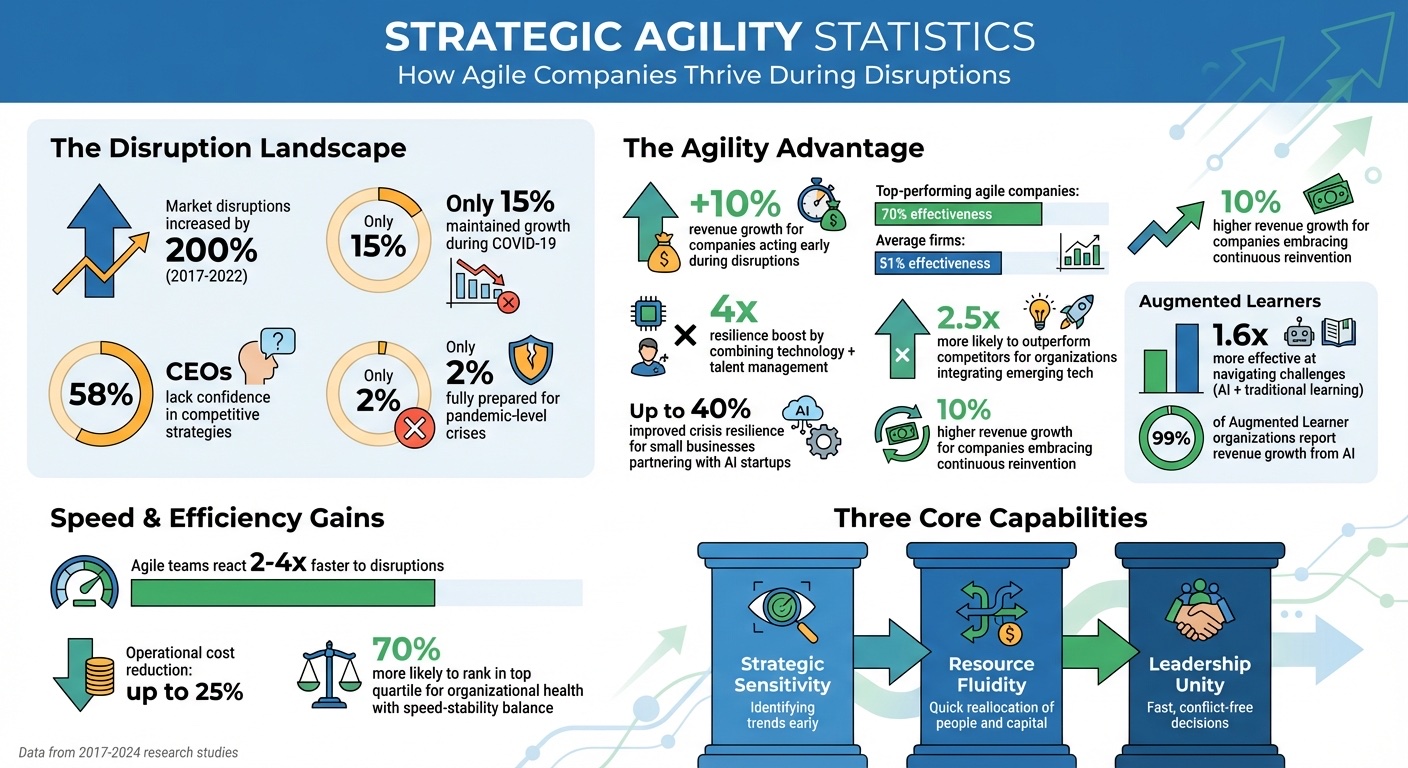
Strategic agility is the ability of businesses to quickly sense, respond, and adjust to market disruptions, ensuring they stay competitive and turn challenges into opportunities. Unlike resilience, which focuses on enduring shocks, agility focuses on thriving during uncertainty. This concept is critical as disruptions have surged by 200% between 2017 and 2022, with only 15% of companies maintaining growth during crises like COVID-19.
Key takeaways:
- Companies that act early during disruptions see up to 10% revenue growth, while others face declines.
- Success requires three core capabilities: identifying trends, reallocating resources, and unified leadership.
- Examples like Amazon, Zoom, and Tesla show how sensing shifts, making quick decisions, and using technology can drive success during crises.
To thrive, businesses must prioritize flexible planning, use data-driven decisions, and integrate emerging technologies like AI to stay ahead of competitors.
Strategic Agility Statistics: How Agile Companies Outperform During Market Disruptions
Strategic Agility. How to Stay Ahead in a Rapidly Changing World
Research Findings on Strategic Agility
Strategic agility is more than just a buzzword - it's a set of actionable capabilities that help companies stay ahead in a constantly changing environment. Academic studies, particularly David Teece's dynamic capabilities framework, highlight three essential abilities that set agile companies apart: strategic sensitivity (the ability to identify trends early), resource fluidity (quickly reallocating people and capital), and leadership unity (making fast, conflict-free decisions). Together, these capabilities allow companies to turn uncertainty into opportunities.
To strengthen your strategic sensitivity, explore our SaaS Market Trends 2026 analysis covering 25 market trends with growth trajectories, competitive dynamics, and opportunity areas across AI/ML, Vertical SaaS, Security, and other high-growth categories.
The numbers tell a compelling story. Top-performing companies excel at these dynamic capabilities, with 70% effectiveness, compared to just 51% among average firms. Companies that combine advanced technology and strong talent management boost their resilience fourfold. Even smaller businesses benefit - those that partnered with AI startups saw their crisis resilience improve by up to 40%.
Core Capabilities of Strategic Agility
Strategic agility thrives on three interconnected processes: sensing, seizing, and transforming.
- Sensing means keeping a finger on the pulse of customer needs and market changes through real-time data analysis.
- Seizing is about mobilizing resources quickly to capitalize on opportunities.
- Transforming involves continuously updating and refining core capabilities using flexible tools.
These processes are particularly effective in handling deep uncertainty - those unpredictable, "unknown unknowns" that traditional risk management struggles to address. Economist Frank Knight captured this challenge perfectly:
"With uncertainty present, doing things, the actual execution of activity, becomes in a real sense a secondary part of life; the primary problem or function is deciding what to do and how to do it."
This highlights a critical distinction. While operational capabilities focus on efficiency (doing things right), dynamic capabilities prioritize strategic alignment (doing the right things). Both are essential, but during periods of disruption, identifying what to do often outweighs perfecting how to do it.
What Drives Strategic Agility
Unified leadership is a cornerstone of strategic agility, enabling quick, decisive action without internal bottlenecks. However, leadership must also embrace what researchers call the speed-stability paradox. Agile organizations combine rapid decision-making with clear goals, measurable outcomes, and accountability. Companies that strike this balance are 70% more likely to rank in the top quartile for organizational health.
A strong digital foundation - using cloud computing, real-time data, and AI - further enhances agility by enabling evidence-based decisions in days rather than months. But technology alone isn't enough. Organizational culture plays a vital role. Companies that encourage innovation, support experimentation, and collaborate externally consistently outperform those that rely solely on internal resources.
Research highlights the importance of search breadth (drawing insights from a wide range of external sources) during the exploration phase and search depth (deep collaboration with key partners) when it's time to execute. These principles pave the way for understanding how real-world companies are applying strategic agility, which will be explored in upcoming case studies.
Case Studies: How Companies Adapted to Disruptions
Here are some examples of how different companies successfully navigated disruptions by staying agile and making strategic decisions. These cases highlight the importance of being able to sense, seize, and transform in response to market challenges.
Amazon: Scaling Operations During the Pandemic

The COVID-19 pandemic brought a surge in demand that pushed Amazon's fulfillment network to its limits. With only 2% of companies fully prepared for such a crisis, Amazon’s response stood out as a model of adaptability and strategic thinking.
Amazon relied on what it calls an "organizational sensory system" - a sophisticated network of tools that provided real-time insights into inventory, workforce availability, supplier capacity, and regional restrictions. Using AWS data lakes, AWS Glue, and Amazon Redshift, the company could forecast demand spikes with machine learning and pre-position inventory to avoid shortages.
In late 2020, Amazon restructured its fulfillment network into eight regional hubs, which were managed by its long-term planning team. This change increased the percentage of customer orders fulfilled within their own region from 62% to 76%, improving delivery times and cutting transport costs.
"Our focus moved from trying to figure out how to make customer deliveries as fast as possible to trying to meet exceptional customer demand by pushing as much volume as we could through our network."
. Adam Baker, Vice President of Global Transportation, Amazon
Amazon also empowered its teams with a "two-way door decision-making" framework, which distinguishes between irreversible decisions and reversible experiments. This allowed fulfillment center managers and frontline workers to make quick adjustments based on real-time data without waiting for executive sign-off. As research scientist Xiaoyan Si explained, "When you boil it right down, regionalization is just a software setting".
Zoom faced a similarly intense challenge during the pandemic and used agile strategies to meet skyrocketing demand.
Zoom: Managing Explosive User Growth
Zoom experienced hypergrowth during the pandemic, navigating the challenges of recognizing opportunities, making decisions, and executing at an exceptional pace. To succeed, the company had to align its ability to detect new user needs, decide on a course of action, and implement changes swiftly.
By virtualizing its operations and scaling its infrastructure rapidly, Zoom managed to handle an influx of users while maintaining the reliability of its core video platform. The company balanced stability with adaptability, recalibrating strategies and resources to meet the evolving needs of its users.
Tesla’s experience with supply chain disruptions offers another example of how agile strategies can mitigate challenges.
Tesla: Overcoming Supply Chain Challenges
Tesla demonstrated its ability to adapt during global supply chain disruptions, maintaining production while others faced setbacks. The company’s approach involved three key strategies: keeping extra capacity to manage demand surges, stockpiling critical materials, and diversifying its supplier network across multiple regions to reduce risks.
Tesla also used digital simulations and disruption modeling to prepare for potential challenges before they occurred. This, combined with a three-horizon planning framework, allowed the company to operate on multiple levels: long-term strategic planning, short-term resource allocation, and real-time crisis response. While 57% of companies struggled with serious disruptions during the pandemic, Tesla’s approach ensured it could keep production running smoothly.
Tesla’s success also reflected a broader trend: 92% of companies continued investing in technology during the pandemic, recognizing that digital tools and automation were crucial for navigating uncertainty. Tesla’s heavy focus on automation and AI-driven operations positioned it to thrive in what experts refer to as "lights-out" manufacturing - fully automated, hands-free production.
sbb-itb-7c23fa1
Lessons for Product Leaders
Amazon, Zoom, and Tesla highlight the importance of being able to sense, decide, and act quickly in a fast-changing market. For product leaders, this means moving away from rigid planning and embracing strategies that adapt as markets evolve. By applying lessons from these companies, product leaders can turn strategic flexibility into tangible product success.
Building Flexible Product Strategies
Successful companies treat product roadmaps as evolving tools rather than fixed blueprints. For a practical starting point, see our guide on how to build a product roadmap that balances structure with flexibility. A method like three-horizon planning helps manage decisions across different timeframes: long-term strategic investments (spanning years), short-term tactical resource allocation (weeks or months), and immediate responses to market disruptions. Including buffers in these plans allows teams to absorb unexpected changes without needing to rewrite entire strategies. Framing decisions as experiments or hypotheses also helps teams avoid overanalyzing situations, making it easier to act decisively when faced with uncertainty.
HubSpot offers a compelling example. Between 2019 and 2024, under CEO Yamini Rangan, the company transitioned to an AI-first platform, integrating more than 200 features. This shift helped grow revenue from $675 million to over $2.6 billion. As Rangan put it:
"We want to be an AI-first company, not just an AI-first product."
This transformation was treated as a long-term strategic decision, while individual product teams made tactical adjustments based on real-time customer feedback.
Another effective approach is what some call "Contextual Methodology" - a blend of Design Thinking, OKRs, and Lean experimentation tailored to specific business needs. Airbnb used this method to recover from pandemic-related losses, ultimately achieving one of the most successful tech IPOs by the end of 2020.
Setting short-term goals, like 3-month "stability" objectives, can also help keep teams aligned while staying adaptable to market shifts. For example, Estée Lauder uses AI to track weekly trends, such as a sudden spike in demand for the color "peach" on social media. By identifying matching products across its 20+ brands with techniques like "fuzzy matching", the company can repackage and redeploy inventory almost instantly.
Using AI to Scale Product Management
As strategies become more flexible, AI plays a critical role in scaling agile product management. AI is transforming how product teams work by acting as a data researcher, strategic advisor, simulator, and communicator. Companies that combine traditional organizational learning with AI capabilities - referred to as "Augmented Learners" - are 1.6 times more effective at navigating technological and regulatory challenges. Nearly all of these organizations (99%) report revenue growth tied to their use of AI.
A major advantage lies in building proprietary data ecosystems. AI models trained on unique internal data - like customer feedback, usage patterns, and market trends - provide insights that generic tools simply can’t match. As Alexander D'Amico, Senior Partner at McKinsey & Company, explains:
"Artificial intelligence can't - and, we believe, won't - replace human logic and interpretation in a complex domain, such as strategy. However, the technology can provide faster, more objective answers that can significantly augment our decision prowess."
Platforms like IdeaPlan are helping product teams implement these principles. Acting as an AI-powered "thought partner", IdeaPlan streamlines workflows, identifies blind spots, and supports data-driven decision-making - allowing teams to focus on more impactful work.
Aflac U.S. showcases the power of this approach. Under CIO Shelia Anderson, the company used generative AI to reverse-engineer outdated code, improving system productivity by 5 to 10 times. They also created a technology incubator to rapidly prototype new business models, enabling product teams to prioritize strategic initiatives instead of getting bogged down by legacy systems.
The shift from static roadmaps to "living systems" powered by real-time data is gaining momentum. Product Owner Dipti Gupta describes this evolution:
"The product roadmap is evolving - from a static document to a dynamic, data-driven decision system powered by AI."
She continues:
"The role of the Product Manager? To curate, challenge, and coach - not just to create lists of features."
Companies that integrate emerging technology into their strategies are 2.5 times more likely to outperform competitors. Those embracing continuous reinvention and technology-driven strategy see 10% higher revenue growth. The takeaway is clear: product leaders who use AI and flexible, data-informed strategies are best positioned to navigate the next wave of market disruptions.
Conclusion: Thriving Through Market Disruptions
Between 2017 and 2022, market disruptions have surged by 200%, yet a striking 58% of CEOs admit they lack confidence in their strategies to stay competitive in the future. The dividing line between companies that rise above and those that falter often boils down to strategic agility - the ability to detect shifts, reallocate resources quickly, and adapt effectively.
Drawing lessons from companies like Amazon, Zoom, and Tesla, one thing becomes clear: planning must be flexible and dynamic. By using multi-horizon frameworks that blend long-term vision with short-term adaptability, teams can react 2. 4 times faster to disruptions and cut operational costs by up to 25%.
Equally important is embracing technology. Organizations that integrate emerging technologies into their strategies are 2.5 times more likely to outperform competitors. Those committed to continuous reinvention often see 10% higher revenue growth. Tools such as IdeaPlan help product teams work smarter by automating priorities, identifying blind spots, and connecting day-to-day efforts with broader business goals - turning the concept of strategic agility into actionable results.
The future doesn’t demand perfect predictions; it demands quick, informed responses. As Gaurav Gupta, John Kotter, Vanessa Akhtar, and Nick Petschek wisely observed:
"The key is not the ability to predict which way the wind will blow but rather the ability to sense the prevailing winds and adapt quickly to ride with them."
Related Blog Posts
- Essential Product Management Checklist for 2025
- AI Product Leadership Playbook
- AI Software Development Lifecycle Playbook
- Outcome-Driven Leadership: Tips for Product Managers
Explore More
- Discovery for CPO/Executive Product Leaders - Executive product discovery: market sensing, strategic research governance, building a customer-obsessed culture, and discovery as competitive advantage.
- Prioritization for CPO/Executive Product Leaders - Executive-level product prioritization: company strategy alignment, board communication, portfolio governance, and building a prioritization culture.
- Roadmapping for CPO/Executive Product Leaders - Executive roadmapping: vision-driven planning, board-level communication, multi-year product strategy, and building a roadmapping culture across the org.
- Roadmapping for Senior Product Managers - Senior PM roadmapping: multi-team coordination, strategic narrative, portfolio-level planning, and influencing roadmaps you do not own.