Quick Answer (TL;DR)
Product managers prioritize technical debt by identifying the 20% of debt causing 80% of problems, scoring items by severity, dependency, and business impact, then allocating 15-30% of sprint capacity to the highest-impact fixes. The key metrics to track are Technical Debt Ratio (keep below 5-10%), Mean Time to Resolution, and code churn. Link debt reduction to business KPIs like deployment speed and customer satisfaction to maintain stakeholder buy-in.
Technical debt is like borrowing time to deliver features faster, but it comes at a cost. The metaphor was coined by Ward Cunningham in 1992 to describe the trade-off between shipping quickly and writing clean code. If left unmanaged, it can slow development, frustrate customers, lead to unmanaged feature requests, and hurt your product's scalability. Here's how product managers tackle it:
- Identify Debt: Use tools like SonarQube or Git data to find problem areas.
- Measure Impact: Metrics like Technical Debt Ratio (TDR) and code churn help assess how debt affects efficiency.
- Prioritize Wisely: Focus on the 20% of debt causing 80% of issues. Use scoring models to weigh severity, cost, and dependencies.
- Plan for Debt: Allocate 10-30% of sprint capacity for maintenance. Include debt in sprint planning goals and track progress in your product roadmap.
- Communicate Value: Link debt reduction to KPIs like deployment speed or customer satisfaction to gain stakeholder support.
- Stay Consistent: Regularly review debt, use dashboards for visibility, and integrate fixes into daily workflows.
Managing technical debt isn't about eliminating it entirely - it's about balancing short-term delivery with long-term growth. And technical debt is only part of the picture. product debt (feature cruft, UX inconsistencies, and abandoned experiments) can be even more dangerous because it compounds in ways that are harder to measure.
Identifying and Assessing Technical Debt
How to Identify Technical Debt
Technical debt can be uncovered through a mix of automated tools and developer expertise. Tools like SonarQube, SonarCloud, CAST, and Kiuwan use static code analysis to flag potential coding issues. Meanwhile, analyzing Git commit data can reveal modification hotspots - areas in the code that frequently change and sap productivity. This behavioral analysis also helps identify spots prone to recurring problems.
"Technical debt is often mistaken for 'bad code in general'. This is a dangerous fallacy that leads organizations to waste months on improvements that don't have a clear business outcome or aren't urgent."
To stay ahead of technical debt, incorporate regular code reviews, retrospectives, and maintain a technical debt register. These practices make it easier to capture issues early and track recurring bugs, which often point to deeper architectural flaws.
Once you've identified the debt, the next step is to measure its impact on your team's efficiency and overall project timeline.
Measuring Technical Debt Impact
After pinpointing technical debt, it’s crucial to evaluate its effect using specific metrics. Proper measurement turns technical debt into a manageable factor rather than an overwhelming challenge.
Start by monitoring cyclomatic complexity - higher values often correlate with more bugs and longer testing cycles. Another useful metric is code churn, which measures how much code changes over time. High churn can signal problem areas that are slowing down development.
To quantify the cost of technical debt, use the Technical Debt Ratio (TDR) and Mean Time to Resolution (MTTR). The TDR gives a clear picture of how much debt exists relative to the system’s overall value, with a ratio below 5% considered acceptable. However, a TDR above 30% indicates a critical risk that demands immediate attention.
The financial impact of technical debt is significant. According to McKinsey, CIOs report that 10 to 20 percent of the technology budget dedicated to new products is diverted to resolving tech debt issues, and tech debt can amount to 20 to 40 percent of the value of an entire technology estate. Industry estimates suggest organizations spend 60% to 80% of their software budget on maintenance rather than new development. Teams weighed down by high technical debt often deliver significantly fewer features compared to those working with well-maintained codebases.
sbb-itb-7c23fa1
Prioritizing Technical Debt as If Time & Money Matters • Adam Tornhill • GOTO 2022
Frameworks for Prioritizing Technical Debt
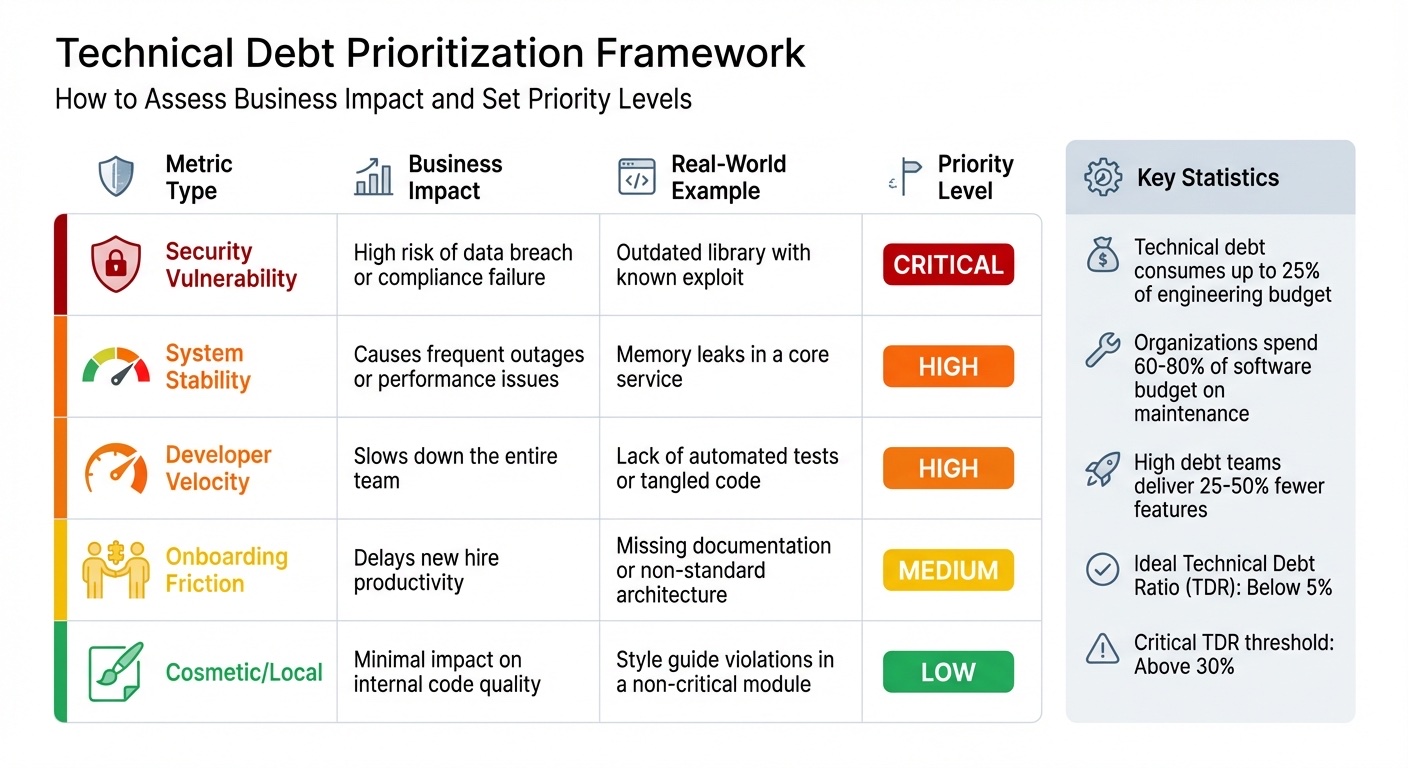
Technical Debt Prioritization Framework: Criteria and Priority Levels
The 80/20 Rule for Prioritization
The 80/20 rule is a valuable tool for product managers looking to tackle technical debt effectively. Instead of attempting to address every issue, focus on the 20% of debt that causes 80% of the problems. This typically means prioritizing systemic debt - large-scale architectural challenges that slow down the entire organization - over smaller, acute issues that can be resolved quickly.
It's important to differentiate between problems that hinder individual developers and those that block entire teams. Many organizations dedicate 10% to 20% of each sprint to maintenance tasks and reducing technical debt.
"Companies and products never win by having as little as possible tech debt. Speed to delivery, being first to market, and constantly adding value to the product are things that lead to winning." - Matt Greenberg, CTO at Reforge
To measure your technical debt burden, use the Tech Debt Ratio: Total Estimated Technical Debt / Velocity. Ideally, this ratio should fall between 3 and 7 sprints' worth of debt, depending on your product's stage of development. If the ratio exceeds this range, it's a signal to allocate more resources toward resolving debt before it starts to hinder progress. This approach sets the stage for more structured decision-making models, discussed in the next section.
Business Impact Scoring and Decision Trees
A structured scoring model can help evaluate technical debt by considering multiple factors. Start by assessing these dimensions:
- Severity: How much the debt affects functionality.
- Dependency: The number of components tied to the issue.
- Cost of Fixing: Estimated in story points.
- Code Knowledge: Whether your team understands the affected area. If key knowledge is at risk, prioritize addressing that debt.
The RICE framework offers another structured approach: score each debt item by Reach, Impact, Confidence, and Effort to produce a comparable priority score. You can run the numbers quickly with the RICE Calculator. One practical formula combines these factors:
Total Score = (Knowledge + Severity + Dependency). (3 × Cost).
To express uncertainty, use a Fibonacci scale (1, 2, 3, 5, 8, 13, 21).
When designing a decision tree, consider five key factors:
- Confidence: How likely is failure?
- Time: How urgent is the issue?
- Impact to User: How does it affect quality and speed?
- Sequence: Does it block key milestones?
- Accumulated Debt: How long has the problem persisted?
Martin Fowler's taxonomy of technical debt distinguishes between deliberate and inadvertent debt, and between reckless and prudent debt. A useful lens for prioritization. A real-world example of this approach is Twitter's development of "Manhattan", a custom distributed database. Between 2006 and 2014, Twitter prioritized user acquisition by relying on open-source storage systems. When scaling became critical, they addressed years of accumulated debt with this new solution.
Comparison Table: Prioritization Criteria
| Metric | Business Impact | Example | Priority Level |
|---|---|---|---|
| Security Vulnerability | High risk of data breach or compliance failure | Outdated library with known exploit | Critical |
| System Stability | Causes frequent outages or performance issues | Memory leaks in a core service | High |
| Developer Velocity | Slows down the entire team | Lack of automated tests or tangled code | High |
| Onboarding Friction | Delays new hire productivity | Missing documentation or non-standard architecture | Medium |
| Cosmetic/Local | Minimal impact on internal code quality | Style guide violations in a non-critical module | Low |
An example of prioritizing technical debt on a large scale comes from Airbnb. Before its IPO, the company refactored over 10 million lines of code to transition to a Service-Oriented Architecture. Led by Zainab Ghadiyali, Head of Product on Platform, this effort became one of the top six priorities in Airbnb's S-1 filing. The move was essential for enabling the launch of new business lines.
Strategies for Managing and Addressing Technical Debt
Once you’ve nailed down a solid prioritization framework, the next step is to dive into tactical sprint and KPI strategies to keep technical debt in check.
Adding Technical Debt to Sprint Planning
A great way to manage technical debt is by reserving a set percentage of capacity in every sprint - usually between 15% and 30%. Think of it as a "tech budget." This approach ensures you have predictable bandwidth for maintenance and avoids the constant temptation to "borrow" time from other tasks to push out new features.
Using a single issue tracker, like Jira, for both features and technical debt items is a smart move. It keeps everything in one place so nothing gets overlooked. Let engineers handle prioritizing the technical backlog while product managers focus on feature development. This division of labor ensures that the most critical architectural problems get addressed without overloading PMs. Aim for combined sprint goals that tie features to technical improvements, such as: "Launch the payment gateway AND reduce page load time by 20% through refactoring".
To prevent new debt from piling up, include technical standards in your Definition of Done. For example, require unit tests and complexity reviews as part of the process. If you do end up borrowing from the tech budget during a sprint, treat it as a formal trade-off that needs to be repaid right away.
Once you’ve established predictable sprint allocations, you can take it further by implementing specialized sprints or focused epics.
Using Pit Stop Sprints and Epics
While ongoing debt repayment is ideal, some teams find value in scheduling dedicated "pit stop" sprints once a quarter. These sprints focus solely on remediation work. However, avoid saving all technical debt work for hardening sprints, as looming deadlines often push such tasks to the back burner.
To keep technical debt epics from dragging on endlessly, scope them by quarter (e.g., "Tech Debt FY26 Q1"). This creates clear boundaries and makes progress easier to track. Use labels and categories in your issue tracker to streamline reporting on velocity and capacity planning.
Make it a habit to groom your technical debt epics regularly. Remove items that are no longer relevant due to library updates or shifts in architecture. Encourage the "Boy Scout Rule" - developers should leave the codebase cleaner than they found it during regular feature development. This approach helps reduce the amount of debt that gets carried into dedicated epics.
By tying these structured efforts to measurable outcomes, you can shift the perception of technical debt from being a burden to being a strategic asset.
Connecting Technical Debt to KPIs
To get stakeholders on board, link technical debt to key business metrics. For example, segment your Net Promoter Score (NPS) feedback to pinpoint areas where users are frustrated with performance. Use these insights to prioritize framework updates. Track metrics like deployment frequency, mean time to change, and the percentage of sprint time spent on support issues to show how debt impacts delivery speed.
Visual tools like software health scorecards (e.g., Atlassian Compass) and the DORA metrics from Google's DevOps Research and Assessment program can be incredibly effective for leadership. These dashboards can highlight security vulnerabilities, deployment frequency, and other DORA metrics that reveal how technical debt affects reliability. According to Forrester, organizations dedicate roughly 20% of their IT budget to technical debt, and a significant share of IT staff time goes toward managing it. Quantifying these impacts makes a strong case for prioritizing fixes.
One way to frame debt repayment is as "roadmap insurance." It’s a predictable cost that helps prevent long-term risks, like major outages, which could derail your entire product roadmap. When stakeholders see that addressing debt will speed up future development, it becomes much easier to prioritize.
Tracking Progress and Maintaining Momentum
Once you've set up strategies to manage technical debt, the next step is making sure those strategies actually work. Without consistent tracking and clear metrics, it's easy for technical debt initiatives to lose steam and fall off the radar. Regular monitoring ensures your efforts stay on track and deliver meaningful results.
Setting Up Baselines and Dashboards
Start by defining your team's technical debt. This might include bugs, legacy code, missing tests, or outdated dependencies. To keep things clear, estimate this debt in the same units you use for feature work, like hours or story points, so everyone is on the same page.
One useful metric is the Technical Debt Ratio (TDR). Use your preferred method to calculate it and establish a baseline. Research suggests that teams with a TDR below 5% to 10% maintain good velocity, while ratios above 20% often indicate deeper issues. You can also compare your total debt points to your team's velocity to estimate how many sprints it would take to address all outstanding debt.
For better visibility, integrate a Technical Debt Register directly into your product backlog instead of keeping it in a separate spreadsheet. This way, debt items come up during every planning session. Tools like SonarQube or DeepSource can help identify areas with high complexity or low test coverage, giving you a solid starting point.
Dashboards and scorecards can also be valuable, especially for leadership. These tools can track metrics like deployment frequency, security vulnerabilities, and build success rates. To complement system metrics, consider developer surveys to assess "experience debt" - the friction and mental strain caused by working with outdated systems. With these baselines in place, schedule regular review sessions to ensure your debt management strategy aligns with broader business goals using roadmap planning software.
Regular Reporting and Adjustments
Once you've established a system for tracking, make it a habit to hold biweekly triage sessions with technical leaders. During these meetings, review your debt register and update risk ratings as needed. Monitor metrics across several key areas, including:
- Flow metrics: Velocity and time-to-market
- Quality metrics: Production incidents and bug counts
- System metrics: Code churn and dependency age
- Experience metrics: Developer satisfaction and cognitive load
This multi-layered approach helps you understand both the technical and human impact of accumulated debt.
When presenting to stakeholders, tie your debt reduction efforts to measurable business outcomes. For instance, show how fixing specific debt items improved deployment frequency, reduced the number of support tickets, or shortened the time needed to implement changes. These tangible results make a strong case for continued investment in managing technical debt.
It's also important to set thresholds for your TDR. For example, if the ratio rises above 7, it may be time to prioritize refactoring over new feature development.
Continuous Modernization
The goal isn't to eliminate all technical debt - it’s about managing it wisely. Some debt isn’t worth fixing, but you want to avoid letting it pile up to the point where it disrupts your ability to deliver efficiently.
One effective approach is implementing "Platform Days" - a day each month where developers focus on tackling smaller debt items. This keeps progress steady without requiring full-scale debt sprints. Additionally, encourage continuous improvement during regular feature work by enforcing code quality standards with every change.
Use automated tools like software catalogs and scorecards to monitor real-time metrics, such as DORA indicators and build success rates. These tools provide ongoing visibility, helping you identify potential issues before they escalate. With codebases growing rapidly. Stepsize's State of Technical Debt survey found that the average engineer spends six hours per week dealing with tech debt. Modernization should be treated as an ongoing process, not a one-time fix.
Finally, establish steering committees that include senior IT and business leaders. These committees can help enforce modernization goals and resolve conflicts when priorities clash. By keeping modernization efforts aligned with both technical and business objectives, you can ensure long-term success.
Conclusion: Balancing Technical Debt and Product Growth
Managing technical debt is all about finding the right balance. Matt Greenberg, CTO at Reforge, sums it up perfectly:
"Companies and products never win by having as little as possible tech debt. Speed to delivery, being first to market, and constantly adding value to the product are things that lead to winning".
The key is to keep delivering features at a good pace while ensuring that technical debt doesn’t become a roadblock.
This approach ties back to earlier strategies for handling technical debt effectively. The best product managers see technical debt not as a burden but as a strategic tool. They use frameworks like the 80/20 rule, business impact scoring, and debt registers to balance innovation with maintenance. By dedicating 10. 20% of sprint capacity to addressing debt and linking those efforts to measurable KPIs, teams can clearly show the value of their refactoring work.
Long-term success depends on consistent tracking and open communication. It’s important for stakeholders to understand how reducing technical debt impacts metrics like deployment speed, customer satisfaction, and team productivity. Tools like automated dashboards and regular reporting help keep everyone aligned on what matters most.
Managing technical debt isn’t about stopping feature development, it’s about steady progress. For a full treatment of how technical PMs balance architecture decisions, engineering partnerships, and debt management, see the Technical PM Handbook. Whether it’s through initiatives like Platform Days, dedicated sprints, or following the Scout Principle, maintaining momentum is crucial. Companies like Twitter and Airbnb are great examples; they strategically took on technical debt during growth periods and later prioritized large-scale refactoring when scaling required it. These cases show how managing debt at the right time can fuel both innovation and growth.
Related Blog Posts
- Essential Product Management Checklist for 2025
- Ultimate Guide to Idea Generation for Product Managers
- Top 7 KPIs for Product Operations Teams
- Outcome-Driven Leadership: Tips for Product Managers
Explore More
- How to Prioritize Technical Debt vs Features - Expert answer on balancing technical debt against new features.
- Sprint Planning Tools for ClickUp Teams - How to use IdeaPlan prioritization tools alongside ClickUp for better sprint planning.
- When to Use MoSCoW Prioritization - Expert answer on when MoSCoW prioritization works best, including ideal team size, project type, and common pitfalls to avoid.
- WSJF Prioritization for Linear Users - How to use WSJF scoring alongside Linear for better feature prioritization.