Quick Answer (TL;DR)
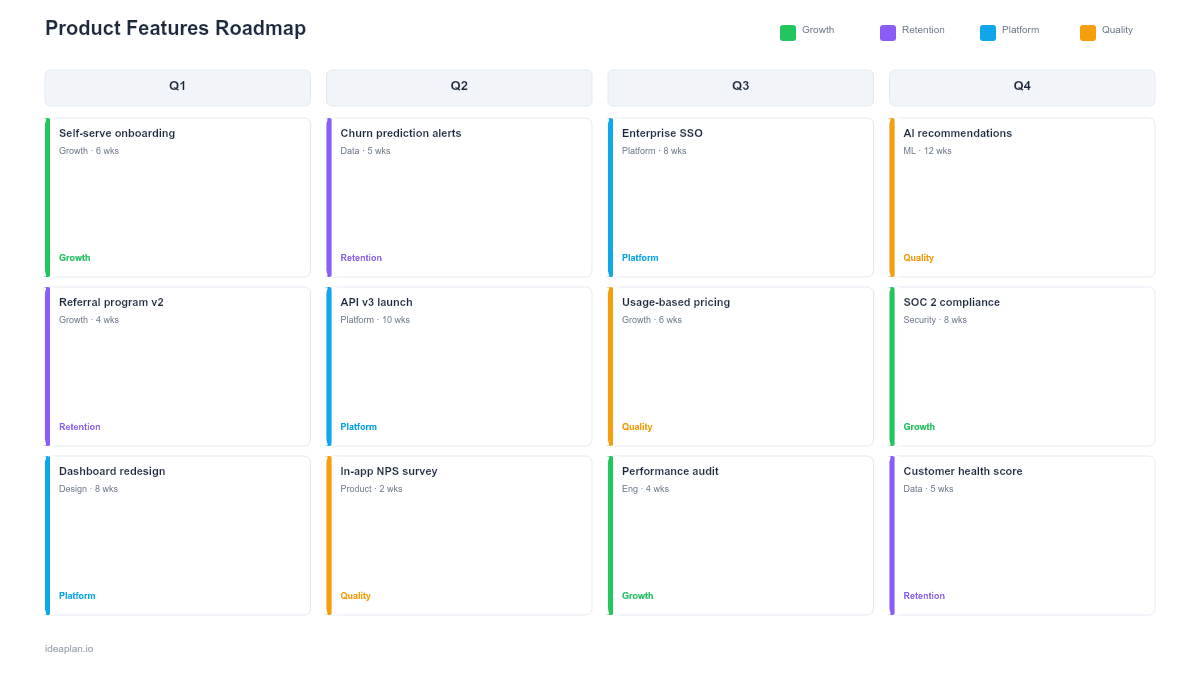
A product features roadmap is a complete view of every feature your team plans to build, organized by priority, status, and strategic theme. Unlike a single-feature roadmap that focuses on one feature at a time, this template manages the entire feature portfolio. From early-stage ideas through released capabilities. It is the system of record for what your product will become, and this free IdeaPlan template lets you set one up in about 40 minutes. For background on the features roadmap format and how it fits into your planning process, see our guide to building a product roadmap.
What This Template Includes
- Full feature inventory with structured fields for name, category, priority tier, status, effort estimate, business justification, and target quarter.
- Theme-based grouping that clusters features under strategic themes (growth, retention, platform, compliance) for clearer communication to leadership.
- Multi-stage pipeline view tracking features through Idea, Discovery, Design, Development, Beta, and Released stages.
- Weighted scoring model (RICE framework built in) for consistent, defensible prioritization across all features.
- Stakeholder communication layer that generates a simplified view for executives showing only themes, progress percentages, and key milestones.
- Capacity planning integration with fields to estimate and track engineering weeks consumed per feature and per theme.
Template Structure
Feature Inventory
The inventory is the master list of every feature. Shipped, in progress, and planned. Each entry includes a unique identifier, a short description, the originating source (customer request, strategic initiative, technical need), and a category tag. The inventory serves as the single source of truth. When a salesperson asks "Are we planning to build X?" the answer lives here. Maintaining a clean, up-to-date inventory eliminates the information silos that form when features are tracked across multiple spreadsheets, Slack threads, and meeting notes.
Theme Grouping Layer
Features in isolation are hard for leadership to reason about. The theme layer aggregates individual features under strategic themes. For example, "Self-Serve Onboarding," "Enterprise Security," or "Platform Performance." Each theme includes a brief narrative explaining the business case, the expected customer impact, and the success metrics. When presenting to executives, you show themes rather than features. When talking to engineering, you drill into the features within each theme. This dual-resolution view is one of the most powerful aspects of a well-structured features roadmap.
Multi-Stage Pipeline
The pipeline tracks each feature through six stages: Idea (captured but not yet evaluated), Discovery (being researched and validated), Design (UX and technical design in progress), Development (engineering is building), Beta (released to a subset of users for validation), and Released (generally available). The pipeline view makes it easy to spot bottlenecks. For instance, if twenty features are in Discovery and only two are in Development, you have a throughput problem that needs attention. It also provides a natural framework for stage-gate reviews where the team decides whether a feature should advance, pivot, or be killed.
RICE Scoring Framework
The template includes a built-in RICE (Reach, Impact, Confidence, Effort) scoring model. Each feature is scored on four dimensions: how many users it will reach, the expected impact per user, the team's confidence in the estimates, and the engineering effort required. The formula produces a single composite score that can be used to rank features objectively. RICE is not a replacement for product judgment, but it provides a data-informed starting point that reduces bias and gives stakeholders transparency into how prioritization decisions are made.
Capacity and Progress Tracking
This section ties features to actual engineering capacity. Each feature has fields for estimated engineering weeks and actual engineering weeks consumed. Aggregated at the theme level, this data answers critical planning questions: How much of our capacity is going toward growth versus maintenance? Are we spending more than planned on any single theme? Do we have enough capacity to deliver the features we have committed to this quarter? Tracking capacity at the feature level also improves estimation accuracy over time. You can compare estimates to actuals and calibrate future planning accordingly.
How to Use This Template
1. Build the Feature Inventory
What to do: Consolidate all existing feature ideas, requests, and plans into the inventory. Pull from your backlog, customer feedback tools, sales CRM notes, and strategic planning documents. Assign a category and source to each entry.
Why it matters: Centralization is the first step toward control. You cannot prioritize what you cannot see.
2. Define Strategic Themes
What to do: Work with your product leadership and stakeholders to identify three to five strategic themes for the current planning period. Themes should map directly to company objectives or key results.
Why it matters: Themes provide the narrative structure that makes a features roadmap intelligible to non-technical stakeholders. They answer "why" at a level that individual features cannot.
3. Score and Rank Features
What to do: Apply the RICE scoring model to every feature in the inventory. Involve engineering leads in estimating effort and product managers in estimating reach and impact. Sort the inventory by composite score.
Why it matters: Consistent scoring eliminates the "squeaky wheel" problem where the loudest stakeholder dictates the roadmap. It creates a defensible, transparent ranking.
4. Assign Features to Pipeline Stages
What to do: Based on current status, place each feature into the appropriate pipeline stage. Features with high RICE scores and available capacity should be moved into Discovery or Design. Features that are already in Development or Beta should have their status verified.
Why it matters: The pipeline view reveals your team's actual workflow distribution and highlights bottlenecks that could delay delivery.
5. Establish Governance and Review Cadence
What to do: Schedule a monthly features roadmap review. Use the review to update statuses, reassess priorities based on new data, and make stage-gate decisions (advance, pivot, or kill features). Document decisions and share the updated roadmap with stakeholders.
Why it matters: Without regular governance, the roadmap decays. A monthly cadence is frequent enough to stay current without overwhelming the team with process overhead.
When to Use This Template
This template is designed for product teams that manage a feature-rich product with an extensive backlog. If your product has dozens or hundreds of feature requests and you need a systematic way to evaluate, prioritize, and track them, this is the right tool. It is especially valuable for B2B SaaS products where feature requests come from multiple customer segments with competing priorities.
Teams of ten to fifty engineers working on a single product will get the most value. The theme grouping and RICE scoring provide enough structure to manage complexity without requiring a dedicated program manager. For smaller teams with fewer than ten features in flight, the simpler Product Feature Roadmap Template may be a better starting point. You can always graduate to this full version as your product matures.
Organizations that are transitioning from ad-hoc feature planning to a more structured process will find this template particularly useful. It provides a clear framework that can be adopted incrementally: start with the inventory and pipeline, then layer on RICE scoring and theme grouping as the team becomes comfortable with the process.
Key Takeaways
- A product features roadmap is the system of record for your entire feature portfolio, from ideation through release.
- Theme grouping translates individual features into strategic narratives that leadership can understand and fund.
- RICE scoring provides a transparent, data-informed prioritization framework that reduces bias and stakeholder conflicts.
- The multi-stage pipeline reveals workflow bottlenecks and provides natural stage-gate checkpoints for feature advancement decisions.
- Monthly governance reviews keep the roadmap current and prevent the slow decay that makes roadmaps untrustworthy.